Curtain call
Source:Global Times Published: 2014-2-12 20:33:01
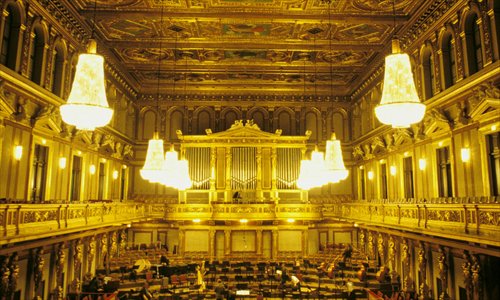
The Golden Hall Photo: IC
For a long time Chinese people's fascination with the Vienna Golden Hall showed no signs of fading. In the years following 1998, when Chinese folk music first resounded in the hall, it was the dream of numerous domestic music troupes and singers to perform there, as the place often turned those who did into big stars when they returned to China.Meanwhile, even very famous folk music singers such as Song Zuying, Zu Hai and Li Yugang returned many times to perform at the Golden Hall, as if it were the destination of a pilgrimage.
However, last year some domestic media revealed the motives of those performers who saw the Golden Hall as a stepping stone to fame, and an unsuspecting public began to question the true "gold content" of those who have performed at the Golden Hall.
The phrase Golden Hall (in Chinese Jinse Dating), although appearing often in Chinese media during the past years, is actually not the translation of its official name, which is in fact Wiener Musikverein, a German name literally meaning Vienna Music Association.
In September 2013, People's Daily (the official newspaper of the CPC) published the article "Vienna Golden Hall becomes a Gold-Plating Spot," pointing out that some domestic performances there actually have low attendances.
In the wake of this article, more media reports followed, revealing or criticizing the various commercial interests behind the performances.
Figures showed that from January to mid-August last year there were a total of 133 Chinese performances staged at the Golden Hall.
But since September when the revelations came to light the number of Chinese performances there has declined sharply.
Elderly tours
Last year older Chinese females, a group that have strong purchasing power, also showed their artistic capabilities at the Vienna Golden Hall.
Although they were not invited, they took care of all expenditures by themselves.
On November 15 a domestic artistic troupe comprising 27 elderly people from Dalian, Liaoning Province, performed traditional Chinese music at the Golden Hall, one of the few Chinese groups who still performed there in the later half of the year.
Organized by a domestic cultural company, the performance cost them 20,600 yuan ($3,399) per person, which included trips to six other countries besides Austria.
"The overall expenses are a little high, but the appeal of the Golden Hall is so strong for a music lover," said Zhang Meihua, vice president of the performing troupe called Sound of Friendship.
"The cost of joining some tours may be even higher, and most importantly, they can't satisfy our wishes to perform at the Golden Hall," said Wang Jingren, a performer from the troupe.
Dream performances
In the decade following January 1998, when the China National Orchestra became the first Chinese troupe performing at the Golden Hall, large and professional music troupes from big cities like Beijing and Shanghai were frequent visitors there.
In 2010 the professional troupes began to lose interest in touring there, and amateur troupes comprised of older groups and student choruses took over the baton of performing at the Golden Hall.
The goals of the Chinese troupes who performed there have also changed during this period.
Before 2010, most professional troupes went there just for the glory bestowed by the Golden Hall, with their performances often overwhelmingly praised in various Chinese media reports.
According to a report by the Southern Weekly earlier this month, since the China National Orchestra returned home after performing at the Golden Hall in 1998, their revenue from one single performance could reach 200,000 yuan, while before that they couldn't even afford their personnel's salaries.
"That was probably the first time traditional Chinese music made a profit," said Chen Ping, the Chinese cultural counselor in Germany who also watched the performance in Vienna in 1998.
"That performance at the Golden Hall helped the development of the China National Orchestra, but the effect disappeared several years later," Chen told the Southern Weekly.
In recent years, usually organized or invited by some domestic cultural companies who will arrange everything from the performance there to tours of neighboring countries, more and more amateur music troupes jumped on the bandwagon of performing at the Golden Hall.
However, instead of seeking fame so that they can profit after returning home, most of those performers went there to realize their musical dreams.
"There should be no blame for those who want to perform at the Golden Hall," said Wu Jiatong, general manager of Wu Promotion based in Beijing, who was behind the landmark 1998 performance by the China National Orchestra in Vienna.
"The Golden Hall is not state-owned, it needs to rely on its rent to survive. By renting the hall Chinese performers can enjoy themselves, and that's all," said Wu.
That's all
"That's all" should be the conclusion when all sides view the case.
Like many other world renowned music halls or opera houses, the Golden Hall has its performing season from October to June in the following year, during which high-quality classical musicians from different parts of the world are invited to perform there.
But these days there aren't many domestic troupes or singers performing at the Golden Hall, and any performances there are, due to low attendances, are usually backed by free tickets. In 2003 when a Chinese orchestra comprised of middle-school students performed there, only 300 people watched the show in an auditorium built to house 2,000.
Outside of the performing season the hall is either closed for maintenance or rented out by classical music performers for their own performances.
"The Golden Hall is actually just a good music hall," said Chen.
"The veneration of the Golden Hall is just artistic self deception," said Wang Qi of the People's Daily, "with free tickets flying around and low attendances, it's not a true representation of Chinese traditional music."
Posted in: ARTS