HOME >> LIFE
Back to school
By Sun Shuangjie in Myanmar Source:Global Times Published: 2014-2-16 20:28:01
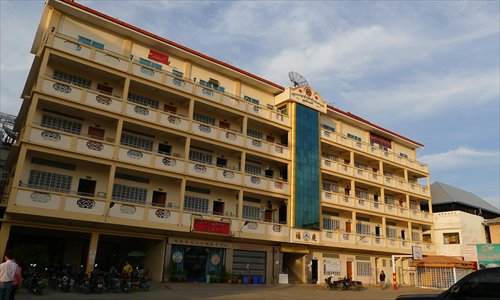
One of the two new teaching buildings at Fuqing Language and Computer School in Mandalay Photo: Sun Shuangjie/GT
On March 1, Mandalay-based Fuqing Language and Computer School will officially launch its 12th Chinese teaching center. The center will be located in a Buddhist temple in the capital of Myanmar, Naypyidaw.Li Zuqing, the principal of the school, told the Global Times that the school has been experiencing its best time ever since its establishment in 1993.
In 2008 the school opened Myanmar's first ever Confucius classroom to be officially accredited by China's Confucius Institute Headquarters. Twenty three of the some 40 teaching staff, some of them former students at the school, have received postgraduate diplomas from universities in China, while 3 hold doctor's degrees. Equipped with two brand new five-story teaching buildings Fuqing's Mandalay school currently serves more than 700 students, including both ethnic Chinese and Myanmarese. Beyond Mandalay, it has expanded by establishing 11 Chinese teaching centers in four regions and two states in Myanmar. Each center teaches roughly 80 students.
Language boom
About 500 kilometers away from Mandalay, the Eastern Language and Business Centre (ELBC) in Yangon, Myanmar's biggest city and its former capital, is thriving as well.
Established in 2002 by eight overseas Chinese groups, ELBC offers Chinese education for local children from grades 1 to 12. About 800 students currently attend classes at ELBC, 95 percent of them are ethnic Chinese.
Last December, ELBC became home to Myanmar's third Confucius classroom. Meanwhile, when the new semester starts in March, the school will begin Chinese classes for adults.
"Over the past two years more and more people have shown an interest in learning Chinese; not only ethnic Chinese but also local Myanmarese," said ELBC teacher Huang Bixing, noting that local university students in Yangon have also showed an increasing interest in Chinese as a major.
Both Huang and Li agreed that the rise of China's economy and status in international society has been a major force simulating demand for learning Chinese in Myanmar.
China remains Myanmar's largest trading partner and biggest source of foreign investment. According to Myanmar newspaper Mizzima, Chinese companies have poured $14.12 billion in investments into the country from 1988 to September 2013, accounting for 42 percent of the nation's $33.67 billion in foreign investment.
Sweat and tears
However, establishing Chinese education in Myanmar hasn't been easy.
According to a report written by Zeng Yuanxiang, ELBC chairwoman, more than 300 Chinese schools set up by overseas Chinese existed in Myanmar in 1945. However, after anti-Chinese riots broke out in Yangon on 26 June, 1967 (a result of Chinese students' defiance towards the Myanmar government's ban on wearing Mao badges in school) Chinese education in Myanmar, which dates back to the early 1900s, came to a complete halt.
"For a long time after the riots, Chinese people didn't dare speak their mother tongue in public, especially in southern Myanmar (close to the political center), for fear of causing trouble for themselves," recalled 57-year-old Li, the third generation descendent of an overseas Chinese family.
It was around the year 1990 that Chinese education gradually recovered, most starting in the form of classes on Buddhist scriptures in northern parts of the country.
With the support of some entrepreneurs of Fujian descent, Fuqing started with a small two-story building and only three local Chinese teachers, as they couldn't afford to hire teachers from the Chinese mainland. Meanwhile, ELBC, the classrooms of which now occupy a four-story building with some 15 classrooms on each floor, only occupied roughly two floors for its offices and classrooms in 2003.
"It's only been during the past two years that we've been able to buy textbooks from China directly. Before we had to copy and print textbooks ourselves," said Huang.
While both schools only charge a small tuition, Fuqing charges about $10 per month, while ELBC charges $20 to $25 per month, the steady demand for learning Chinese has ensured the two institutes' survival.
Students in Confucius classes can also apply for scholarships from China's Confucius Institute to study in universities in China. Fuqing has established cooperation with prestigious universities such as Minzu University of China in Beijing, Jinan University in Guangzhou, Jiao Tong University in Shanghai and Yunnan University in Kunming.
Looking to the future
"However critical the environment may become, overseas Chinese will take on any difficulty and grasp every opportunity to continue and develop Chinese education in Myanmar," wrote Zeng in her report.
One problem facing almost all Chinese schools in the country (except government-backed universities that offer Chinese courses), including Fuqiang and ELBC, is that these schools exist in a legal grey area in the country.
The Private School Registration Law promulgated at the end of 2011 stipulates that private schools cannot depend on sponsorships provided by foreign countries or organizations, nor be under the charge of foreign organizations, as well as being free from any religious organization.
"The government currently just lets us go, neither challenging us nor giving us support," Li told the Global Times. Zeng regards it an important task to legalize Chinese education in Myanmar. She suggests two feasible plans: to apply for certification as a private Myanmarese-language school and then to open Chinese courses alongside the required national curriculum; to cooperate with universities in China to set up a Chinese-language international school.
Mutual Exchange
In 2012, Fuqing opened a research center to hold lectures on Myanmar culture and custom to Chinese businessmen, while also teaching Myanmarese employees in Chinese companies about Chinese culture.
Classes like these are the school's attempt to help Chinese companies better adapt to working within the country. Li told the Global Times that better understanding between Chinese and Myanmar people will benefit Chinese companies in Myanmar, which in turn may attract more people to learn Chinese.
Khin Swe Swe Win, a Myanmarese teacher in Fuqing who achieved her Ph.D at Minzu University of China, told the Global Times on January 29 that she enjoyed the harmonious relationship between Chinese and Myanmarese in Mandalay and hoped that both sides could learn more about each other in order to facilitate friendship and avoid unnecessary conflicts in the future.
Posted in: Miscellany