Shanghai’s endangered street snacks
There was a time when Shanghai's street food scene thrived with an amazing assortment of cheap and delicious eats. These foods - cooked in all manner of ways by local street food vendors - could be easily found in pushcarts, back alleys and minor streets around the city.
However, with Shanghai developing at a frenzied pace, in a mere couple of decades, most of these makeshift stalls have given way to ubiquitous fast-food chains and a slew of sleek new eateries.
While many favorite Shanghai street snacks, such as shengjian bao and xiaolong bao, remain available in local restaurants, others have begun to fade from people's memories and are becoming increasingly difficult to find.
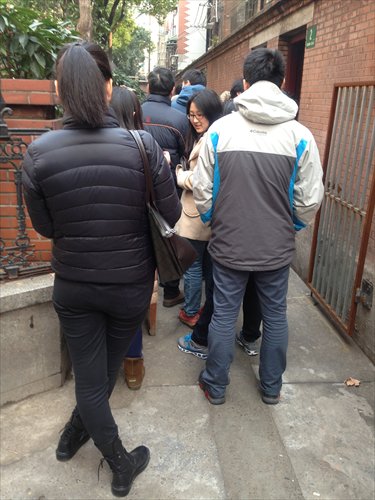
People line up waiting at A Da's for the famous congyou bing
For a taste of nostalgia, look out for one of these once-ubiquitous street-side bites before they become extinct.
Congyou bing (scallion oil pancake) has long been a common breakfast option in Shanghai. Although stalls selling congyou bing are not hard to find, the making of this traditional snack has evolved and thus its taste is slightly different from the one many Shanghai natives grew up with.
One of the city's most well-known stalls selling congyou bing is A Da's. Tucked away on a small lane off Nanchang Road, A Da's has forged its name among foodies in Shanghai, both local and foreign, with its exceptionally tasty scallion oil pancakes.
Run by Master Wu, who has been making congyou bing for more than 30 years, this ramshackle stall is so popular that there's always a long queue during business hours from 5 am to 2 pm.
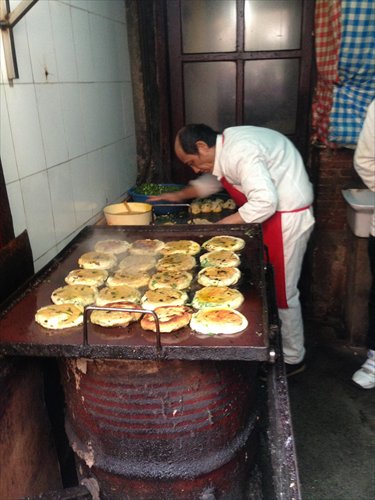
Master Wu prepares congyou bing besides his skillet.
To make a batch of congyou bing, Wu first puts small rounds of dough stuffed with salty scallions on a hot skillet before adding oil to the dough. The lumps of dough are then flattened and fried on both sides for about 10 minutes until golden brown. Then Wu finishes the pancakes on an old-fashioned fire stove to crisp the outsides, an extra step that most congyou bing vendors nowadays skip.
It takes about 20 minutes to bake one batch of 20 pancakes and many customers stock up once they reach the front of the line, so be prepared to wait an hour or so for a bite of crisp perfection. A Da's is closed on Wednesdays. A pancake costs 4 yuan ($0.65) here.
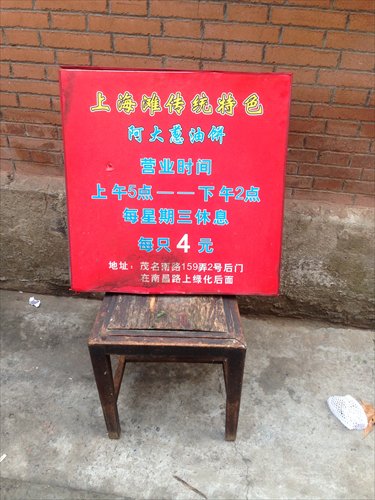
A Da's congyou bing
Youdunzi is a deep-fried pastry filled with meat or vegetables, usually shredded radish. This delightful snack is simple to make. First, the vendor scoops a couple of spoonfuls of dough into an oval-shaped iron cooking utensil. Then the filling is added before another layer of dough covers the top. Finally the stuffed cooking utensil is plunged into a cauldron of hot oil to deep-fry for a few minutes until the cake is fully cooked. The pastry emerges fragrant and crispy.
However, this once-popular snack has become almost invisible due to the efforts of the chengguan (urban management officers) who drive illegal street vendors away and after the country's recent food safety scandal where "gutter oil" is reused from kitchen waste.
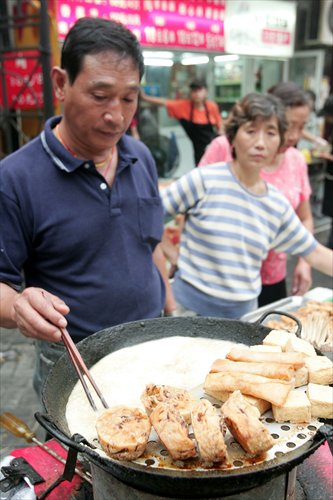
A vendor sells youdunzi at a food stall. Photos: IC and Yang Zhenqi/GT
Today, diners have to try their luck at food stands hidden in alleyways of residential communities. Another alternative is sit-down restaurants where traditional Shanghai street snacks are offered at higher prices.
Laohu jiaozhua (literally "tiger paws") are the endangered species of Shanghai snack foods. They almost died out after the 1970s when the old-fashioned ovens used for baking flatbread and pastries were gradually replaced by modern electronic appliances.
The sweet baked pie is named for its shape, which resembles a tiger's paws, and was well-liked by children and adults alike. After a decades-long absence from the local street food scene, Shanghai Wangjiasha, a large chain store specializing in traditional snacks and dishes, brought laohu jiaozhua back from the brink of extinction by hiring experienced bakers to make fresh pies in the mid-2000s.
However, when we visited the Wangjiasha flagship store on Nanjing Road West last week, the staff told us that laohu jiaozhua has been removed from the restaurant's menu due to low demand.
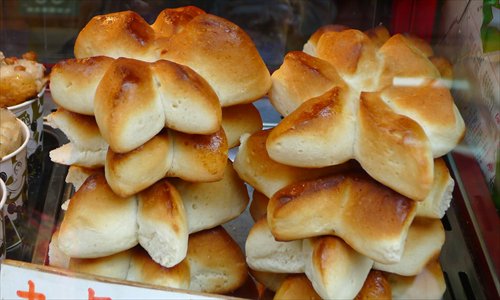
Shanghai's dying out snack laohu jiaozhua Photo: Ctrip.com
Nevertheless, the tracks of "tiger paws" can still be found at Minhang Qibao Old Street and around the City God Temple, according to users on China's Yelp-like site dianping.com.
We were also told that the food courts near the City God Temple were among the few places still serving guihua zhou, osmanthus congee, a famous specialty of Wuxi, a city in neighboring Jiangsu Province noted for its sweet dishes. The scented porridge has reportedly been enjoyed by Shanghai residents for more than a century.
Unfortunately, we failed to find the congee, but we did speak to a 60-year-old Shanghai food enthusiast surnamed Miao, who shared her recipe for osmanthus congee. She recalled her childhood experience of eating the rice porridge as "a real treat for anyone with a sweet tooth."
Ingredients:
15 grams of dry osmanthus fragrans, 1 kilogram of glutinous rice, 500 grams of red beans and dates, 1 kilogram of rock sugar
Method:
Wash the glutinous rice, reds beans and dates
Cover them in a pot with cold water and bring to the boil
Let the pot simmer for about 30 minutes
Wash and add the dry osmanthus fragrans
Add rock sugar, and keep stewing and stirring until the consistency becomes porridge-like