HOME >> LIFE
Comedic domination
By Li Jingjing Source:Global Times Published: 2014-2-24 21:53:01
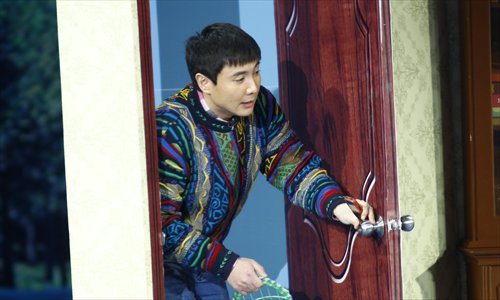
Northeastern actor Shen Teng performed on the stage of 2013 chunwan on CCTV. Photo: CFP
People from Northeast China have been the main force behind Chinese comedy for decades. From hit comedy talent shows and TV series to the China Central Television (CCTV) Spring Festival Gala, their influence is everywhere.Nicknamed "Northeast Tigers" after Northeast China's protected tiger Panthera Tigris Altaica, their rise truly began with the Spring Festival Gala, or chunwan, events that have been broadcast since the 1990s.
When chunwan first started in 1983, comedy programs including short plays and crosstalk performances all followed the styles found in Beijing and Tianjin. Not surprising considering crosstalk originated from Tianjin and most chunwan performers were from these two cities.
However, this pattern gradually changed when a "northeastern uncle" in an old Chinese tunic suit and hat walked on the chunwan stage in 1990. Comedian Zhao Benshan is now considered the grand master of comedy in China.
Zhao is not the only one to have had an impact. Fan Wei, Pan Changjiang and many other veteran comedian stars from Northeast China have been taking the lead in comedy for years. Although they have started to pass the baton to the next generation, these newcomers, such as Shen Chunyang, Ma Li and Shen Teng, are also from Northeast China.
Expanding out
Due to huge cultural and dialectical differences, comedies from one place usually face overwhelming challenges when performing outside their native region.
Geographically speaking, the biggest difference probably exists between northern and southern China, which is one of the main reasons northeastern comedy used to have such a difficult time making southern audiences crack a smile. However, this situation has been changing.
Shen Teng, a popular comedian who has appeared on chunwan for the past three consecutive years, shared his experience with the Global Times. "We usually don't have communication problems when we perform our stage plays in other cities. Audiences still understand what we say and laugh out loud. Of course, we avoid using local slang," he said.
An article by the Chinese Business Morning News analyzed the reasons behind northeastern comedians' success stating that since northeastern dialects are the closest to Putonghua, the official language of China, almost no barriers to understanding exist around the nation.
Migrant workers from the Northeast also have fewer problems communicating in other places, compared to migrant workers from other areas. This helps short plays, crosstalk, and storytelling be understood and have an impact on the nation as a whole. Television has played a major role as well, as state television broadcast stations such as CCTV will no doubt choose programming that can be understood by a majority of people in China.
Inspired by life
Another reason behind the popularity of this style of comedy is its close relationship with grass-roots society in China. Most performing arts in the Northeast originated among from the under-class, and were then gradually adapted to fancier and more high-class stages. For instance, the song and dance duet known as errenzhuan, a local performing art in Northeast China, features two persons on a stage portraying down-to-earth figures who use everyday language and situations to make audiences laugh.
Although sometimes suffering from the criticism that it comes across as too crude, defenders of this form of comedy say that this "vulgarity" resonates with audiences because it allows them to see themselves.
Many successful northeastern short plays have been inspired by errenzhuan as well. Besides excellent punch lines, one factor that has contributed to these short plays' success is that they reflect the characteristics of the era.
This factor explains the success of a TV series featuring northeastern actors. Called Country Love Story, this drama is already in its seventh season and has been shown on numerous satellite television stations. Performed by Zhao and his students, this series portrays a group of people from a village in Liaoning Province called Xiangyashan. Focusing on the most grass-roots of people, it is performed in the northeast dialect and has successfully won over an audience despite not featuring any big stars in main character roles or relying on a big production budget.
When audience numbers reached an all new high during its third season, former director of Beijing Television Zhang Xiaoai commented, "It is down to earth with stories based on life experience. Its true secret is its cast. They never deviate from their focus on farmers and telling stories about common folk."
Concerns
Of course not everything works. After Zhao Benshan wasn't seen on the chunwan stage after 2012, some worried that northeastern comedy had hit a bottle neck. According to Liaoning Daily, the success of many previous works were because writers were inspired by their life experiences.
However, a lot of what is being created now is sometimes divorced from real life, and instead of being creative comedy has now become a matter of finding jokes and just putting them randomly in a sketch. With this in mind it comes as no surprise that northeastern comedy has suffered and comedians from other areas are gaining in popularity.
During this year's Lantern Festival Gala on February 14, two crosstalk performers from Shaanxi Province, Wang Sheng and Miao Fu, were praised for their work, parts of which were performed using the Shaanxi dialect.
"Their script was really well written. Their punch lines work for speakers of Putonghua, northeastern dialects or any other dialect. This shows how crucial a good script is," Shen Teng commented.
Posted in: Miscellany