Navigating a sea of words
When Chao Feng was a 14-year-old Communist soldier, he came face to face with the barrel of a Japanese gun. But recalling the heart-stopping incident today, the 86-year-old Chao said his narrow escape during the War of Resistance against Japanese Aggression (1937-45) was not the most hair-raising moment of his life.
"It doesn't compare with the risks that I took in 1979," Chao said, referring to the compilation of the 1979 edition of Cihai. First published in 1936 and revised in 1957, Cihai, which means "sea of words," is one of the largest and most influential Chinese encyclopedic dictionaries, collecting and explaining Chinese words and characters from a range of academic disciplines.
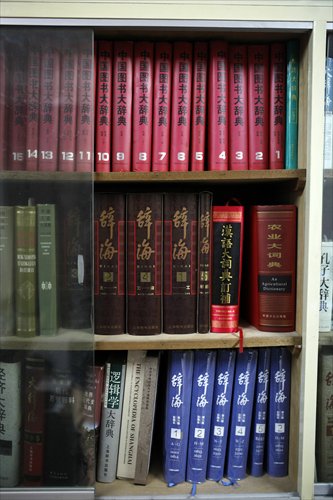
Different editions of Cihai edited by Chao Feng
A senior lexicographer at Shanghai Lexicographical Publishing House (SLPH), Chao has worked on every edition of Cihai since 1979, when revised editions began to be published every 10 years.
After publication, demand for the 1979 edition always outstripped supply, so later, one could only purchase a copy by showing a marriage certificate.
Of the five editions he has helped to compile, Chao recalls 1979 as the most difficult year.
"We received the task at the end of 1978 and were told that it must be published before National Day in October 1979 as a tribute specifically for the 30th anniversary of the founding of the People's Republic of China," he said. At the time, Chao was the director of SLPH.
Remarkably, the third edition of Cihai was completed in under a year and published in September 1979.
The team that compiled the 1979 edition was the largest Chao has worked with. Almost 100 editors and an equal number of proofreaders were organized to work together in three old houses on Shaanxi Road South.
Chao put a large board inside the staff canteen which showed the rate of progress of all the sections. "No one could avoid seeing it when they went to eat and so it prompted competition between them," Chao recalled.
Even more worrisome was that after the initial run of 80,000 copies was printed, a wrongly written Chinese character was discovered. Chao led his team to work all through the night to correct every single reference to the character one by one.
However, the biggest hurdle in compiling the 1979 edition was not the tight schedule, but the challenge of avoiding political interference.
"At the time, the ideological issues from the Cultural Revolution (1966-76) hadn't yet been fully eliminated and rectified," Chao told us.
"We dared to draft a document ourselves which outlined how to deal with ideological issues in the new edition of Cihai," Chao recalled. "Because no other superior document was given to us to follow and no one could give us any assertive instructions in advance," he added.
The document served as a guide on "eight entries and 39 items" which the editors of the 1979 edition used to rectify terms and phrases that were actively promoted during the Cultural Revolution, including "the Cultural Revolution" itself, as well as slogans like "to take the class struggle as the key link" and "to continue the revolution under the dictatorship of the proletariat." They also added entries in disciplines such as sociology, aesthetics and ethics, which at the time were still marked with the label of capitalism.
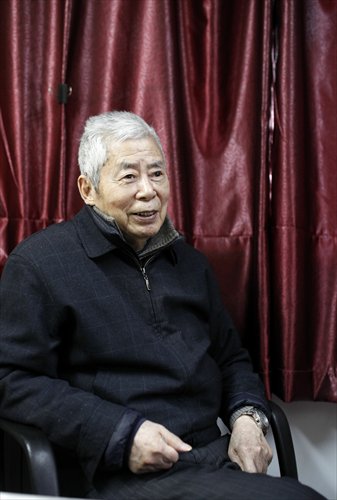
Chao Feng, who has worked on every edition of Cihai since 1979 Photos: Cai Xianmin/GT
"We invited Fei Xiaotong, the founder of sociology in China, to compile the sociology section," Chao said. "Fei was criticized a lot during the Cultural Revolution and still hadn't returned to work by then, but he accepted without hesitation. For both him and us, it was a bold act."
"And we also gave a proper and judicial description of Confucianism, which was also heavily criticized during the Cultural Revolution," Chao added.
According to Chao, although their guiding document received the approval of Chen Hanbo, the acting director of General Administration of Press and Publication, before they started work, all of the "breakthroughs" that would appear in the new Cihai were still hidden land mines they had to navigate one by one to grope their way forward.
"In fact, I had also 'been educated' during the Cultural Revolution, but I insisted on doing what I thought was right," he told us.
Chao was "educated" after he publicly expressed comments that went against the theories promoted during the Cultural Revolution. He was placed on probation within the Party, dismissed from his post at Shanghai People's Publishing House and sent to do manual labor in the countryside.
Having spent a decades-long career revising encyclopedia entries, Chao has come to see lexicography as a process of constant error correction, to rectify the mistakes not only in previous editions of reference works, but in society, too.
"I have to admit that there are still many errors in the existing editions of Cihai," Chao said.
"However, I've realized that few young people today are willing to sit down to revise an entry or write an entry for a new word," Chao said. "I don't know whether it's because of the popularity of modern technology that makes people lazier, but qualified lexicographers are increasingly hard to find."
Today, this octogenarian still works a regular nine-to-five day at his small office in an old building on Shaanxi Road North, the current headquarters of SLPH, editing the next edition of Cihai.
"I will be 91 when the 2019 edition of Cihai comes out. I hope it will be the best edition that I ever worked on," he said.