Pudong-style pipa
Editor's note
According to UNESCO's definition, an "intangible cultural heritage" includes traditions or living expressions inherited from our ancestors and passed on to our descendants, such as oral traditions, performing arts, social practices, rituals, festive events, knowledge and practices concerning nature and the universe or the knowledge and skills to produce traditional crafts. It has to be traditional, contemporary and living at the same time, inclusive, representative, and community-based. The safeguarding of intangible cultural heritage is an important factor in maintaining cultural diversity in the face of growing globalization. An understanding of the intangible cultural heritage of different communities helps with intercultural dialogue, and encourages mutual respect for other ways of life.
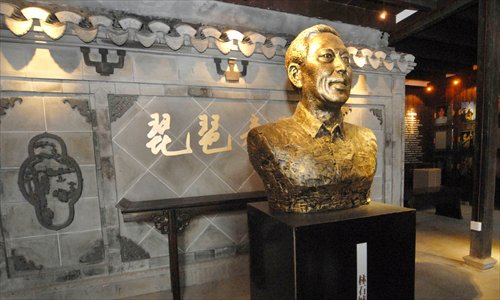
A statue of the pipa master Lin Shicheng at a memorial hall in Nanhui Photo: CFP
Wearing a dark blue outfit with an orange scarf around her neck, Zhou Lijuan sits gracefully on a chair holding a pipa, a four-stringed traditional Chinese lute, on top of her lap. The fingers of her left hand move swiftly up and down the pipa's neck, pressing on the strings, and liquid notes flow from the curled fingers of her right hand as she plucks the strings, her body gently swaying with the emotion of the melody.
A professor of folk music at the Shanghai Conservatory of Music, Zhou began to play the pipa aged 9, under the tutelage of the great pipa master Lin Shicheng (1922-2005). Today, she is one of only two successors of Shanghai's intangible cultural heritage, Pudong-style pipa playing, the other being Lin's son Lin Jiaqing, now a leading musician at China Opera and Dance-Drama Company in Beijing.
"Mr Lin's influence on me is comparable with that of my parents bringing me up," Zhou said with gratitude.
Long history
Lin Shicheng was a sixth generation inheritor of Pudong-style pipa playing. Originating in Nanhui, a former district that was merged into Pudong New Area, the pipa style dates back to the reign of the Qing Emperor Qianlong (1735-96), when Nanhui local Ju Shilin was known as "the best pipa player south of the Yangtze River." His skills were passed down from generation to generation, and Shen Haochu (1889-1953), a fifth generation inheritor of the style, contributed to its evolution by writing a great number of pipa compositions. Shen's student Lin helped develop the pipa style even further. Lin was not only a brilliant pipa player and composer, but also an educator who tutored a string of talented students, many of whom became big-name musicians and active members in today's folk music circle in China.
"Before Mr Lin, pipa playing was a folk art practiced and popularized among ordinary people. But Lin, as the first pipa professor at the Central Conservatory of Music from 1956, began to promote the performance of folk music in an academic circle," said Zhou.
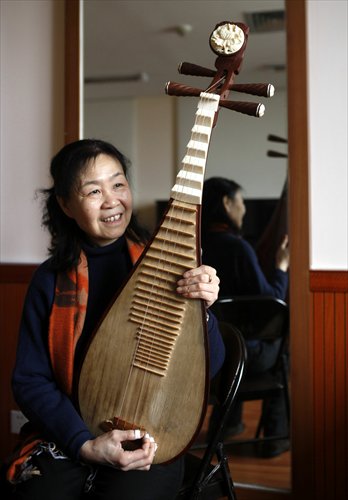
Zhou Lijuan, one of two successors of Pudong-style pipa Photo: Cai Xianmin/GT
Special techniques
Among the five pipa playing styles in China - Wuxi, Pinghu, Pudong, Chongming and Shanghai - Pudong-style "has the biggest influence in the music circle," Zhou told the Global Times. The performance techniques of Pudong-style involve finger movements that do not exist in the other styles. For example, a technique called bingxian requires using the forefinger of the left hand to seize the four strings of the pipa in a second. "It sounds easy, but this can only be achieved by years of practice of the finger's muscle, especially in childhood, otherwise the finger will not have enough strength to do it," Zhou explained. "Because of these special techniques, Pudong-style is generally acknowledged to be the most difficult style to learn and more expressive than the other styles."
Requiring a more flexible pair of hands, the characteristics of Pudong-style pipa playing are distinctive. When it comes to the classic pipa composition Shimian Maifu (Ambushed from Ten Sides), which recounts a battle story, the Pudong-style is very good at creating a tense atmosphere by rapid strumming that puts listeners on the edge of their seats. For a slower performance like Chen Xingyuan Hefan (Chen Xingyuan's Despair), the playing style's vibratos can evoke the sorrow, agony and resentment of a girl forced to marry a man faraway from her home.
Another specialty of Pudong-style pipa is a percussive use of the string instrument to imitate the sound of gongs and drums. When performing Longchuan (Dragon Boat), a classic pipa piece, the player strikes and knocks the board of the pipa, bringing the audience to the scene of a dragon boat race. In another piece, Poxi Xiangzheng (Quarrels between In-laws), the pipa can imitate not only the arguing voices of the mother-in-law and daughter-in-law, but also the sounds of smashing kitchenware. "These techniques and sounds are rarely used in other pipa styles," said Zhou. "Pudong-style pipa players can play a larger range of musical sounds."
Mass education
Now in her 50s, Zhou has gradually reduced the number of her public performances, though she is still in the habit of playing the pipa for at least one hour a day. She now focuses her attention on music education. She has written many books and tutored a number of students who have won gold medals in both national and international contests.
Her students are not limited to those attending music college but also include amateurs. Unlike some traditional cultural art forms that are on the verge of dying out, Zhou has found lots of younger talents picking up the pipa. "Anyone who likes Pudong-style pipa, I'm happy to teach them," Zhou said.
Zhou has been leading classes for amateur players every Sunday since 1995, when a Pudong-style pipa school was established in Nanhui by the district government. She has never missed a week, even in the early days when public transport was inconvenient and a round trip took six hours.
"It was Mr Lin's will to promote Pudong-style pipa among more and more people. He once said he felt reassured to hear that I was teaching students at the school. I just inherited his persistence and responsibility, and his love of the pipa," Zhou said.