HOME >> BUSINESS
Gap seeking new berth in mainland with Old Navy
Source:Reuters - Global Times Published: 2014-3-2 23:48:02
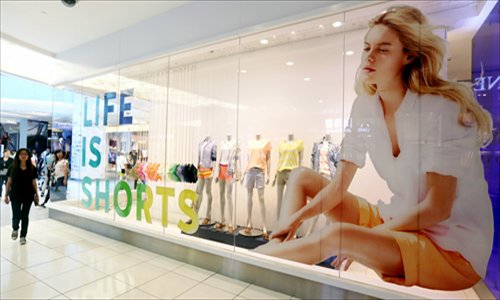
A visitor passes by the window display of a Gap store in Beijing. Photo: CFP
Gap, which launched its first Old Navy store in Shanghai on Saturday, plans to open five stores of the value-end chain this year as well as add 30 new Gap stores to its current 81, Gap's Greater China president Jeff Kirwan said Saturday.
"Outside North America this is the largest opportunity for us, acknowledged by all the senior leadership in the company. This is the No.1 growth vehicle for the company," Kirwan said in an interview at Gap's Shanghai office.
A bastion of the clothing sector in the US, where it has around 4 percent of the apparel market, Gap entered China behind its rivals, setting up its first own-brand shop in 2010. It now has around 80 stores, around half the number of rivals H&M, Zara and Uniqlo.
"I hadn't heard of Old Navy before. I was just passing by and saw something going on. It was my sister who told me it was part of Gap," said Ji Yin, 30, queuing for the flagship store's launch in Shanghai's upscale Jing'an district.
Gap's China team plans to invest in promoting brand awareness with local shoppers, especially online, to play into the rapid growth of China's e-commerce sector, a segment of the retail market that is unusually large.
"We're putting a lot of attention into e-commerce for both brands," Kirwan said.
They might need it. Gap's account on popular Sina Weibo, China's equivalent of Twitter, has just 86,000 followers, a figure dwarfed by Uniqlo's 3.6 million Weibo fans. Old Navy, which joined Weibo in January, has just 3,700 followers so far.
"If you can get a social media buzz in China it goes fast and wide, because Chinese people are very well connected. Without one, it's difficult for a consumer brand in China," said Nick Debnam, Asia Pacific chairman for consumer markets at KPMG.
One hurdle facing Gap is that some consumers say it lacks the trendy image of Zara but prices itself above affordable rivals such as Uniqlo, a specialist in basic clothing items. Gap says with its Old Navy brand it will try to leverage an energetic and enthusiastic "American voice."
"Gap's position in China is not very clear. It's outpaced by Zara on a fashion level and out-competed by Uniqlo on the concept of high-value basics," said Cherry Dai, Shanghai-based project manager at consulting firm SmithStreetSolutions.
Price is also a factor for China's cost-conscious consumers. A pair of Gap women's jeans costs up to 599 yuan ($97.48), higher than around 299 yuan in Uniqlo and 399 yuan in H&M, according to a Reuters' analysis.
Kirwan said the key rivals for Old Navy would be Uniqlo and H&M.
Uniqlo has 260 stores in the Chinese mainland, and has plans to add up to 100 stores each year. Tiger Pan Ning, Uniqlo's China CEO, told a press conference in Hong Kong on Friday that Uniqlo's wide store footprint, speed of openings, and its range of simple, everyday basics gave it a "competitive edge."
In a market where low cost can be equated with low quality, however, price is not the only factor determining success.
"The most important criteria is of course the clothes being good-looking. The price should also not be too low," said Wang Manxue, 21, a female student in Shanghai, who shops at France's Etam Developpement SCA and boutique Chinese brands.
A shift toward mass market retail could work in Gap and Old Navy's favor. Lower-priced fast-fashion brands such as H&M and Zara beat store expansion goals last year, while two-thirds of high-end retailers missed their target.
Posted in: Companies