Danshui Road
Running from Huaihai Road Middle to Jianguo Road West in the heart of downtown Shanghai, Danshui Road offers visitors a nostalgic glimpse at one of the city's most historic neighborhoods. The typical Shanghai-style housing that is still in existence here are residences with tingzijian. Tingzijian refers to a small room located at the back of a shikumen lane house, usually above the kitchen. During the 1920s and 30s, homeowners often rented the cramped rooms out to single young men for extra income.
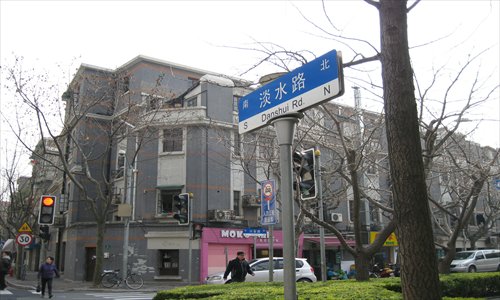
Danshui Road in downtown Shanghai offers visitors a nostalgic glimpse at one of the city's most historic neighborhoods.
Today on Danshui Road, old buildings with tingzijian stand among rows of modern blocks and the gentrified commercial complex of Xintiandi.
Formally named Rue Chapsal, the road is littered with the former residences of renowned progressive writers and intellectuals. Danshui Road is also famous as an important site of meetings in the early days of the Communist Party of China (CPC).
From the 1920s to the 1940s, many prominent figures were in frequent contact as neighbors along the street, including writer Shen Congwen, poet Ai Qing, composer Li Jinhui, painter Tao Lengyue and social activist Xu Langxi.
Some of them are depicted in the upcoming movie The Golden Era, which tells the story of Xiao Hong (1911-42), one of modern China's most important female writers. Directed by acclaimed Hong Kong helmer Ann Hui, the film follows the 10 years from the start of Xiao Hong's writing career to her death in 1942 when she lived in Shanghai with her lover Xiao Jun (1907-88), who was also a prominent writer.
The film's title comes from a letter that Xiao Hong wrote to Xiao Jun, in which she described a surprising revelation: "In this silence, something suddenly came to my heart, like an alarm bell, saying, 'Isn't this my golden era right now?'" It could equally refer to the street where so many of modern China's most celebrated thinkers lived.
Other well-known Chinese writers portrayed in the film include Ding Ling and Hu Feng, who were close friends of the couple and their neighbors on Danshui Road.
From 1937 to 1939, the tingzijian on the third floor of 192 Danshui Road was rented by a group of underground CPC members as the Shanghai Office of the Eighth Route Army, which was regarded as an indispensable organizing site of the CPC in the 1930s.
Now on Danshui Road, most of the old houses are still standing, however, it is impossible to find any traces of the long-gone occupants except in one building, the site of the first meeting of the Chinese Peasants and Workers Democratic Party (CPWDP) at 338 Danshui Road.
One of the earliest democratic parties in China, the CPWDP was founded in Shanghai by Deng Yanda, a famous left-wing Nationalist leader who left the Kuomintang over disagreements with Chiang Kai-shek. They held their first meeting in secret on Danshui Road on August 9, 1930. It is said that the participants had to pretend to be guests at an evening banquet there.
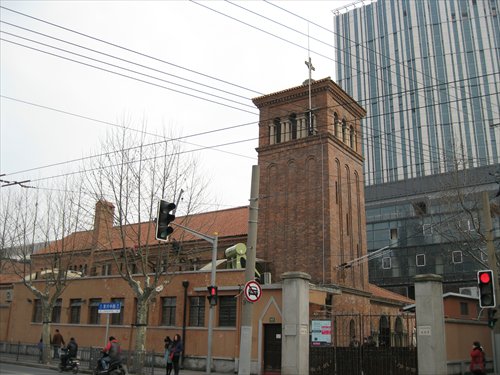
All Saints Methodist Church
Not far from the meeting place of the CPWDP, at the intersection of Danshui Road and Fuxing Road Middle, stands a particularly noticeable building. The 17th century European-style structure with red brick walls, rose windows, a triangular roof and bell tower is the All Saints Methodist Church (425 Fuxing Road Middle, 6385-0906), originally constructed in 1925 under the direction of a missionary from the American Saints Association. The main hall can hold 500 people and the attached halls can seat a further 1,000. There is a service every Sunday from 7 am to 9:30 am. During the week, the church hosts a Bible study session at 7 pm on Tuesdays, a fellowship meeting at 1:30 pm on Wednesdays, a prayer meeting on Thursday mornings and a youth meeting on Thursday nights.
More recently, a number of small bars, cafés and shops have opened up on Danshui Road, including Melbourne-style coffee shop Caffeine (264 Danshui Road, 156-1816-4988), cozy cocktail lounge Mr Shaker (229 Danshui Road, 187-2120-5453), and Belgian brew specialists Beer Shelf (232 Danshui Road, 6339-1962).
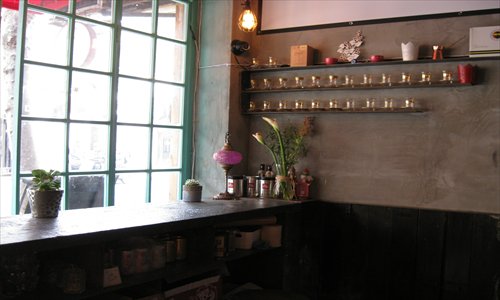
Turkish café and bar Anatolia
Café and bar Anatolia (200 Danshui Road) is one of the few places in town that serves Turkish coffee for 38 yuan ($6.18). The process of making Turkish coffee, which has been listed by UNESCO as an Intangible Cultural Heritage of Turkey, involves boiling finely ground coffee in a pot called a cezve, usually with sugar. The coffee is then served in demitasse cups.
"In some regions of Turkey, your fortune is told by the placement of the coffee grinds left in your cup, and here, I can do it for you," owner Chris Yao said with a smile.
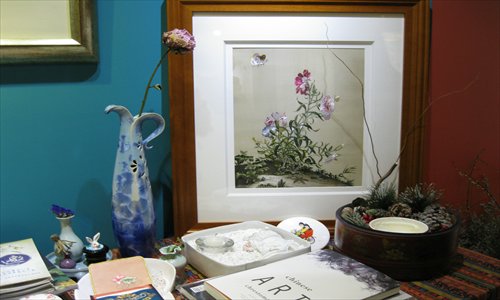
Suzhou embroidery shop Lotus Space
Opposite Anatolia is Lotus Space (221 Danshui Road, 152-1669-2978). Owner Chen Cheng has been involved in Suzhou embroidery for over a decade and she sells contemporary embroidery handicrafts depicting scenes from traditional Chinese ink wash paintings. Customization is also available in her shop. "Any picture or photo you provide and want to turn into an embroidery work, we will try to realize it for you," Chen said.
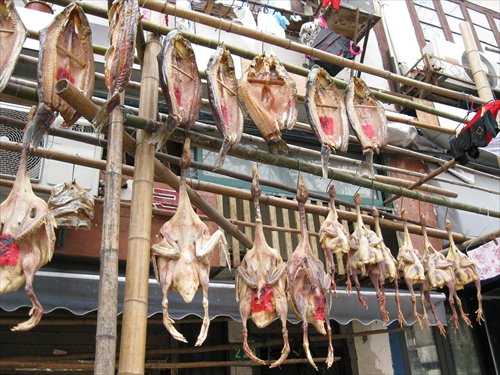
Danshui Road in downtown Shanghai offers visitors a nostalgic glimpse at one of the city's most historic neighborhoods.Photos: Hu Bei/GT