‘Picasso: Suite Vollard’

Four engravings from The Minotaur. Photo: Xiong Yuqing/GT
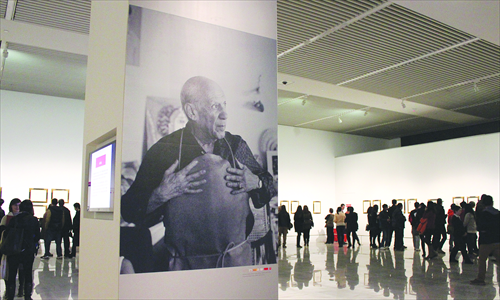
Photo of Pablo Picasso used at the National Museum of China. Photo: Xiong Yuqing/GT
For most Chinese people, even those not interested in art at all, Pablo Picasso (1881-1973) is a huge name. While many might not be able to name a particular work, they can still be deeply impressed by the strong personality displayed in his paintings and sculptures.
Marking the 40th anniversary of the establishment of diplomatic relations between Spain and China, a collection of 100 of Picasso's engravings created in the 1930s, Picasso: Suite Vollard, is being displayed at the National Museum of China up until April 27. This is the first time these great works have been shown in China.
Reflections of life
Some of these works act as a private diary of this genius' life in the 1930s. The Spanish Ambassador to China, Manuel Valencia, pointed out that the emotion behind these artworks is what make the suite so precious, "His passion for life and art permeates the engravings and this is, according to many experts, what makes them the most important series of engravings of the 20th century."
Through his unique skills, Picasso was able to take this group of engravings to an all new artistic level. "Picasso used various techniques in these masterpieces, such as etching, printing, drypoint and aquatint. He didn't regard engraving as lower than any other art form such as painting or sculpture. For him engraving was another method of creating interpretive art," said the ICO Foundation's Alicia Gómez, the curator of the exhibition.
"Picasso influenced many Chinese masters in the 20th century, including famous painters Zhang Ding and Zhang Daqian, who both visited the genius during the 1950s," said Lü Zhangshen, director of the National Museum of China. "His distinguished personality and artistic creativity have encouraged Chinese artists to continuously challenge traditional art and think outside the box."
The exhibition consists of six sections: Various Themes, Rembrandt, The Love Battle, The Sculptor's Study, The Minotaur and Portraits of Ambroise Vollard.
Fading romance
Among the sections, The Sculptor's Study, consisting of 46 works, records the strong affection Picasso had towards his model, muse and lover, the young French girl Marie-Thérèse Walter (1909-77). Walter appears in most of the engravings in this section as both a model and partner to the artist.
The several romances Picasso had throughout his life are a tasty morsel for some art fans. Walter first met the 45-year-old Picasso when she was 18. The exhibition presents the first seven splendid years they spent together until the birth of their daughter Maya. The next section, The Suite Vollard, records a change in their relationship, from sweet passion to its end.
"The interesting thing is some of the sculptures that appear in these engravings actually exist. The lovers witnessed the birth of these great surrealistic artworks, while these engravings record the lovers," Gómez told the Global Times.
In the engravings, Picasso portrays himself as a strong bearded middle-aged man with hardly any age gap with his lover who was about 27 years younger. They stay in harmony, giving a feeling of peace and love while touching and lying with each other.
This portrayal stands in sharp contrast with the next section, The Minotaur, where the artist displays himself as the half-bull figure from Greek mythology. Picasso was commissioned by a French magazine to create the image of the Minotaur, which he then used as an alter ego to present his personal life to the public. Blind, lecherous and tragic this monster shows a different side of the artist.
"Although still passionate, we can tell the relationship between Picasso and Walter is going downhill. The artist starts to change the way he treats the girl, no longer as a lover, but as a future mother of his child," Gómez told the Global Times.
In a group of Minotaur engravings, Picasso portrays Walter as a little girl guiding the blind and old Minotaur in the dark, demonstrating a conclusion to their 7-year-long relationship.
Although Picasso soon fell in love with photographer Dora Maar in 1936, some of Picasso's great pieces such as Le Reve still present Walter in a bright and dreamlike way, showing that she was still one of the most important women in the genius' life.
Friend and dealer
The Suite Vollard exhibition got its name from the famous French art dealer and Picasso's friend Ambroise Vollard (1866-1939).
During the opening ceremony, Ambassador Valencia quoted Picasso's description of Vollard as a vain and narcissistic man that invited many top artists of the time including Paul Cézanne (1839-1906), Pierre-Auguste Renoir (1841-1919) and of course Picasso himself to draw portraits for him. "There are few kings in the world that were treated like this," said Valencia.
As you may have guessed the last section, Portraits of Ambroise Vollard, displays three portraits of Vollard. "They are psychological paintings, presenting different aspects of this man at a very high level," explained Gómez.
Other parts of the exhibition express the uncertainty and aesthetic confusion Picasso experienced. "This was when he gradually abandoned cubism and transformed to surrealism. He developed a new classicism, which can be found in some of the engravings, that led to some criticism that this was a 'regression' or 'return to order' for the master," he added.
As a whole this exhibition displays an unfamiliar aspect of the great master to Chinese audiences. For instance, The Love Battle section presents a series of five pieces showing an erotic relationship in an aggressive or even violent way. Lü feels that there is no reason to worry that Chinese audiences won't be able see these works as art, rather than just blatant nude images.
As an important period of Picasso's life, the exhibition "provides to the Chinese public a wonderful opportunity to acquire a comprehensive understanding of the art of Picasso," said Lü .