'The Invisible Hand'
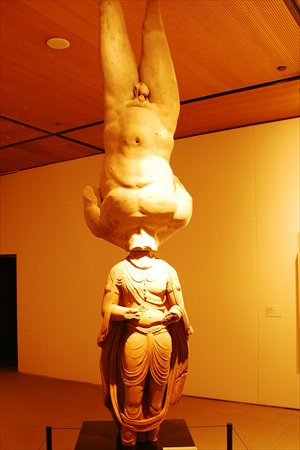
An artwork by Xu Zhen at the exhibition Photo: Liao Danlin/GT
Wherever there is an exhibition, there is a curator. Over the past two decades, the art of curating has become increasingly popular throughout the world. How to organize an exhibition, conduct relevant research and display the academic value of the objects shown in the exhibition in a systematic way are all part of the job of a curator.
While there are many successful artists who hold successful exhibitions around the world, the question of what kind a role a curator can play in order to make a difference at these exhibitions still needs to be answered. In order to answer this question and increase the professional level of curating, many art colleges offer courses for students that dream of becoming a professional curator.
From February 28 to April 20, the second CAFAM Biennale organized by the Central Academy of Fine Arts (CAFA) Art Museum is taking place in Beijing. For the main exhibition titled The Invisible Hand: Curating as Gesture the museum has invited six young curators representing different art colleges around the world to participate in discussing the hot topic of curating.
An academic biennale
"We are the first art college to undertake such a large-scale art biennale," said Xu Bing, vice president of CAFA, on February 28 during a press conference for the exhibition.
In 2011, the first CAFAM Biennale, Super Organism: A Particular Research View and Experiment, was one of the biggest exhibitions that year, and was later awarded with "Best Exhibition of 2011" by several art institutions.
This year, an academic committee has been established for the biennale, inviting international experts including Ann Demeester, director of the Frans Hals Museum; Hou Hanru, a curator based in Rome, Paris and San Francisco; as well as art critic Yves Aupetitallot.
While there are still many art biennales held at museums around the world today, most have encountered a bottleneck. Many of them have lost their focus and become simple art festivals used to stimulate a city's economic development or tourism industry.
The main problem of these types of biennales, Xu pointed out, is a lack of a core avant-garde focus or a strong research base. As a result, art critics have begun arguing if such biennales should even still exist.
"The biggest feature of the CAFAM Biennale is that every exhibition is focused on an unsolved international issue," said Xu, adding that the theme this year, curating, is also a topic that has not yet been fully studied or even carefully thought about in the artistic community.
Art curator Wang Chunchen agrees. Also a member of the academic committee, after several months of research by him and several graduate students at CAFA they discovered they couldn't find a single book covering the history of curating. "Although, the role of a curator has developed to the stage it has today, no systematic studies about this subject exist, while many important issues related to this field aren't being discussed by academics at all," Wang remarked.
It's for this reason the organization team decided to make a history of curating a part of the exhibit. Their hope is to highlight the interaction between artwork and the art of curating.
"What we feel needs further exploration aren't the theories that have been established about curating, but what is happening in reality; in other words, the practice of curating itself," Xu added.
Poetic themes
The whole exhibition was under development for a year and careful attention was paid to the selection of curators in order to incorporate an international outlook.
Separated into six areas, each dedicated to one of the invited curators, the exhibition includes artworks from about 80 artists, gathering videos, installation art, photos and performance art.
One of the curators, Kit Hammonds, a lecturer at the Royal College of Art in London, said during the press conference that the title Invisible Hand: Curating as Gesture is not the theme of the exhibition but rather an idea that articulates what the exhibition is trying to show.
According to Hammonds, whose area is called No Puppet is Dumber than its Puppeteer, the title Invisible Hand only represents some of the ideas that they came up with during the many discussions they had last year.
"It's a conversation that has gone in different directions. The decisions we made individually come from this idea of dialogue, whether that's cross cultural or educational," Hammonds said.
Xiaoyu Weng, another curator, is from the California College of the Arts in San Francisco.
Her show named Parliament of Things, or, Wandering in a Continuously Bewildering Wonder consists of the works of 20 artists, the highest number of works among the six areas.
For Weng, the purpose of this exhibition is not to present a proposition to the audience but to open up new ways of thinking.
"The Invisible Hand here goes beyond curating. It includes art culture, society and philosophy. It is about the areas where curators' strategic plans and the artists' intentions can overlap through selection, categorization and display," said Weng, who finds that in this way, a curator isn't just organizing things but also creating.
Ecology of curating
Yu Ding, a professor at CAFA, sees the exhibition as the first time in curating history that six art colleges with important roles in the art landscape have worked together. He feels the exhibit establishes a dialogue where both conflict and disagreement are valuable.
"While the curators are independent in their works, they have also learned to cooperate within the same platform. This explores a new model of cooperation in curating. For young people who want to become a professional curator, this is a good lesson," Yu concluded.
Xu pointed out that one of the advantages of holding such a biennale on campus is that the young artists involved have not been overly influenced by commercial art circles. Therefore, the dialogue happening here between artists and future artists can act as a useful reference for teaching.
Xu thinks education on curating, being such a young discipline, can act as a foundation for the also relatively young contemporary art scene because people have not yet done adequate in-depth research nor experimented in the field as they have in the areas of sculpture or painting. These many blind spots mean there is room to grow when it comes to the development of more mature and clearer theories about curating.
"Contemporary art is the most dynamic part of art and is a cultural phenomenon that we must understand. For that purpose we need to establish a clear understanding of the relationship that exists between curating and the artistic creative process," he said.