HOME >> CHINA, TWO SESSIONS 2013
Terrorists to be 'severely punished'
By Global Times – Xinhua Source:Global Times - Xinhua Published: 2014-3-11 0:38:01
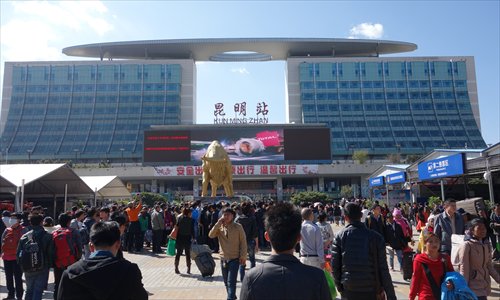
People pay their respects outside the Kunming Railway Station, which resumed operation on Sunday. Photo: Yang Jingjie/GT

China's chief justice Monday pledged to severely punish terrorists in cases like the recent Kunming railway station attack, in a 2014 outline for the courts.
Chinese courts will work to safeguard national security and social stability and help build up people's sense of security, said Zhou Qiang, president of the Supreme People's Court (SPC), when delivering a work report for the SPC to the second session of the 12th National People's Congress (NPC).
Courts will severely punish offenders who harm national security, especially those who carry out terrorist attacks, pose serious threats to public security and damage military facilities, Zhou told nearly 3,000 national lawmakers, who will deliberate overthe report.
On the evening of March 1, a group of knife-wielding assailants indiscriminately attacked civilians at a railway station in Kunming, Yunnan Province, causing at least 29 deaths and injuring another 143.
In the past few days, Chinese lawmakers, as well as political advisors, have been proposing improved legislation to counter terrorism following the Kunming attack.
Guo Chengzhen, a member of the Chinese People's Political Consultative Conference (CPPCC) and vice president of the China Islamic Association, on Saturday urged the country to set up a counter-terrorism law in a bid to fight against such terror attacks effectively.
Guo, while slamming the attack in Kunming, said that terror attacks frequently targeted the public, regardless of their age, gender, nationality or religious belief.
Dilnar Abdulla, a Uyghur deputy to the NPC said improving anti-terrorism legislation is definitely necessary, adding that she hopes people would realize terrorists' "ulterior secessionist motive and the destructive nature of their acts."
The Standing Committee of the NPC passed a decision to improve anti-terrorism work in October 2011, but it was never made into law.
Zhu Yilong, a CPPCC member and deputy chairman of the All-China Federation of Returned Overseas, said that China already has a legal framework for efforts to counter terrorism based on the Constitution, the Criminal Code and the Extradition Law, but much more needs to be done when compared to other countries.
A senior official with the top legislature on Sunday stated that the country will work on a counter-terrorism law.
Zang Tiewei, deputy head of the criminal law division under the Commission for Legislative Affairs of the NPC Standing Committee, said that in order to draft counter-terrorism law, the legislature will have to evaluate the situation, consult related agencies and conduct research.
Read more in Special Coverage:

Posted in: Politics, Latest News