Shining examples

Daji Island with its lighthouse standing tall. Photo: Courtesy of Song Bo from Shanghai Aids to Navigation Department of Shanghai Maritime Safety Administration
Lighthouses have been marking out port entrances or dangerous sections of coast for centuries. The Pharos, or the Lighthouse of Alexandria, was built around 247 BC and for aeons was listed as one of the seven wonders of the ancient world.
The first lighthouse in China's modern history was a red stone building built for the Guangzhou Customs in 1859. Today there are about 200 lighthouses along the 32,000 kilometers of China's coast and eight of these fall within Shanghai's territory. Five of Shanghai's lighthouses, Hengsha, Wusongkou, Gongshan, Tangnaoshan and Xima'anshan are unattended, their beacons run remotely and powered by solar energy and storage batteries.
But the Dajishan, Sheshan and Jigujiao lighthouses are still operated and maintained by an exclusive band of workers, men who have to survive long periods of isolation and loneliness to keep the beacons shining through the nights.
Some of Shanghai's lighthouse keepers have been doing this for 25 years or more but others are young men who have accepted the monotonous routines - usually a month at a time on duty working and sleeping with only the waves and the reverberations of the diesel engines running the generators keeping them company.
A long trip
It takes a long time to get to the Dajishan lighthouse from downtown Shanghai. When the Global Times visited the isolated beacon the journey involved driving to the south of Shanghai's Luchaogang, crossing the 32.5-kilometer Donghai Bridge, and then boarding a boat belonging to the Shanghai Maritime Safety Administration at Yangshan Port. Then, after an hour and a half of choppy waters (and seasickness), the Global Times arrived at Daji Island.
No one apart from the four lighthouse keepers and a scruffy gray dog lives on the 500-square-meter island. It's a long climb from the dock but the track winds through a selection of plants, flowers and shrubs and eventually arrives at the top of the island and the lighthouse itself. Beside the lighthouse building there are huts containing the diesel engine, the Radio Beacon-Differential Global Position System (RBN-DGPS) and the Radio Beacon-Differential Beidou Navigation Satellite Systems (RBN-DBDS). On the other side of the lighthouse are clean and tidy living quarters, bedrooms, kitchen and bathroom.
Chi Caiming is the head operator for the lighthouse and showed the Global Times around. "There is a lot of valuable equipment here on the island. This lighthouse is the only GPS and BDS base station at the entrance of the Yangtze River. It also functions as an Automatic Identification System, radar, a coastal radio station and telecommunication system. We have to make sure all of this is kept working so that shipping can proceed safely."
Day and night ships, big and small, pass this little island and the lighthouse has to continue working 24 hours a day, seven days a week. The staff here work in shifts throughout the day from 7 am to 12 am, 12 am to 5 pm, 5 pm to 11 pm, 11 pm to 4 am and 4 am to 7 am. The four keepers take shifts in turn throughout the day and night, "When we are on duty, we patrol through the lighthouse and check the machinery and electronics' rooms as well. We each have a speciality and we are responsible for maintaining different equipment," Chi said.
Most small and medium lighthouses now use solar power and storage batteries and operate automatically. But large lighthouses like Dajishan, which has a lot of advanced technology, still need people. "Lighthouses like Dajishan are more like an electronic information station on the sea than a traditional single-function lighthouse," Chi said.
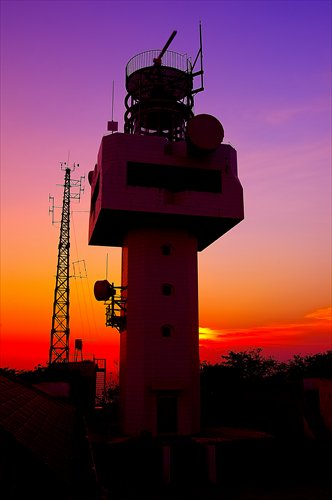
Just before the beacon is turned on the lighthouse glows in the sunset. Photo: Courtesy of Song Bo from Shanghai Aids to Navigation Department
How to fix things
"Being a modern keeper doesn't just mean you have to light the light every evening. In fact these days lighthouses can light themselves automatically. To qualify for this work these days you have to know what can go wrong and how to fix it. We have to understand marine navigational processes, electronics, machinery and computers," Chi told the Global Times.
And the job demands a great deal of commitment. Once when the diesel generator broke down, Chi was trying to fix it when a pipe filled with scalding oil burst and sprayed his face and hands. His priority was to get the generator back working and restore the lighthouse's power supply before he could be treated for his burns. In pain but determined to do his job he eventually located the source of the trouble - a fuel injection valve that had moved out of place - and fixed it before seeking medical help.
On another occasion after a level 12 typhoon had knocked out two of the lighthouse's navigational antennas Chi climbed to the top of the 25-meter lighthouse roof to fix the problem. Mechanics had been sent from the base on the shore but the weather had delayed them reaching the island for several hours and Chi knew antennas had to be connected quickly.
Chi graduated from senior high school in 1987 and began working at the Sheshan lighthouse in 1988. The 46-year-old moved from Sheshan to Dajishan in 1994 and has seen that lighthouse undergo three major upgrades with state-of-the-art technology now installed and operating. At first he was curious about lighthouse work but the curiosity was soon overtaken by a constant loneliness. "You are alone on a small island, completely surrounded by the sea, the waves roaring ceaselessly day and night." He says his biggest achievement over the years has been coming to grips with the loneliness his job involves and finding ways to fill in the time.
He has a lot of books and is an avid reader and occasionally he turns on the radio to listen to human voices. There is a television in the lighthouse living quarters but reception is usually poor - "sometimes all we can see on the screen is snow." And tucked away is a 1,000-piece jigsaw puzzle which he is saving for a day in the future.
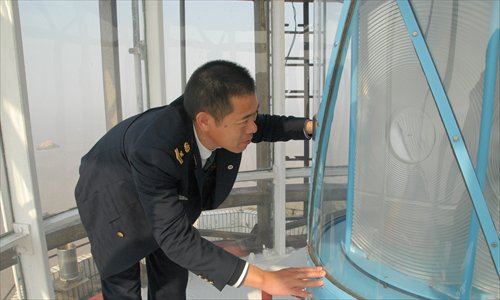
Chi Caiming checks the lens on the light itself. Photo: Courtesy of Song Bo from Shanghai Aids to Navigation Department
Not romantic
At 50 Yao Yong is one of the oldest staff members on the island and he has been a lighthouse keeper by profession for more than 30 years, his constant companions the sea and the lonely island life. "People think starry nights and sea views are romantic but for us it is the opposite. It's a view that sometimes hurts our eyes," he smiled.
For extra company, Yao brought a dog to the island three years ago. He's been a great companion, following the keepers wherever they go on the island, offering affection and acting as a sentry. "If anyone comes near the island he lets us know." Strangely the dog has not been named by the keepers - but it seems happy with this arrangement.
A supply ship comes to Dajishan four times a month, bringing fresh eggs, meat, vegetables, fruit and water. But if the weather turns bad the ship cannot always dock and supplies are often delayed.
Huang Dongyun, the Yangshan Port superviser from the Shanghai Aids to Navigation Department, said that bad weather isolated the lighthouse for more than half days of the year. "Especially in summer if there are two or three typhoons in succession sometimes there will be no supplies to the island for a month."
With this in mind the keepers on Dajishan collect rainwater and tend a vegetable garden to be a little self-sufficient. "This winter, we grew garlic, radish, basil and cabbage. We grow different vegetables throughout the year," Chi said.
Illness is one of the nightmares for keepers. If someone is injured or develops a serious illness it can be difficult getting treatment or moving the sick person to the mainland. Although the island has good clean fresh air and plants thrive there, the constant noise of the sea and the machinery can be wearing.
Different roads
Each keeper came to this work by different roads. Before he became a lighthouse keeper 43-year-old Han Bowen had a variety of jobs including working as a welder and fitter. In 2001 he decided to become a keeper partly because he needed a steady job and partly because he wanted to be beside the sea.
He still vividly remembers the seasickness that overwhelmed him on the first trip to the island. These days he has grown accustomed to the routine and the isolated life. "When I am on the island, I miss home, but when I am home, I miss the island."
Dai Haiyue is 48 now and used to be a fisherman until 2007 when he sold his boat and became a lighthouse keeper. He was first assigned to the Jigujiao lighthouse, a small lighthouse built on a 100-square-meter reef. Unlike Dajishan there are no other buildings on this reef and conditions there are harsh. In 2013 Dai was moved to Dajishan.
Together the keepers are like brothers in a family, living and working together. Chi noted that he had had more dinners with his colleagues than he has had with his wife. But the monotony of their work can provoke frustrations and stress. As the leader Chi understands each man's personality and knows how they are feeling.
Their families also have to learn to live without their husbands and fathers. When Yao Yong's father was taken ill and needed an operation the family decided not to tell Yao until he had recovered. Chi was not told of his grandfather's death until he went home for a break. Another man's wife was seriously injured but didn't tell her lighthouse keeper husband - tragically she died soon afterwards. A real tragedy, the keepers agreed.
All these lighthouse keepers are contracted workers. "They have to pass examinations like the national public servants exam or the Shanghai public servant test if they want to be public servants, and it's not easy," Huang said. "It's getting difficult to recruit young university graduates for this work. They don't feel comfortable in jobs like this. But someone has to do it. Someone has to make a sacrifice."