Beggar slaves
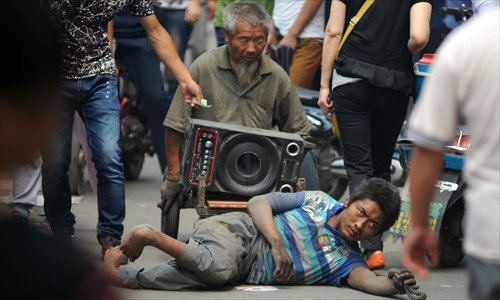
Disabled beggars beg on the streets of Taiyuan, Shanxi Province, on August 27, 2012. Photo: CFP
It had been 10 years since Lu Xiaoyan, a factory worker in Dongguan, Guangdong Province, had heard from her cousin. She assumed he was dead. So when he called her one night in September 2010 she was shocked.
"Lu Jianqiu hadn't contacted us in over a decade, ever since he left home to work in Dongguan. We all thought he had died," Lu told the Hong Kong-based Phoenix TV.
Thrilled at her cousin's return, Lu hurried to the place where he had suggested they meet, but she was appalled by what she saw.
"He had lost two legs and his right hand had been amputated," Lu said.
Lu had been drugged, abducted and maimed. In the decade he had been missing, he had been enslaved and forced to work as a beggar by a criminal gang.
Before Lu Xiaoyan was able to ask for detailed information about her cousin's plight, he was hauled into a mini-van by two well-built men.
Once again, her cousin vanished.
Media reports have shone a light around the edges of a horrifying industry in Dongguan, the manufacturing industry hub of Guangdong Province, in which people, including children and the elderly, have been crippled, maimed or disfigured in order to generate sympathy while begging.
But these kinds of atrocities are not confined to Dongguan. In Beijing last year, two gang ringleaders were revealed to have made over 1 million yuan ($160,930) by drugging and abducting physically disabled people and forcing them to beg, according to the Beijing Evening News.
In response, local public security authorities vowed to look into such crimes and said they would severely crack down on organized begging if the cases proved to be true.
Cases like these are actually nothing new to most Chinese people, who have heard similar stories dating back throughout history. But they still generate huge public anger at the perpetrators, as well as the authorities for allowing it to happen.
Underground networks
Each morning, gang members are believed to drive vans around Dongguan, transporting disabled beggars and dropping them off in densely-populated downtown areas.
Some members stay at a close distance to keep an eye on them, Phoenix TV reported.
Sometimes they unload large numbers of disabled beggars to get money when large scale events like trade fairs are held.
At the end of the day, the gangsters come to pick them up, confiscate their money and take them to places on the street, often the same places they were found.
Reports have shed some light on these pitiful places. They are often devastated construction sites or disused overpasses. The beggars are given a small amount of food and a little money for their efforts, and are beaten if they do not make enough money.
Wang Xiuyong, a migrant activist in Dongguan who has been looking into cases like these for a long time, told Phoenix TV that in Dongguan there is an estimated 10 beggar gangs, most of which are run by people from Central China's Henan Province.
Wang said the gang ringleaders mainly come from the cities of Zhoukou, Zhumadian and Xinyang. They are believed to have originally rented infants and children from local families by offering thousands of yuan, but when this became more difficult, they began to abduct children.
Wang said he once witnessed gang members breaking the legs of a homeless infant girl after they found her on the street.
"The more severely those children were hurt, the more valuable they could be. They can collect more money by arousing public sympathy," Wang said. "They were fed strong sleeping pills, so that the children would not run away, hide money or notify people to come and rescue them," Wang said.
According to official statistics from local authorities, there are over 3,000 beggars in and around Dongguan. The real number is probably higher. There are no reliable figures on how many are forced to beg.
The shocking enslavement of beggars has caused many people to call on the authorities to crack down.
Lack of action
"We are now looking into the alleged crimes. If it is true, we will definitely crack down on this organized begging," an official from the Guangdong provincial police department surnamed Zeng told the Global Times.
According to the law, people who use violence or force the handicapped or children under 14 to beg can be sentenced to three years of imprisonment and fined. The most severe cases can result in sentences of three to seven years.
Chen Tao, a Beijing-based lawyer, said a lack of action on the part of public security bureaus has encouraged organized begging.
"The public security bureaus should intervene in cases involving suspicious organized begging. Instead of shirking their responsibilities, they should first investigate any clues or tip-offs offered by people," Chen told the Global Times, calling on the legislators to strengthen penalties for these crimes.
Wang Xiuyong said that police often try to pass the buck. He said he once reported a beggar gang to police in Shijie, a district of Dongguan, but local policemen did not follow up on his request, claiming that the urban management bureau is responsible for issues relating to begging activities.
But the police reluctance may stem from numerous reports of beggars faking their disability across the country. These cases, where healthy beggars claim to be disabled to get money, have worn out public sympathy and taken up a lot of the authorities' time, distracting from real issues.
Even though local authorities have been increasing the number of shelters for the homeless in recent years, they have proven unable to cope with the growth in the homeless population, who have been the main source of beggars.
"We changed the shelter system in 2003, from being compulsory to voluntary. But this means handicapped people and children who were controlled by gang members often can't be rescued," Chen told the Global Times.