Growing trend
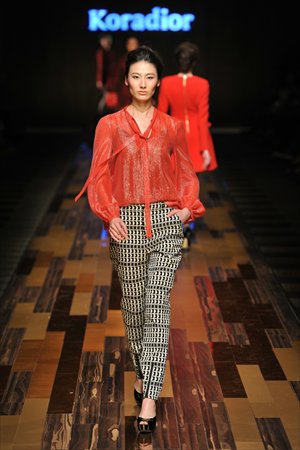
Models take the catwalk at China Fashion Week in Beijing. Photo: Courtesy of Koradior
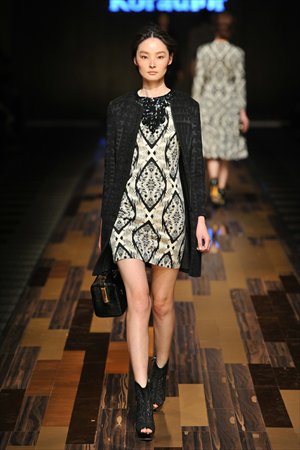
Models take the catwalk at China Fashion Week in Beijing. Photo: Courtesy of Koradior
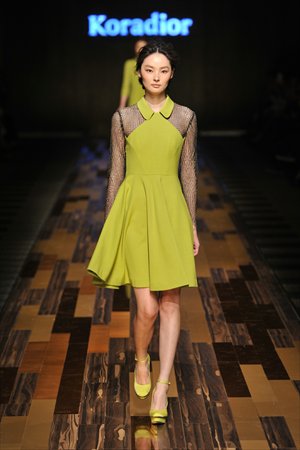
Models take the catwalk at China Fashion Week in Beijing. Photo: Courtesy of Koradior
Spring and autumn are always the busiest seasons for the fashion industry. During this time international fashion weeks come one right after another bringing not only the latest fashions but also all kinds of related events: galas, charity banquets and conferences.
While this occurs on a less crazy scale in China, from the time Shanghai Fashion Week begins to when China Fashion Week in Beijing ends, everyone in the field begins moving at a non-stop pace.
China Fashion Week Autumn/Winter, which ran from March 25 to Monday, gathered fashions from about 50 designers and 60 brands. Of these, half the brands were participating for the first time.
Highlight of trends
Fashion doesn't care about temperature. As such transparent materials continue to be a hot choice for the autumn and winter season, and spectacular naked backs and plunging necklines with careful structuring were commonly seen.
Organza, 3D meshes and thin silk shirts and blouses match easily with thick jackets and suits, creating layers of visual effects.
Similar to Milan Fashion Week, where fur was largely employed in several shows despite protests from environmental activists, capes and sleeves made of fur were trending on the stage of China Fashion Week.
Qi Gang, who was absent last season due to Milan Fashion Week, was back on stage for China Fashion Week. His designs largely used fur and floor-length dresses drawing inspiration from Han Dynasty (206BC-AD220) clothing styles to create a series of luxury fashions with jacquard weaving, beading and skin texture reconstruction that emphasizes layers and multi-dimensional cutting.
"Coming to Fashion Week is the fastest way to allow the international fashion industry to know what is happening in China. Chinese fashion culture must be connected to the world," Qi, who has participated in the event since 2000, said during the press conference for China Fashion Week on March 24.
Also worth mentioning is the Koradior brand by designer Fang Ying. Entitled All About Times, the show was dominated by black and golden colors, using luxury fabrics imported from Europe to create some retro-futurist looks combining elements from the classic European industrial age and modern lifestyles.
This year, collective designers coming from different parts of China showed off the hottest local elements.
For instance, non-profit agency Fashion Farm Foundation from Hong Kong led a number of enterprises including 112mountainyam, Daydream Nation, INJURY and KC GIDEON to participate in China Fashion Week. Presenting sporty jackets, leather ankle boots and shorts, the collections soon became a snapshot of street style among Hong Kong youths.
Additionally, five South Korean brands including Resurrection, Shin Jang-kyoung and Kumann Yoo Hye-jin showcased their new collections. Korean-styled clothing has always been popular in China but in recent years the focus has shifted from those famous Korean brands targeting consumers in their 20s. Instead Boutique stores are increasing in popularity with more independent designers in South Korea being recognized as a group in China.
Promoting the new
Over the past several years, young designers have become increasingly important players in the fashion industry. Although they can't compare to well-known brands that have their own factories when it comes to production quantity, many young designers are still able to garner a decent amount of loyal customers and celebrity followers.
Receiving over 1,000 works from 22 countries and regions, the 22nd Hempel Award China International Young Fashion Designers Contest played a leading role in promoting the younger generation during Fashion Week.
Taking the theme "Golden Age," the Hempel Award headed Fashion Week's opening show.
New this season is a project called Hempel Original Workroom (HOW) which is meant to help support young designers.
China Fashion Week specifically provided an opportunity for talented new designers to release their latest designs for HOW. In addition, together with a designers salon, there were also experienced mentors offering guidance and advice for young designers.
A parallel event to Fashion Week is the 10+3 Showroom Project, an invention last season that is now a regular part of Fashion Week. Hosting various shows and salon discussions daily the project presented works by 10 selected young fashion designers and three accessory brands.
Designer Qiao Qi's Georgette was one of the brands that participated in the 10+3 Showroom Project last season, where her handmade knitting designs received a plethora of positive reviews from fashion editors and celebrities. This season, she was able to hold her own individual fashion show, in which she once again emphasized her handmade details by using the natural contours of wool.
Transformation going on
Taiwanese designer Gioia Pan told the Global Times that the more fashion weeks she attended, the more changes to China Fashion Week she noticed.
"Going from a local fashion meeting to an international fashion feast, China Fashion Week plays a leading role in promoting fashion culture and is developing towards a more organized international level," she said.
Zhang Qinghui, vice president of the China Fashion Association, explained during the press conference that being international means much more than increasing international participation.
"It also means to be more confident and mature, keeping an international perspective, organizing a wide diversity of events and attracting international media and sponsors," said Zhang.
However, despite improvements, there is still criticism surrounding the show. One of these criticisms being that the current catwalk calendar is dominated by big domestic companies, while designer brands are limited.
One of the explanations is that the cost of the show is too high for start-up designer brands that have limited resources. Additionally, when it comes to those designers who only want to unveil their latest catwalk collection at one fashion week, they tend to choose one of the big four fashion weeks.
Zhang said that among all the participating brands this season, half of them were participating for the first time, which indicates that there is still plenty of space for new arrivals to the industry.
Zhang also added that the reason people think of fashion when mentioning cities like Paris and Milan is not because they have the biggest fashion weeks in the world, but because of the image they have established over the past few decades.
Thus, Fashion Week is the first step in creating such an image as well as guiding the fashion culture. "And that is what China Fashion Week has been doing in the past," he said.
Many say that the fashion industry in China is entering a golden age. However, whether this is true or not might still take time to prove.