HOME >> CHINA
Move where?
By Liu Sha Source:Global Times Published: 2014-4-3 20:03:01
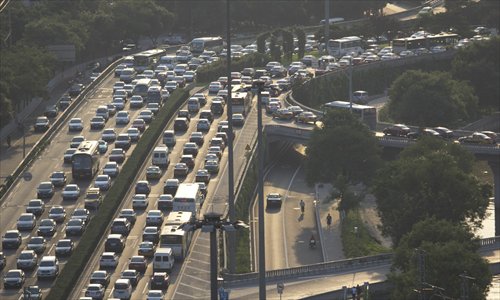
Hundreds of cars line up on Beijing's 2nd Ring Road around 5:30 pm in the smoggy weather on July 17, 2013. Authorities are mapping out a plan to move some government functions out of the capital to ease pollution, traffic and pressure on the cost of living. Photo: CFP
Although getting fed up with of the smog, traffic jams and crowded streets in Beijing, 36-year-old Li Boming, an employee of a public institute under the Ministry of Finance, does not want to relocate to Baoding, a city some 140 kilometers south of the capital that is set to become an "auxiliary capital" and take over some administrative functions from Beijing.
Hebei provincial authorities released an urbanization plan on March 26, saying that Baoding will become a satellite city of Beijing. Other cities like Langfang will also be prepared to receive the capital's industries or other functions.
The Baoding government then announced a plan to set aside 34 districts of 115,000 hectares to receive branches of institutions and companies moved from Beijing.
The document was released for soliciting feedback. The central government has made no corresponding plan so far, but Li has started to worry about whether his company will be moving out as relocating his family members would bring many troubles.
"If I'm asked to leave for Baoding, shall I take my wife and my son in primary school with me? Shall I start to research which primary schools are better there?" he asked.
Experts reached by the Global Times all agreed that because Beijing's resources are being stretched thin, it has been an inevitable trend to move some government functions to neighboring Hebei Province and Tianjin Municipality to ease pressure on the capital and promote development in the region around Beijing.
However, they noted that the relocation process, which must balance the interests of Beijing, Hebei and local people in the region, will require all parties to make compromises and even sacrifices.
Few fans in Beijing
Li is not the only person worrying about being relocated to Baoding.
Hebei's urbanization document mentioned that Beijing might transfer not only public institutions, but also universities, research centers and hospitals to Baoding.
Huang Huihui, an employee with the Chinese Center for Disease Control and Prevention, voiced similar concerns. "It took me a long time to get a Beijing hukou (household registration), which will guarantee me a stable life here, and I won't give it up easily," Huang said.
She said that there are many public resources like top universities, international enterprises, shopping malls and museums in Beijing. "I came to work here because the capital is full of opportunities. But Baoding is a place that I don't even want to visit for tourism."
Huang added she would change her job to stay in Beijing if her company moves to Baoding.
Baoding lags behind Beijing in many aspects, especially in economic development and infrastructure, and that's one of the biggest obstacles in enacting the plan, said Zhang Yaojun, a professor with the School of Sociology and Population Studies at the Renmin University of China.
"During the process, officials have to be prepared to tackle many deep-rooted problems like hukou, the wealth gap and the past mistake of blindly gathering too many [resources and institutions] in Beijing," Zhang said.
The latest figures show that the per capita GDP of Baoding in 2013 was 24,000 yuan ($3,900), compared to 93,460 yuan in Beijing.
Through government intervention, Beijing has absorbed too many resources. Competitive industries in North China have rushed here, leaving few for its neighbors.
The relocation plan is also in line with China's call for concerted development of the Beijing-Tianjin-Hebei region. Development of the region was also included in the central government work report in early March.
Lack of supporting facilities
It's not just employees that are concerned. Some employers don't think their companies can do as well in Baoding as they do in Beijing.
"There might not be a market for us, and some of our employees may leave us due to an unclear future," an editor from the China International Publishing Group told the Global Times, refusing to be named.
Zhang said the government needs to map out a detailed relocation plan, including what kind of institutions to keep and what to move.
"But the 25 core departments probably won't leave," he said.
"Moreover, people also need various services like education, medical care and entertainment. A set of facilities should be provided to keep a new district developing," he added.
The Hebei government should be more flexible with favorable policies like low land prices and tax cuts to attract cost-sensitive industries, he said.
The Beijing Times reported on Monday that 200 million yuan would be allocated by the Hebei provincial government to support competitive industries transferring from Beijing.
A conflict of interest
"What Beijing wants to move out might not be what Hebei needs," Ye Tanglin, an urbanization expert with the Capital University of Economics and Business, told the Global Times.
Since Caijing magazine first reported that Baoding was the leading candidate to become an "auxiliary capital" on March 19, investors have flooded into Baoding. In the past week, local housing prices increased 60 percent from 5,000 yuan per square meter to 8,000 yuan, a Global Times reporter learned in Baoding.
A Weibo post saying that "Baoding does not want traffic jams and high housing prices" has been spreading online and so far over 200 Net users have forwarded it.
The author Zhao Yang, a local resident in Baoding, told the Global Times that she knew that being an "auxiliary capital" would benefit everyone in terms of better infrastructure and higher income. "But in a short term we have to experience skyrocketing housing prices, inflation and traffic jams, problems we don't want to see."
Another Net user, A Man, also an opponent of the relocation plan, cited the example of the relocation of steel giant Shougang Group. It was moved to Tangshan, another city in Hebei, and "now the air quality in Tangshan is terrible."
It is a matter of competing interests, Ye said. "What Beijing wants to give may be some low-end industries like wholesale markets, but Hebei is expecting new development."
Beijing's Xicheng district signed a cooperation framework Thursday with Langfang in Hebei. Langfang might become a destination for the downtown Beijing Zoo Clothing Wholesale market that contains thousands of small businesses. It is believed to be one of the industries to be driven out of the capital to control the population.
Baoding Mayor Ma Yufeng said that along the high-speed train line between Beijing and Baoding, there should be headquarters of some high-end enterprises and universities.
The entities moving out of the capital contribute to Beijing's fiscal revenue, so the Beijing government may be reluctant to let them leave, Ye said. Moreover, Beijing must let go of some of its top hospitals and universities, which draw people from around the country, otherwise it cannot achieve its goal of reducing its population and traffic jams.
Chu Daye contributed to this story
Posted in: Politics