Search for the self
On April 13, 1906, one of the world's most influential writers of the 20th century, Samuel Beckett, was born in Dublin. His thought-provoking meditations on the horror and absurdity of the human condition, combined with his intense intelligence and wit, earned him the Nobel Prize in literature in 1969.
To commemorate the 108th anniversary of Beckett's birth, local theater group Shanghai Shakespeare will be presenting three short plays by the great dramatist - Play, Footfalls and What Where. They will be performed in Chinese for the first time, with the permission of the Estate of Samuel Beckett and Curtis Brown Ltd in London, which strictly manage the properties of the late writer.
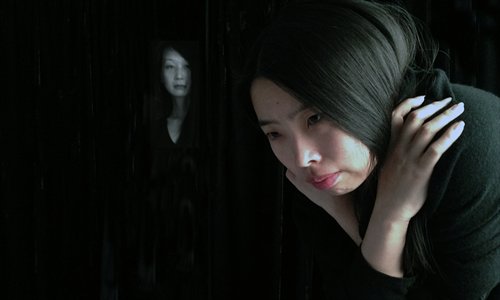
Stage photos from Footfalls, Play and What Where Photo: Courtesy of Shanghai Shakespeare
"They are very careful about who does the plays and how, and you can't change things like the genders of characters and the locations," said Thomas Caron, founder and director of Shanghai Shakespeare. It took Caron some seven months of negotiations via e-mail to get permission to put on the plays, during which he had to vouch for the credentials of the translator and explain his vision for the productions. Zhang Yadong, an English professor from Shanghai International Studies University who wrote The Search for the Self - on Samuel Beckett's Dramas, translated the plays, keeping the same simple and straightforward language of Beckett, Caron said.
In 1994, the Estate once shut down a West End production of Footfalls because the director cut the text, changed the color of the female performer's costume and allowed her to move around the stage when she was supposed to only pace in a specific area.
"Some people feel that they are robbed of their artistic freedom when doing Beckett, but that's not the case because Beckett sets up a special image. He himself sees the image as more important than the words," Caron told the Global Times.
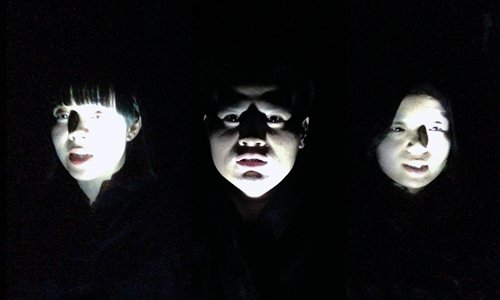
Stage photos from Footfalls, Play and What Where Photo: Courtesy of Shanghai Shakespeare
Play, a 25-minute one-act play that was first performed in English in 1964 (the original production was in German the year before), features fragmented monologues given by one male and two female characters (one is the man's wife and the other his mistress), each of whose bodies are encased in an urn, only their heads visible. They sometimes speak in chorus - their words overlapping unintelligibly - while at other times they speak singly as a spotlight highlights their faces. Beckett once likened the effect to that of a lawn mower, which produces a burst of energy followed by a pause and a renewed burst followed by another pause.
Footfalls, written in 1975, feature a female character pacing back and forth on a strip outside the room of her dying - if not already dead - mother; While What Where, Beckett's final play, focuses on the interrogation of five male characters, only four of which appear on the stage.
Caron told the Global Times that the images used in Play have their roots in Dante's works, while the interrogation in What Where echoes Beckett's experience of interrogation at the hands of the Gestapo during his time with the French Resistance in World War II.
Born in Massachusetts, 62-year-old Caron's experience in the theater began in New York at the age of 18, and he has performed extensively in places that include Los Angeles, the UK and China. Locally, Caron is perhaps best-known for playing the lead in Shanghai Repertory Theater's King Lear in 2010, and then directing Twelfth Night and Catastrophe in 2011. The following year he set up Shanghai Shakespeare, which is dedicated to producing Shakespeare's plays in Chinese. So far, they have tackled Antony and Cleopatra and Pericles.

Stage photos from Footfalls, Play and What Where Photo: Courtesy of Shanghai Shakespeare
Caron says that Beckett has always been one of his favorite writers. He played Vladimir in a 2009 production of Waiting for Godot in Shanghai, and also performed in Play and directed Footfalls in New York in 1991.
"Shakespeare's world is very broad and it covers everything, while Beckett's world is very narrow, but just as deep," said Caron.
Twenty-eight-year-old Zhang Xi plays one of the female roles in Play, and was also in both of the Shanghai Shakespeare productions. Doing Beckett, according to Zhang, is totally different to doing Shakespeare.
"Maybe Shakespeare is like a classical realistic oil painting, while Beckett belongs more to the school of abstract art, in which the audience needs to actively engage its imagination," said Zhang.
While the actors at Shanghai Shakespeare are all amateurs, their performances have received consistently high acclaim from audiences.
Caron said he treasures the lack of experience among his actors, as it allows him to train them to work in the same way and connect on stage.
Date: April 13, 3 pm and 7:30 pm
Venue: Qianshuiwan Culture Center
浅水湾文化艺术中心
Address: 179 Yichang Road
宜昌路179号
Tickets: 180 yuan (presale), 200 yuan (at the door) and 100 yuan for students
Call 6266-1110 for details