Cures for kids
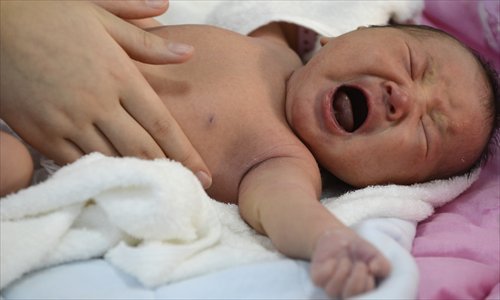
A baby undergoing a gentle tuina massage Photo: CFP
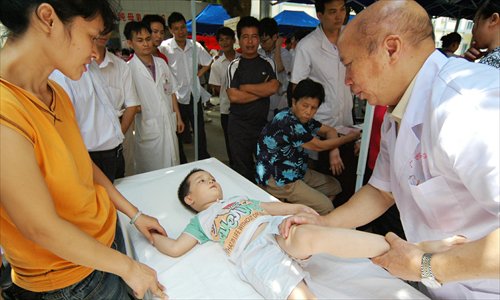
A mother looks on as her son is treated by a tuina practitioner. Photo: CFP
Spring in Shanghai brings warmth, blossoms and variable weather - and variable weather for many children means illness. Hay fever, asthma, coughs, allergies and runny noses thrive in the hot and cold conditions of spring.
Also thriving in Shanghai are medical practitioners offering to cure any children suffering from these ailments. Especially, it seems, therapists offering tuina, the Traditional Chinese Medicine form of massage.
Tuina stimulates acupuncture points on the body and has been practiced in China for at least 700 years. At present city hospitals, clinics and parlors providing pediatric tuina report a surge in demand.
At Yueyang, Shuguang, and Longhua hospitals, which are all leading TCM hospitals connected to the Shanghai University of Traditional Chinese Medicine, there are tuina departments with some practitioners specializing in treating children. To have a hospital consultation will mean a parent will pay about 15 yuan ($2.4) to register and 100 yuan or more to actually see an expert. A treatment session will cost more than 100 yuan.
When the Global Times visited the tuina department at the West Campus of the Shanghai Shuguang Hospital on a recent Thursday afternoon, half a dozen were waiting with parents or grandparents to see a practitioner. Many of the parents reported that their children were suffering from coughs and diarrhea.
Barely qualified
But outside the recognized hospitals private tuina clinics and parlors, found in the districts of Yangpu, Zhabei, Hongkou and Baoshan, are booming. The problem is that, according to several city newspapers including the Youth Daily, the practitioners in these clinics are barely qualified.
One of the leading private clinics is the Pediatric Tuina Cure Clinic on Xinjiaqiao Road North in Hongkou district. It advertizes itself as "the only professional pediatric tuina institution with a medical practice license." The license was apparently granted by the Hongkou Health Bureau in July, 2011, and hangs on a wall facing the waiting area in the clinic.
In the consulting room three middle-aged women and a young man, all in white coats, were sitting at tables, gently massaging children who were sitting in their laps - three of the patients were babies. Outside, parents and grandparents looked after children who were waiting for their turn or had just finished being treated.
Wang Demin, from Henan Province, runs the clinic. She calls herself "Chief Physician" according to the sign on her office door. The clinic's recruitment advertising on a human resources website asks applicants to be graduates in acupuncture and tuina, have TCM diplomas and three years of work experience.
However when the Global Times asked about Wang and her colleagues' qualifications, the other two women giggled. Wang said that the clinic would not have been able to open and get a license under Shanghai's regulations unless she was a licensed TCM practitioner who had already worked more than five years at a first-tier or second-tier hospital.
When pressed for more details about the qualifications of the staff Wang did not offer any facts but insisted that pediatric tuina was actually a grass-roots craft.
"People with a lot of education and diplomas aren't necessarily good at tuina, and many of the great TCM practitioners had no formal qualifications," Wang stated.
Mechanics
Li Zhengyu is a professor at the School of Acupuncture and Tuina with the Shanghai University of Traditional Chinese Medicine. He has worked as a tuina department doctor at Yueyang and edited a number of national TCM textbooks. "A proper pediatric tuina practitioner has to be a qualified practitioner in the first place and then a pediatric tuina specialist, otherwise they are just mechanics," Li told the Global Times.
One way to become properly qualified is to study for a degree at a TCM university. At the Shanghai University of Traditional Chinese Medicine, for example, students from the School of Acupuncture and Tuina study tuina as a specialist subject.
They begin with gong (inner strength) practices and massage techniques and move on to theory and pediatrics. To study pediatric tuina, a student will undertake 54 sessions which combine theory with practice. TCM students from other schools can obtain certificates showing they have undertaken pediatric tuina as an optional course, but legally they cannot practice with this alone.
Western medicine practitioners can also become qualified for pediatric tuina by undergoing a university course or studying at tuina hospital for a year then completing a one-year internship.
For those who want some sort of qualification but lack any formal medical education there are crash courses available - students can enroll for a pediatric tuina course at some universities which charge more than 1,000 yuan for up to 30 hours of teaching spread over four weeks. "These students come from all walks of life. One day they are farmers and the next day they are doing pediatric tuina," Li told the Global Times. Graduates from these courses cannot practice.
Li said that without qualified and experienced doctors, most of the private pediatric tuina clinics are not proper medical centers and at the best could only be considered health advise centers.
Li explained that one of the techniques used in tuina is nie ji (spine pinching), which helps prevent colds, and improves appetites and overall health, along with other benefits.
Promise to cure
This is a modest list compared to the claims by the Cure clinic in Hongkou, the Junchen clinic in Putuo and the Aiwawa clinic in Zhabei, which say they can cure nearly 20 common childhood diseases from coughs and colds to eczema and disturbed sleep.
Complicating matters is that some of the clients believe these clinics really do provide effective treatments. Xia Guiwei, who brought her 5-year-old grandson to the Junchen clinic, told the Global Times that after his tuina sessions the boy no longer suffered asthma attacks. "After we started tuina there was a lot less wheezing and shortness of breath, and after a short time he stopped coughing. It took time for me to lose my initial doubts and trust this, but now I am completely convinced," said Xia.
Many people have turned to these clinics after being dissatisfied with Western medicine and reading praise about the clinics online. Ms Chen, a regular client at the Cure clinic, said her 5-year-old son's rhinitis had got worse after he was operated on, and the two months of antibiotics that followed did not help either. "But after two weeks of tuina, his nose wasn't blocked and after six months he rarely has a sniffle."
This came at a price. At the Cure clinic clients have to enroll for a seven-session course of treatment (sessions last between 10 and 15 minutes) - this costs 1,000 yuan. Chen can get a 50 percent discount with a membership card but she had to deposit 10,000 yuan on the card when she enrolled. So when Chen brings her boy for daily treatments she pays 500 yuan a week which, even at 70 yuan or so for a single session, is cheaper than the TCM hospitals.
While Xia and Chen are fans, other former clients have been quick to disparage the private clinics. "The masseurs were nice at first, but after we had paid for another two courses the sessions became shorter and shorter and there was no apparent improvement," one parent who had spent 3,000 yuan complained on the rating website dianping.com.
It is not just a large monetary outlay that is a problem for clients. Professor Li said that unqualified therapists who don't have a proper understanding of anatomy and don't have training often miss key symptoms and misdiagnose.
"For example, tuina can reduce the body temperature, and it is possible that a child's temperature will fall after tuina. However, diseases can change rapidly and over a few hours pneumonia could develop and the child will be seriously ill.
"Without sufficient medical expertise and a true understanding of pediatrics, however, these unqualified people won't know that something helpful at one stage might be useless at another, and they cannot make proper assessments to handle possible emergencies," said Li.
Moreover, all of these clinics offer courses to train parents to perform tuina on their children at home. They charge up to 1,000 yuan for four weekend classes totaling 10 or so hours.
Xia's daughter enrolled for one of these courses and regularly does tuina on her son. "When the boy isn't ill, I do this as a preventative measure. Sometimes I call the clinic for advice and, because I have taken the course, it is quite easy for me to understand their instructions."
Do it yourself
On 12anmo.cn, a website dedicated to promoting pediatric tuina to parents, hundreds of videos teaching pediatric tuina are available. Even YouTube offers clips of pediatric tuina treating indigestion and coughs.
Learning from these videos could be problematic. The Xinmin Evening News reported that experts said without thorough training it would be difficult for parents to find the appropriate acupuncture points or apply the right massage techniques. The outcome might be unhelpful and could be harmful.
At Yueyang, the most common childhood illnesses treated by the tuina department are diarrhea, anorexia, and wry neck. Other ailments that respond to tuina include constipation, asthma, myopia, and hyperactivity.
"Pediatric tuina is particularly helpful for diarrhea, but the symptoms can be misleading if the cause of the ailment is not clear. If it is indigestion, tuina is great. However, if it is an infection, people should seek Western treatment immediately," Li warned.