HOME >> ARTS
Continuing a classic
By Hu Bei Source:Global Times Published: 2014-4-20 22:18:01
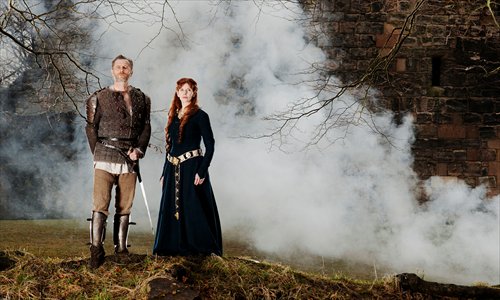
A promotional photo for Dunsinane Photo: Courtesy of Simon Murphy
Although Scotland's Dunsinane Hill plays a central role in Shakespeare's famous play Macbeth, being both the castle from which Macbeth ruled and the place where he met his end, interestingly enough the famous playwright had never actually visited the real life location himself.As a Scotsman, David Greig has driven past Dunsinane Hill four to five times a year since he was a boy. A playwright himself, every time Greig passed the place he couldn't help but wonder what motivated Shakespeare to write about the fall of the king who lived there when he had never actually seen the place with his own eyes. Add to that the fact that he felt that Shakespeare ended the play when it was reaching its most interesting point, Greig couldn't help but ask himself: "What happened next?"
This question haunted Greig for years, especially after he got to know the real history of Macbeth, which is actually very different from what Shakespeare wrote in his play.
"Macbeth was certainly a strong king - maybe the strongest in a time of warlords and barons - but there is no evidence he was a tyrant," Greig wrote in an e-mail interview with the Global Times.
Response to a question
Several years ago, Greig created a new play, Dunsinane, which, in his own words, was his attempt to answer the question that had plagued his imagination.
A co-production between the Royal Shakespeare Company and the National Theatre of Scotland (NTS), this play premiered at the Hampstead Theatre in London in 2010.
"It is not a sequel to Shakespeare's Macbeth, but a response," Greig emphasized. "I want to tell people a new story that stands alone. People don't even need to know Shakespeare's Macbeth exists to enjoy my play since I never even mention his name."
As part of celebrations of the forthcoming 450th anniversary of Shakespeare's birth, Dunsinane will be coming to China.
This Tuesday and Wednesday night, the play will be performed at the National Centre for the Performing Arts in Beijing, and then in Shanghai for another two nights on Saturday and Sunday at the Shanghai Grand Theatre.
In Dunsinane, Lady Macbeth, now known as Gruach, is alive and still casting her covetous eyes on the throne of King Malcolm. While Siward, the commanding officer of the English army who helped Malcolm take the seat of power from Macbeth, becomes the play's new protagonist.
Siward struggles to grasp the alien customs and politics of this harsh country, attempting to restore peace and order. However, he gradually finds himself falling in love with Gruach, while at the same time dealing with a Scottish guerrilla uprising and increasing isolation from his own men. At last, his efforts in restoring peace to a country ravaged by war become futile as the situation spirals out of control.
"He (Siward) is the opposite of Macbeth, although they are both soldiers," Greig told the Global Times. "Through this character, I wanted to explore the impulse to do good. The belief that one can 'sort out' the problems of others. This impulse is noble, but it can also be tremendously destructive, especially when married to force of arms."
According to Greig, in Dunsinane, Gruach's red hair, the Gaelic language that the characters use and even the name of the play itself are all elements that hint towards Siward's incompatibility with an alien culture as an Englishman. "This is also the irresistible force that brings about his failure at last," Greig said.
Refreshing a classic
Greig believes that the dilemma that Siward is caught in is a very common dilemma among modern people: "Do nothing and you allow bloodshed. Do something and you cause more bloodshed."
"Dunsinane is striking to me in how relevant it is to the world we live in," said Wen Shihui, a Chinese associate producer at NTS. It was her efforts that brought Greig's Dunsinane to China this year.
"A world where we all have different ideas as to what peace means. Where good intentions can end up terribly wrong," Wen added.
When Wen was heading to see Dunsinane in Edinburgh back in 2012, she originally thought the play would send her to sleep like so many other historical plays had done in the past.
"However, I was on the edge of my seat the whole time," Wen said. "I was mesmerized by the use of language in the play. Although incredibly modern, some parts of the play still read like poetry and prose."
"The play isn't an adaptation or rewrite of Macbeth, but a new play which makes the audience rethink the history between England and Scotland during the 11th Century."
Wen was also greatly moved by the roles of the young English soldiers in the play. "They were all in their teens, some very young and innocent. However, they had to struggle to make sense of the war they were fighting for, just like soldiers in many of today's wars," Wen said.
Greig admitted that his great interest in today's politics and international issues influenced the creation of Dunsinane. The wars in Afghanistan and Iraq, including the toppling of Saddam Hussein, which, Greig said, echoes Macbeth's fall in Shakespeare's play, were part of Greig's motivation to write Dunsinane.
"In the past, I spent some years working with young writers in the Middle East - Syria, Tunisia, Egypt, Lebanon and Palestine," Greig said. "Visiting those countries and working with young people there, I became very interested in the way power, language and identity worked in between cultures. I think those also influenced Dunsinane."
Posted in: Theater