Enshrined in wax
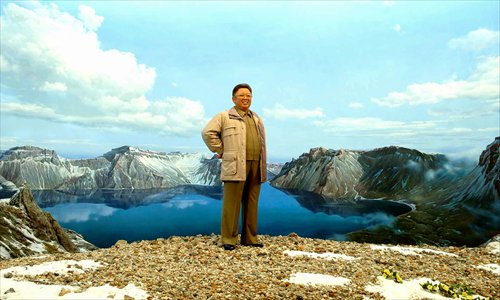
The wax sculpture of Kim Jong-il, finished by Zhang Molei and his team. Photo: IC
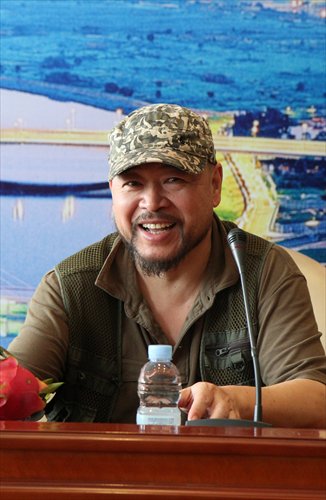
Zhang Molei, director of the Great Man Wax Museum. Photo: CFP

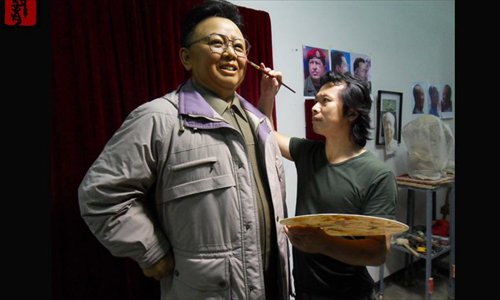
Chinese sculptors making wax sculptures of North Korean leaders. Photos: Courtesy of Jia Wenlong
Zhang Molei's eyes twinkled when he recalled the warm welcome he got from the North Korean government as he escorted the wax statue of Kim Jong-il, the late top leader of North Korea, to Pyongyang.
"They asked what they could do to show their deep gratitude. I said I wished to take a tour in Mount Kumgang. They satisfied me and brought me into a military zone and I tasted really good seafood, which is a rarity there," Zhang, director of the Great Man Wax Museum of China in Beijing, told the Global Times.
It was not the first time Zhang has been welcomed by the North Korean government. In 1994 Zhang and his colleagues began to shoulder the secret responsibility of creating wax sculptures for top North Korean leaders. Each time they delivered another creation, the wax sculptures received warm welcomes in Pyongyang.
On April 8, the hall with Kim Jong-il's wax figure, shown as part of Pyongyang's International Friendship Exhibition, opened to the public, according to the official Korean Central News Agency. The wax sculptures of Kim Il-sung, his wife Kim Jong-suk and son Kim Jong-il, were all made by Zhang and his team.
Zhang remains the only foreigner to be given the award "People's Artist" by the North Korean government.
Things haven't always been so rosy for Zhang's career in wax. In the past, the Chinese people had such powerful reverence for their leaders it bordered on worship. But as this reverence waned, so too did the commercialization of their wax figures.
Now, Zhang has been planning to commercialize the museum by developing celebrity wax sculptures instead of the great men.
Cooperation with North Korea
Zhang has long been aware that building a wax museum is a political task. When talking about the origins of setting up China's first wax museum, he said it was because "the western wax sculptors tended to deface Chinese leaders in the 1980s."
Zhang recalled that when he visited Madame Tussauds in the 1990s, he was angry when he saw the wax sculptures of the great men. "They intentionally defaced their image," Zhang said.
After returning home, Zhang began to apply to launch China's own wax museum for political leaders. It took him six years to realize it. Opening such a museum required different levels of government departments' examination and approval.
"Each time, we had to apply to the upper level of the government if we wanted to recruit one more staff member. We spent too much time involved in politics," Zhang said.
Zhang and his colleagues set up the museum in 1993 and since then have made 10 wax figures of China's top leaders, including Mao Zedong, Deng Xiaoping and Zhou Enlai. In 1999, the museum opened to the public.
These wax sculptures were warmly welcomed by the public. In 1994, Chu Chang-jun, the then North Korean ambassador to China, mentioned many times that North Koreans missed the late leader Kim Il-sung and said it would be a blessing if there was a wax figure to commemorate the deceased leader.
Zhang agreed to help. He soon wrote a letter to the then top leader of North Korea, Kim Jong-il, offering to present North Koreans with a wax figure of Kim Il-sung as a gift.
Kim Jong-il agreed.
This was the first time the wax museum made a wax figure for a foreign leader.
The North Koreans had strict requirements regarding the quality and the production of the wax figure. They had also dispatched two renowned North Korean wax artists to China to assist and supervise the process.
Disputes broke out occasionally. This kind of cooperation was always likely to face challenges.
"We insisted that the wax sculpture should be life-size, but they insisted that the image of their leader should be taller," Zhang said.
North Korea wanted to set the height at 189 centimeters, 12 centimeters higher than Kim's actual height, while Chinese artists insisted to set the height at 185 centimeters, to make it much closer to the actual height.
"At last, we surrendered. After all, they were our customers," Er Baorui, the wax sculptor who was in charge of the creation of Kim Il-sung's sculpture, told the Southern Weekly.
In fact, Zhang and his team members had to compromise most of the time.
When Er glanced over the draft of the wax, he realized there needed to be some improvements, however, he was told not to make any changes, because "North Korea's top leader had already approved the plan and no one was allowed to make any modification."
Zhang was also impressed by the rigor of the North Korean artists. They would report any modification to the government, even minor clothing changes. "We used to do so when Chairman Mao ruled the country, but now, we seldom follow suit," Zhang said.
Sacred delivery
In 1996, on the two-year anniversary of the death of Kim Il-sung, Zhang, Er and other sculptors escorted the train that transported the wax figure to Pyongyang. Zhang remembers the train stopped at every station to let in local officials to pay tribute by presenting flower bouquets.
In Pyongyang, where the wax statue was settled, more than 1,000 government officials and military officiers came to worship the late leader who ruled the country for decades. They all cried to the point of collapse. "The sound of weeping was like the sea roaring," Zhang said.
The Chinese artists were each rewarded with a Swiss watch, Japanese audio equipment and porcelain as gifts.
In Pyongyang, due to their outstanding work, Zhang and his fellows were welcomed. Er was even invited by the North Korean government to settle down in Pyongyang with his family.
Orders came from North Korea again and again. When Zhang was in Pyongyang, a high-profile official approached Zhang and said "it would be perfect if you made a wax sculpture for general Kim Il-sung's wife, Kim Jong-suk."
In 2011, Zhang wrote a letter to Kim Jong-il, suggesting making a wax sculpture for Kim's family to commemorate the 100 year anniversary of the birth of Kim Il-sung.
"It must be a great comfort if we do so" to reunite the family, he wrote.
Kim Jong-il half-consented on the proposal. He responded, saying Zhang should make wax sculptures of his parents only.
But this was no easy task, since there were no photos or images of Kim Jong-suk.
In the spring of 2011, two North Korean artists were dispatched to work with Jia Wenlong, the creator of the family sculpture. They stayed in a workshop in Songzhuang painters' village in Tongzhou district for over seven months.
The two North Koreans would arrive in the workshop punctually at 9 am and worked all through the day. They would take photos from many angles and send back photos to Pyongyang via the North Korean embassy when the critical phase of the sculpture was pushed forward.
Jia was impressed by the strong discipline and teamwork of the North Korean artists.
"They would discuss the length of the wax again and again, and even a little change would have to be discussed and approved by the upper-level government," he said.
On December 16, 2011, Kim Jong-suk's wax sculpture was handed over to Pyongyang from Beijing. One day later, Kim Jong-il died and the new leader Kim Jong-un, son of Kim Jong-il, came into power.
Kim's death brought in new business for Zhang - North Korea wanted to make a wax sculpture for the deceased leader.
This time, Chinese and North Korean artists had longtime disputes over which photo should be used as the model picture.
"Kim Jong-il was seriously ill due to a massive stroke in his last days, which made him look awful. But we had to show his kindness and wisdom rather than the illness," Jia said.
At last, both sides agreed to use the photo displayed on the memorial service.
Kim Jong-un paid huge attention to detail. He even checked the teeth, neck and hair of the sculpture. North Korea sent over 100 photos to make sure the wax statue was perfect. A full set of shoes, glasses, an overcoat as well as other clothes were provided and transported by the North Koreans.
Demanding clients
Zhang admits that the North Korean worship of political leaders added great pressure for Chinese artists and they had to try their best to perfect the wax statues.
"It is believed that creating the wax sculptures of the great men is similar to making a statue for God. We have to show our awe," Jia said, adding that it was "torture" to create the artwork.
"Some of my North Korean friends told me that they don't regard the sculpture as a work of art. Instead, they believe the statues are the embodiment of their leaders," Zhang said at a kick-off ceremony celebrating the unveiling of the statue of Kim Jong-il.
North Koreans had many ways of demonstrating this "awe." When the statue was transported to Pyongyang, North Korea demanded that the statue had to stand while being transported and people who escorted the statue had to wear black suits and white gloves.
On July 9, 2013, the official ceremony was held in Beijing to celebrate China presenting North Korea with the wax sculpture of Kim Jong-il. Officials from the International Department of the Central Committee of the Communist Party of China and staff members from Great Man Wax Museum attended the event.
Despite warm welcomes from North Korea, for Zhang, the most important task is keeping the museum alive. In contrast to the burning enthusiasm he has when recalling the good old days in the 1990s, Zhang's eyes turned dark when referring to the current operation of the business.
"We made a large number of wax sculptures of political leaders, which was time-consuming. In the future, we plan to make was statues for celebrities and stars," Zhang said.
The model sample would be Madame Tussauds, he noted.
Newspaper headline: Chinese sculptors hope N.Korea's orders for leaders' waxworks will save business