School scam
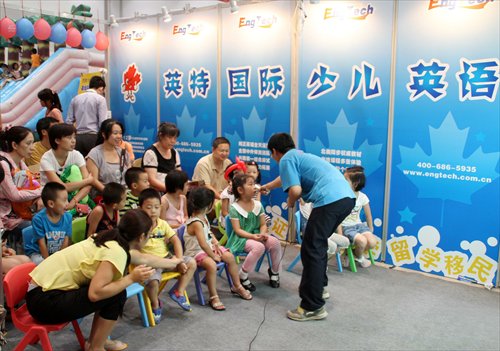
Children and parents participate in activities held by EngTech during an education exhibition. Photo: CFP
Parents whose children go to a Beijing-based English training school got a shock recently when they received a message from teachers saying that the school had no money to continue operating, and that the president had fled.
EngTech International Education Group, which has 18 teaching centers around Beijing, closed its doors and suspended all classes on April 27. This was a major worry for the parents, as they had all paid the tuition fees in advance.
One mother, surnamed Yang, paid 60,000 yuan ($9,588) for some five years for her daughter to learn English at EngTech's branch in Zhongguancun, a technology hub in Beijing's Haidian district.
"Including me, there are over 1,000 households in the district suffering huge losses due to the sudden closure," Yang told the Global Times. She and other parents immediately called local police.
Fortunately, the suspension only lasted for one day, as another English training school, Beijing Juzhitang Education, pledged to take on EngTech's liabilities and keep it running.
However, the temporary closure has refocused public attention on problems and risks in China's English training market.
Boss on the run
Liu Chao, general manager of EngTech, is still trying to contact the company's Chinese-Canadian founder, Qu Wei.
Qu was engaged in financial investment in Hong Kong in the 1990s, according to media reports. After returning to the mainland, she set up EngTech in September 2001, aiming at teaching English to kids aged from 3 to 12, using innovative and creative methods such as games.
"Qu invested in EngTech for years, mainly relying on her husband's money to further the school's expansion. But since last year, the company has been losing money. Qu's husband then cut off the financial support," Liu told the Global Times Sunday.
He noted that as China's private educational institutions do not get government support, they mainly rely on their founders' investment and tuition fees.
But Qu appeared determined to keep the school going. She told staff on April 25 that she had talked with some Hong Kong-based investment companies to seek funds and she promised the staff their salaries would be paid. But after that she disappeared and no one has been able to contact her.
Revenue of about 700,000 yuan for nearly two months since March was not deposited into the company's bank account, which records a deficit currently, said Liu.
Meanwhile, Beijing Juzhitang Education has pledged to take on EngTech's liabilities, including rents and salaries, which will involve an investment of some 20 million yuan, he noted.
But the school does not intend to offer a refund to parents whose faith in EngTech has been weakened by the suspension, according to Yang.
EngTech is not the only private English training school in China whose founder has fled.
Parents reportedly gathered in front of an English training center in Nanjing, East China's Jiangsu Province in June 2013, after the school closed and the founder disappeared with some 5 million yuan in tuition fees.
Chaotic market
Liu attributed the shutdown to the school's declining fortunes.
"The company could hardly make ends meet in recent years amid rapid expansion, and performance was flat because of increasingly heated competition," he explained.
By September 2013, there were thousands of English training centers for children operating in China, according to a report by US-based Huidian Research in September last year.
English education in China has long been a promising and attractive market, partly because Chinese parents are eager to give their children an advantage.
Data from Huidian showed that as of September, 200 million children were learning English in China, nearly 40 percent of whom were attending English training schools.
Chinese parents' investment in their children's English education will continue increasing, Yun Guanqiu, founder of Beijing-based Talenty International Education Co, told the Global Times Sunday.
The next decade is expected to be a golden period for the development of the children's English training market in China, with an annual growth rate of over 20 percent, said Huidian.
A report last December by news portal edu.ifeng.com estimated that the domestic children's English training market would be worth 24.5 billion yuan in 2013.
But Liu noted that owing to fast growth and a lack of supervision, the market has become disorderly.
There are many agencies offering discounts to parents if they prepay for years of tuition, and parents are often willing to pay, despite the risks involved if the school suddenly closes, Yun noted, adding that some of these schools are in fact deliberately fraudulent operations.
Regulation needed
"The absence of sufficient regulation and lack of a mature charging mechanism have become major barriers for the healthy development of the sector," said Liu.
Another problem is that it is difficult for parents who have been cheated to seek compensation through legal avenues.
Yang said she has little hope the public authorities will be able to retrieve the money at EngTech.
She said the head of the Zhongguancun police station in Haidian district told her it was difficult to investigate the case as it could not be proved that fraud had taken place.
Given these problems, some local governments have begun efforts to create stronger regulations and offer more protection for parents.
In February, the local government of Xining, capital of Northwest China's Qinghai Province, announced a new deposit system, requiring private education institutions to pay a certain amount of money when registering in order to guard against sudden closures of schools.
Liu said the central government could roll out some unified standards and detailed rules to improve control of the private education industry. He suggested a maximum prepayment period of six years.
Yun said that one-year prepayment of tuition fees would be reasonable, as it would be enough for schools to run and would curb the risk for parents.
While government supervision is essential, parents should also be more cautious, and stay away from schools requiring years of tuition to be paid for in advance, said Yun.