Volcanic beaches of Lanzarote
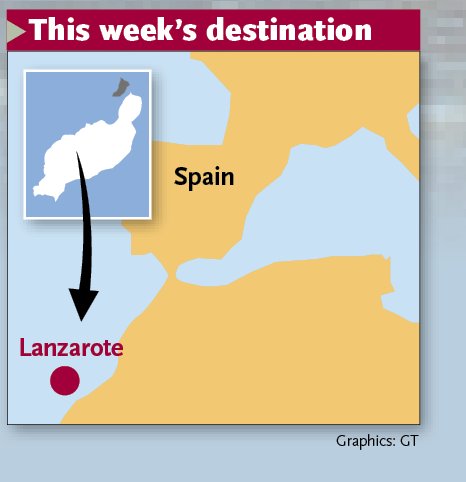
This week's destination
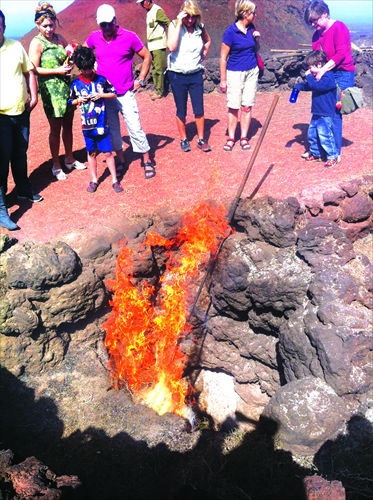
Brushwood in a hole is being ignited by underground heat in the Timanfaya National Park. Photo: Emma Jiang
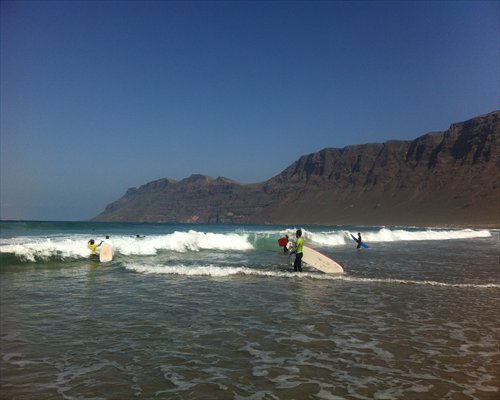
Famara beach on the northwest coastline is famous for its national park.Photo: Emma Jiang
After enduring a drenched winter in the Netherlands, I had been starved of sunlight and craving affordable beach getaways since the beginning of the year.
While it was far too expensive to fly to the bakingly hot tropical beaches in Southeast Asia during the festive season, I had been postponing my holiday, mulling cheaper beach destinations around Europe. The Spanish island of Lanzarote did not come to my mind until I got an email from a friend who recently relocated from Beijing to its capital city of Arrecife.
"Try the beach life here. It's the only place in Europe where you can get sun and beach around this time of a year," said my friend in the email, extending his warm invitation. With that, I was sold on Lanzarote. One week later, I found myself flying with scores of holiday-making elderly on the plane departing Amsterdam's Schipol Airport.
Lanzarote, which means red mountains due to its volcanic origins, as I quickly learned from my friend, is not the typical green island that is at the top of the list for many holiday makers. The fourth largest island of the seven Canary Islands off Africa's northwestern coast, Lanzarote features dramatic volcanic landscapes, rocky bleak fields and atmospheric beaches. During the 10-minute drive from the airport to Arrecife, where my friend lives, I got my first glimpse of the typical landscapes there, interspersed with white and block like houses sparsely dotted in the fields.
It became clear that the local authorities have been putting a lot of effort into developing the island into an upmarket holiday destination. High-rise buildings and roadside advertising billboards are prohibited on the island, and the rampant development to cater growing number of tourists has been halted. These efforts have helped the popular tourist resort preserve its original idyllic rural scenery and architecture, while the place sees teeming numbers of tourists all year around thanks to the pleasant average temperature of 20 degrees.
Although a large area of the island is covered with volcanic landscapes, my friend guaranteed that I would find the place as relaxing, fun and exciting as any other beach destinations with its numerous beaches, holiday resorts, original fishing villages, vineyards, caves, museums and numerous other attractions. Therefore, my mission in the following four days was first to decide my favorite beach out of the 90 beaches there, then visit the volcanic landscapes and explore the less touristy attractions on the island.
Finding my own beach
Blessed with a coastline of about 200 kilometers, Lanzarote harbors a large number of beaches with fine white or black sand, the latter being the aftermath of volcanic eruptions. Though the coastline is interrupted by sand and rocky coastlines, the beaches, or playa in Spanish, are located close to each other, and are frequented by locals and tourists who swim, surf and windsurf.
My beach exploration started with the beaches in the most touristy town of Puerto del Carmen, a 15 minute drive southeast from Arrecife. Blessed with calm waters and white sand, the former fishing village is now home to various bars, restaurants, shops and night clubs. Playa Grande, one of the three adjacent beaches of the holiday hub, is at its best in the morning before it is teeming with screaming and running children. Following a long walk on the beach and encountering a few topless 50-year-olds, I opted to spend my afternoon elsewhere.
With a rented car, we then drove through the center of the island, all the way up to its northwest coast, where the famous surfing beach Caleta de Famara is located. Separated from any holiday resort, the long beach of sand and dunes had no madding crowds except for a few joggers and sunbathers. Surrounded by huge grayish cliffs on one side, the curving bay has an enticing charm due to its grandeur, which is strengthened by the lashing waves. Scattered with pebble stones, the beach is not the ideal place to lie on and doze off in the afternoon. But a dozen of amateur wave surfers, including a teenager girl, who were battling against the strong currents, attracted me to stay.
A few beginners, in tight full-body swimming suits, were making efforts to catch the broken white water waves in the shallow water. More skilled ones were paddling straight into the lineup and picking up unbroken waves while trying to stand up on their surfboards. The teenage girl, under the instruction of a coach, seemed to enjoy riding the broken waves even though she was being washed to the shore after a very short ride. It was my first close study of surfers, and I was amazed how the sea could challenge human beings and how, in turn, human beings enjoyed the challenges.
With a quick look around, I also spotted a few shallow circular hollows, curved by black rocks up on the dunes. The hollows serve as perfect shields from the wind for the sunbathers when the wind gets strong. Later I found the delicate structure is not merely for tourists, but more importantly to provide shelter for cultivating vines in the island's La Geria region or the other few crops that the locals grow. It is another battle between Mother Nature and human beings.
After spending the afternoon on Famara, or the "hot surfers" beach as we nicknamed it, we drove back to Arrecife for dinner. Inhabited by almost half of the population on the island, the capital city is less touristy. The biggest beach El Reducto with golden sand and calm waters is more frequented by local families and children. The typical scenes in the late afternoon would be a local artist sitting carefree next to his sand sculptures of castles, chatting and laughing with his friends, and children running hilariously on the beach, chasing pigeons. Stretching for about 500 meters, the palm trees, the stone San Gabriel Castle and a drawbridge and the cobbled road on its east side formed a tranquil image against the sunset.
Though there are more beaches to visit, after the day exploration, I knew that Famara beach was the one I would be going back to over the next two days. Watching how the surfers battled against the slapping waves gave me a feeling of calmness and courage against challenges.
Volcanic origins
A visit to Lanzarote is incomplete without a visit to its numerous volcanoes and a dose of its volcanic history. The most recent eruption was in the early 18th century, and the eruption, which lasted for six years, solidified lava flows and rock formations. Now the area on the island's western coast has been designated as the Timanfaya National Park, covering vast areas of volcano and lava fields.
Driving to the foot of the national park, we boarded a coach which took the visitors to the dormant fiery mountains for a tour. The coach broadcast guides in a few languages including English and Spanish and stopped at the significant sites so visitors could have a close look at the rock formations.
Although the island looks bleak in a lot of areas, the volcanic ground is actually very colorful, varying from red to orange, yellow, brown and black. Interestingly, the island's unique landscape, which resembles the lunar landscape, has also been featured in a few movies, including the 1966 fantasy One Million Years BC.
Despite the fact the mountains have been inactive for centuries; heat can still be generated from the ground. A staff worker from the park pushed some brushwood into a hole and showed how it could be ignited by the heat from the ground. The fine restaurant, El Diablo, or the Devil, which is seated on a volcano and overlooks the park, uses the remaining heat to cook traditional Canarian barbecues on a sizeable oven. The oven itself has become a must-see attraction.
Seeing Lanzarote's natural high
Besides the beaches and volcanoes, Lanzarote has many more diverse sights to offer. Thanks to the campaigns of local artists like César Manrique, the island has been able to maintain its original fishing village houses while adding a few stylish, modern and tourist friendly designs onto its landscape. To make the most of my last day there, my friend drove me through the island's villages, up to its highest northern viewpoint to have a bird's eye view of its marvelous landscape.
Driving along the coast to the north, the landscape changed and within less than an hour, we were away from the barren fields, surrounded with lush greenery. While most houses around Arrecife are painted entirely white, a lot of window frames of the houses in the countryside are green. I was then told that green frames mean they are for farmers, as local tradition indicates, and blue are for fishermen.
After one-and-half-hour's drive, we arrived at Mirador del Rio, a 500-meter-high viewpoint on a cliff, overlooking the northern coastline. The tourist center, which looks rocky from outside and is accessed via a hole-shaped entrance, is indeed a stylish and spacious restaurant designed by Manrique. A narrow and spiral corridor leads visitors to a souvenir shop on the second floor, and then a platform outside which is seated on a lava rock and gives a stunning view of the straits of El Rio.
We were lucky to be blessed with clear weather that day, and from the platform, we got a significant view of the straits, the Graciosa island and a few more inhabited islands. While cargo ships were steering along the straits, the small islands seemed remote, inaccessible and alien. That is probably why the BBC television series Doctor Who chose the setting for the episode Planet of Fire due its alien plants and culture, as my friend and I agreed later on.
Rules of thumb
When to go: The average temperature on Lanzarote is 22 degrees, and in summer it is around 30, which makes it ideal all year round. But during summer, especially July to September, it can be extremely busy.
How to get there: The Arrecife airport is the only airport on the island. The most convenient way is via connecting flights from major European airports such as Madrid or Amsterdam.
Where to stay: Lanzarote offers a variety of accommodation from hostels, to bungalows, apartments and villas. Popular tourist websites lanzarote.com and discoverlanzarote.com, have a wide range of selections.
How to get around: Public transport is easily accessible. Cars can be rented from firms including Cabrera Medina (cabreramedina.com) and Autos Feber (autosfeber.es).
Newspaper headline: Alien landscapes surrounded by gorgeous shores tempt tourists