Following Van Gogh in Auvers-sur-Oise
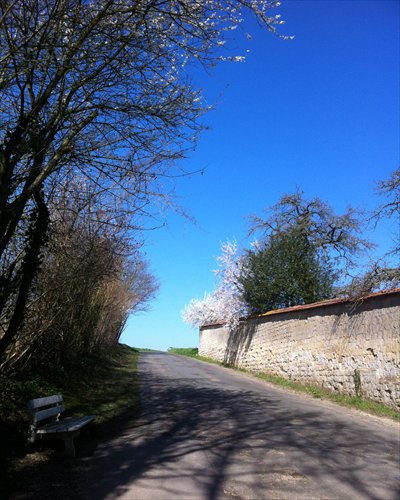
An idyllic country scene of Auvers-sur-Oise Photo: Emma Jiang
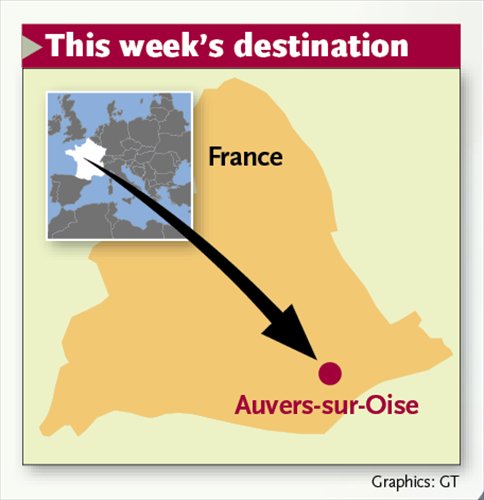
This week's destination
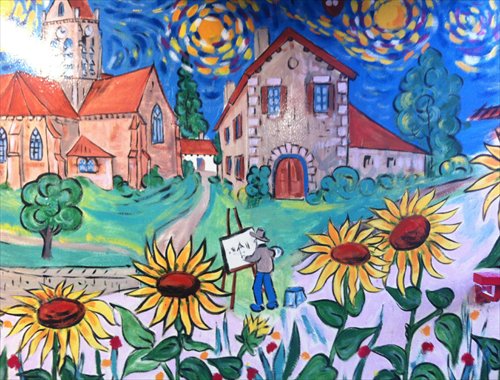
The mural at the tunnel featuring Van Gogh Photo: Emma Jiang
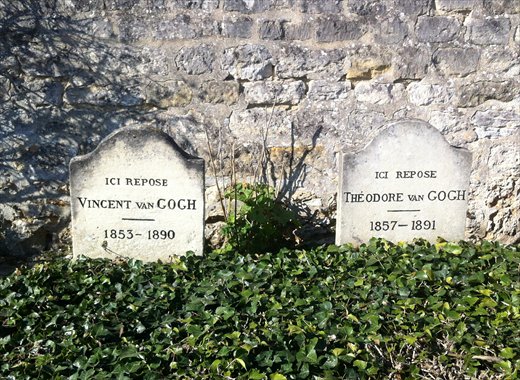
The twin graves of Vincent and Theo Photo: Emma Jiang
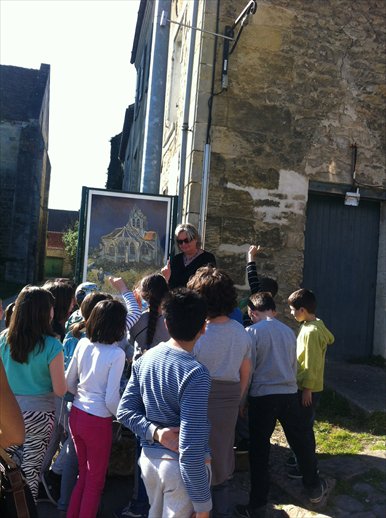
An art teacher explains The Church at Auvers. Photo: Emma Jiang
First time visitors to Paris tend to be fascinated by its spectacular beauty and elegance, complemented with the magnificent Eiffel Tower, alluring flowing waters of the Seine and the many lovely and hidden bistros. I was no exception during my visit to the "city of love". Yet after three days of rushing around, including contending with the madding crowds at the artistic community of Montmartre, I was getting fatigued with the overwhelming charm and definitely craving alternative destinations.
"Is there any place outside Paris we could go which would give us some calmness yet is complementary to the city's charm?" I asked my friend, who relocated to Paris from southern France over a year ago. "Here, Auvers-sur-Oise. It is the place where Vincent Van Gogh last stayed and was buried," she said, pointing at a spot northwest of the city center on the handy map I had gotten from one metro station for free. Though I had had good exposure to Van Gogh's life and works following my visit to the Van Gogh Museum in Amsterdam, I was not aware his last resting place is in suburban Paris.
"It is a pretty village which has changed little since Van Gogh's time and itself is like a big museum," said my friend who visited in November. "It teems with visitors in summer, but I'm sure it is an oasis of calmness at this time of year. You should go," she said. Off we went the next day, following one hour train from the center of Paris.
Tragic stay
As we got off the train we crossed a tunnel to get to the village. The tunnel itself was a landscape, as it is painted in murals with bright colors and delightful images of sunflowers, wheat fields and Van Gogh at work in the open area.
Van Gogh, the great post-Impressionist painter, would have turned 161 this March. He moved to the rural village in May, 1890 after his release from a French asylum and stayed there for about 70 days before he committed suicide. Despite his short stay in the village, he was extremely productive and painted about 70 paintings inspired by the idyllic countryside. However, the beautiful surroundings failed to sway his dark side and he shot himself in the chest in the field and died two days later of infection at the Auberge Ravoux Inn on July 29, 1890.
In celebration of the painter and a few artists who also lived there including Paul Cézanne and Charles-François Daubigny, months of festivals and cultural activities have been planned for this year, including the "From Impressionism to Street Art" exhibition, and that of "Artists' Letters - Correspondence between Vincent van Gogh and his intimates."
The tourist season from April to October has yet to come, and we found ourselves lucky to be almost the only visitors that day.
Though my friend had no problem finding the spots that are most related to Van Gogh, she insisted we visit the tourist office first. The office, about an eight-minute walk from the train station, offers free maps of walking tours. The map highlights the locations in the village and neighboring Pontoise painted by Van Gogh and other artists. There is a signpost with a copy of the original work at the location. By following them we can see and compare the original places and the ones interpreted by the artists on canvas.
Life at the inn
Before we went to see the sites, we made a turn back to the road we passed by and paid a visit to the Auberge Ravoux Inn where Van Gogh spent his last days. The 19th century inn, renamed Le Maison de Van Gogh (the House of Van Gogh) has been kept as a museum as the artist's last residence. His room, Room No. 5, sits on the second floor and now has just a chair. Lit by a small skylight, the room is almost featureless and it is so small that it only allows a few visitors at a time. In the attic a short video of "On the Van Gogh Trail" about Van Gogh's stay in the village is on shown, based on a collection of his paintings, letters and photographs.
Downstairs is a restaurant which serves dishes from Van Gogh's time. It is now equipped with Van Gogh memorabilia and vintage items like the table he used to dine on, and the namesake cook book co-written by an art and food historian, focusing on the cuisine at the Inn. The popular dishes from Van Gogh's time such as the Ravoux style lamb with potatoes, beef cheeks with a Bourguignonne sauce and warm tarte Tatin with heavy cream are still on offer, but they are costly given a three-course dinner is priced at 38 euros (about $53).
Since Van Gogh moved here, he ate almost all his meals at the restaurant and befriended the family running the inn. Adeline Ravoux, the eldest daughter of the inn's owner Arthur Ravoux, has recounted her and her family's memory of the painter to journalists and authors many times. As the model in the Portrait of Adeline Ravoux, she fondly remembered Van Gogh as a gentle and calm person though not very communicative.
Despite Van Gogh's posthumous fame, the room had never been rented out since his death as it got a reputation as a "room of death."
Signposts
Following the free map, we went on to check the immortal spots on Van Gogh's canvas. In the center of the village, after every few steps, we encountered a signpost accompanied by the name of the painting and a few words from the artist. For The Village Street and Steps in Auvers with Figures, an idyllic country scene of a narrow street, stone walls and a hillside juxtaposed with walking figures, the artist commented "People are to paint than things." ("Les gens, cela vaut mieux que les choses.")
On way to the Place de l'Eglise church, which is the prototype of the famous painting The Church at Auvers, we ran into a group of pupils from the local primary school who were having art lessons in the open. With exchanges of smiles and nodding with their teacher, we knew we were allowed to follow her class, which provided us with extra information.
It is clear from his paintings that part of Van Gogh's genius is his ability to transform bleak and dull objects into life-like colorful images. Under Van Gogh's brushes, the 13th century Gothic structure of solid grey stones on canvas embodies his expressionist take and displays flamboyant colors and liveliness with the church against the deep blue sky, blooming green plants and winding paths with golden sand.
Passing by the vast wheat field which Van Gogh painted as one of his last works, Wheat Field with Crows, we queued up with the pupils to enter the cemetery where Van Gogh and his younger brother Theo rest.
In contrast to a lot other graves decorated with delicate tombstones and epitaphs on them, the graves of Van Gogh and his brother are rather humble. Covered with ivy leaves, the twin tombstones simply read "ICI Repose Vincent van Gogh 1853-1890" and "ICI Repose Theodore van Gogh 1857-1891" ("ICI Repose" means "here rest" in English). Theo had been supporting Vincent financially and emotionally and died one year later partly because of the pain from Vincent's death.
Before they paid their one minute silent tribute to the brothers, the teacher asked the pupils to recite a poem they recently learned. With the help of my friend, I was able to grasp the meaning of the most touching lines of the poem, and I believe there was no other better lines to dedicate to the great artist who rendered beauty in his paintings, and pass on it to us.
Rules of thumb
How to go there: There are direct trains from Paris' Gare du Nord to Auvers-sur-Oise on weekends and public holidays from April until November. A return ticket costs 11.6 euros ($16). (check http://www.transilien.com/ for details.)
Where to stay: An overnight stay at the village is recommended in summer time, and affordable accommodation can be found at http://www.lavalleedeloise.com/. To know more about Van Gogh: A large collection of Van Gogh's works from Auvers-sur-Oise are on display at the Musée d'Orsay in Paris and a visit to the museum is highly recommended.
Festivals: Schedules for the Auvers-sur-Oise Cultural program 2014 can be found at http://www.maisondevangogh.fr/pdf/WEB-AuversPartners-EN.pdf
Newspaper headline: Art history infuses every aspect of idyllic French town