Xiaonanmen station
It's hard to miss the many interesting sites of cultural heritage from the past 200 years dotted around Xiaonanmen Station, which lies on metro Line 9.
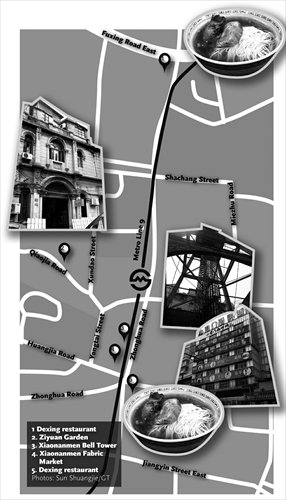
Xiaonanmen Bell Tower
To the north of the station is Shiliupu - which covers roughly the area bounded by the Huangpu River, Zhonghua Road and Renmin Road - which was once one of the most significant economic centers of the city as it served as an important port from the early 19th century until the 1980s.
To the south of the station is Dongjiadu, which neighbors the south Bund to the west, where once dwelled numerous tailors that offered everything from the classic qipao to the most fashionable outfit featured in the latest magazines.
Although the two areas have lost their prevailing economic influence, a number of historical sites remain that are still worth visiting, where glimpses of old Shanghai can still be caught.
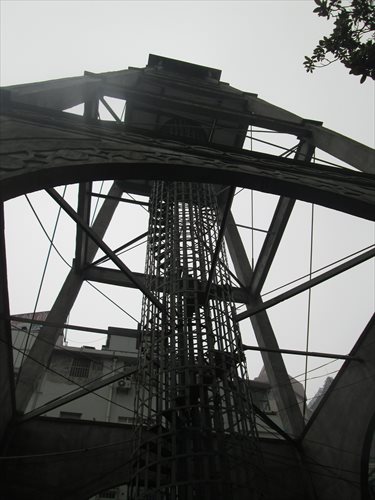
Xiaonanmen Bell Tower
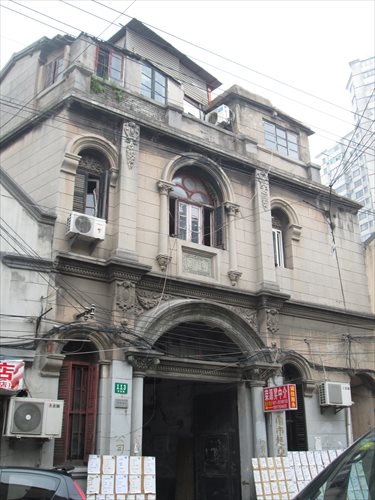
Ziyuan Garden
While Shanghai Tower has taken the crown as Shanghai's tallest building at the lofty height of 632 meters, about 100 years ago, Xiaonanmen Bell Tower (581 Zhonghua Road) was the tallest building in the city, at 35 meters.
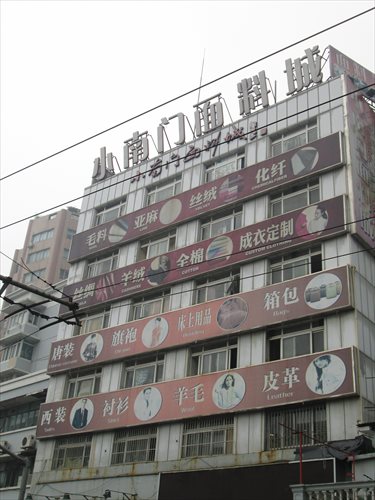
Xiaonanmen Fabric Market
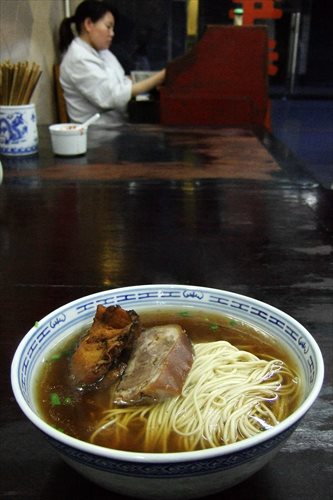
Dexing restaurant
The Bell Tower was built in 1909 by the city's firefighters' association. Its height allowed them to monitor any part of the downtown area, and whenever a fire was noticed, a guard would ring the bell to alert the firefighters.
The steel-and-concrete tower, which features a giant arch at the bottom, even won itself the nickname of "Eiffel Tower in Shanghai."
It also served as a signal tower during the Revolution of 1911, when revolutionaries tolled the bell to call on the local business association and armed forces to start the uprising in Shanghai against the Qing Dynasty (1644-1911) emperor.
The building was officially recognized as a piece of heritage architecture in 2005. Although surrounded by modern residences and a government office, the tower is listed for preservation.
Qiaojia Road
Named after a military official during the Ming Dynasty (1368-1644) surnamed Qiao, Qiaojia Road, which lies in the west of Xiaonanmen Station, also offers a cluster of memorable stories.
Ziyuan Garden (113 Qiaojia Road) is a typical example of the residential buildings of the upper classes of the Qing Dynasty. Visitors can see the Western-style gate, around which is carved Roman-style edging columns as well as floral pattern reliefs.
Below the window of the second floor is engraved the name of the house, based on the calligraphy of celebrated ink artist Wu Changshuo (1844-1927).
When Albert Einstein and his wife paid their first visit to Shanghai in 1922, they were invited to Ziyuan Garden by Wang Yiting, who was an influential entrepreneur and a talented ink artist, and joined a dinner with local celebrities in the fields of education and publishing.
Now, like some other old buildings in downtown Shanghai, the main building, which features a fusion of Chinese and Western styles, is home to a number of local families. However, through the intricate details, visitors can still appreciate the elegance of the original architecture.
Tailor-made
Located on Zhonghua Road near Dongjiadu Road, Xiaonanmen Fabric Market (587 Zhonghua Road) trades in all kinds of fabrics such as silk, cotton, wool and linen.
Walking into the market, customers will be surrounded by numerous small booths, all filled with bundles of cloth, as well as examples of ready-to-wear clothes.
Chen Lanhua and her husband have worked in the trade for more than 10 years, and nowadays they mainly deal with customers who want formal outfits such as suits and shirts.
"A ready-to-wear shirt made of good quality cloth usually costs about 500 yuan ($80.9), but here a tailor-made shirt of the same cloth only costs about 200 yuan," said Chen.
Customers can choose the material and patterns from a number of sample brochures. Orders usually take a week to complete.
Besides formal outfits, there are also several tailors catering for more retro looks, including tailor-made qipao and other traditional Chinese formal clothing.
A taste of Shanghai
The life around Xiaonanmen Station is relatively slow and laid-back, with most people roaming in a relaxed manner rather than hurriedly walking. But there are exceptions: the two Dexing restaurants on Zhonghua Road (respectively 297 and 622 Zhonghua Road) attract lines of diners every day, eager to enjoy the delicacies prepared by the time-honored brand.
The history of the restaurant can be traced back to the 1880s, when it only offered a few basic dishes, such as pork braised with soy sauce and sugar as well as tofu soup. Now the menu of Dexing ranges from daily staple foods such as steamed dumplings, wonton and noodles, to signature Shanghai-style dishes, such as deep-fried shrimp, soy sauce eel, stewed pork with soy sauce and Dexing deep-fried stinky tofu.
As the Dragon Boat Festival draws near, the glutinous rice dumplings, whose flavors include sweet date and salty pork, are big favorites among customers at the restaurant.
Editor's note:
This year is the 21st anniversary of the opening of the Shanghai metro. The subway has facilitated more than 13 billion journeys during its 21 years, and half of Shanghai citizens cite the metro as their favored mode of transport. To commemorate the anniversary, each week the Global Times will take an in-depth look at one metro station and its surroundings. In the case of downtown stations, we will focus on points of interest within walking distance; while for suburban areas, we will cast our net a little wider.
Newspaper headline: History and haberdashery in a laid-back locale