The same but different
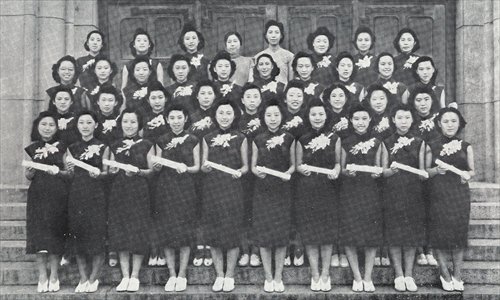
A historic graduation photograph of students wearing qipao. Photo: Courtesy of the Shanghai No.3 Girls' High School
Last month when Jessica Tang posted pictures of herself on some of China's top Internet forums, she jogged the memories of hundreds of older Shanghai folk. Tang appeared in the photos wearing the school uniform she had worn when she went to the Baode Middle School in Shanghai in 1992.
The 32-year-old Shanghai woman, who now lives in New York, had donned her old school uniform. While older people enjoyed the flashbacks many younger viewers and people outside of Shanghai expressed surprise at how fashionable the outfit looked.
"For sure this was why Shanghai was known as China's fashion capital," one respondent (a high school student) wrote. "Even a school uniform made 20 years ago is much better than the thing I have to wear today, an oversized and shapeless tracksuit."
Shanghai's school uniforms go back way beyond 20 years. Some of the Western-style schools which sprang up in the city in the late 19th century introduced uniforms. According to the book Schools and Colleges in Old Shanghai, by Zhuang Zhiling, a researcher at the Shanghai Municipal Archives, wearing school uniforms was originally a must for the Western schools in the concessions, and later uniforms were adopted by some local schools.
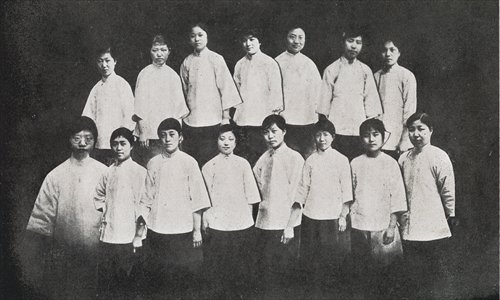
Students wearing gowns and skirts posed for a 1921 graduation photograph. Photo: Courtesy of the Shanghai No.3 Girls' High School
The tunic suit
After the 1911 Revolution, the Chinese tunic suit, the Sun Yat-sen suit, became popular among youngsters in Shanghai for its neatness and militaristic style. In those days several schools told students to wear Sun Yat-sen suits as their uniforms and teenagers wearing these were a common sight on and off campus.
Zhuang's book described how students dressed in the 1920s in Shanghai, the city then known as "the Paris of the Orient." Apart from Sun Yat-sen suits, male students were still fond of the traditional long gowns, and some also liked to wear Western-style suits and leather shoes on weekends.
Female students often wore the graceful and elegant qipao, like the short-sleeved qipao worn by author Eileen Chang in photographs taken of her at St. Mary's Hall where she studied for six years - the pictures appeared in the Shanghai Municipal Archives magazine Memories and Archives earlier this year.
Old pictures of the former McTyeire School, another famous church school in Shanghai and now the Shanghai No.3 Girls' High School, showed students wearing plain qipao as well. "But girls were encouraged to wear any beautiful clothes they liked for festivals," Zhuang said in his book.
The free and easy dress codes came to an end when the city government began stipulating clothing styles for students. The earliest regulation on school uniforms that the Global Times found in the city's archives was made in 1929 and set out the clothing styles for students in some detail. Male students had to wear long gowns and long-sleeved black coats with five buttons, while female students wore long black skirts and a blue 3/4-sleeve blouse with five buttons.
Zhuang noted in his book that in 1934 the government announced new regulations, this time insisting that all students had to wear uniforms supplied by local companies. These regulations were mostly ignored as two-thirds of the city schools did not enforce them after people complained about the costs involved.
In 1941 during World War II, local authorities again tried regulating school uniforms, this time suggesting male and female students should wear long-sleeved T-shirts with boys wearing long trousers and girls knee-length black skirts. The authorities this time suggested that rather than buying these uniforms people should make them themselves.
After the People's Republic of China (PRC) was founded in 1949, a series of major social upheavals shook the country and until the late 1970s school uniforms were rarely seen. In Shanghai, many students wore the green military uniforms of the Red Guards until the Cultural Revolution (1966-76) ended.
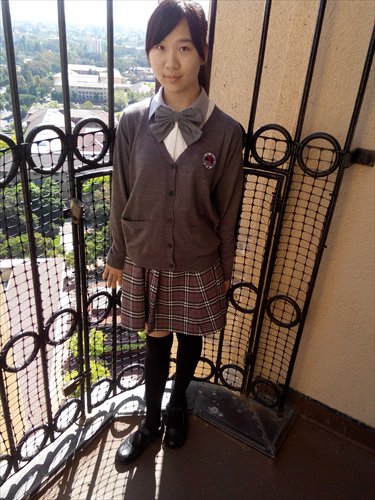
Girls' High School models the new style 2013 uniform. Photo: Courtesy of the Shanghai No.3 Girls' High School
Records destroyed
For most Shanghai people memories of school uniforms go back only to the 1980s. The Shanghai High School is one of the oldest schools in this city. It opened in 1865 but its oldest photograph of students wearing uniforms is a graduation picture taken in 1983. School staff member Gu Yicheng said that the earlier records of the school were missing or had been destroyed during the Cultural Revolution.
In the black-and-white graduation photo, most boys and girls were dressed the same, in trousers and coats with turned-down collars. It's hard to tell the colors of the uniforms but the students could well have been factory workers in this old indistinct picture.
For 60-year-old Shanghai man Xue Yuqin, however, the school uniforms of the 1980s were more than black-and-white memories. "My son's middle school uniform was a bright green and white tracksuit. It made the students look young and lively." Another senior citizen surnamed Ren, 68, though, disliked the school uniforms of that time. "I remember students wearing red or blue tracksuits in those days - they all looked drab."
After the PRC was founded there were no official regulations governing school uniforms until 1992 when the city government decreed that all middle school students in the city should dress alike.
And that's how Tang dressed for the photos she posted. Enrolled at the Baode Middle School in Zhabei district in 1992, she wore a navy blue jacket and an overall. "The puff-sleeve jacket had a white sailor collar and the overall was decorated with golden buttons," she told the Global Times. "They looked really cute.
"In the early 1990s, teenagers dressed in these blue jackets and overalls were seen almost everywhere in the city," she said. At first girls could choose a dress instead of the overall but by 1994, because hardly anyone chose this option, the dress was withdrawn. "Girls of that time were conservative," she said.
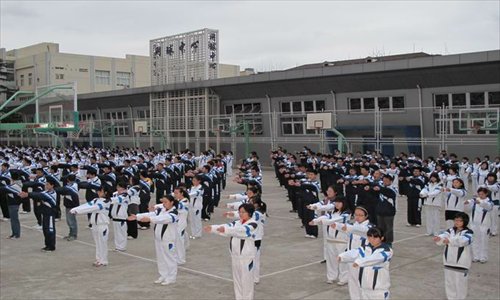
Students in tracksuits, the standard city school uniform today Photo: Courtesy of the Shanghai High School
Eight years unchanged
School uniforms changed again in the beginning of the 21st century when Shanghai schools could choose their own uniforms. Since 2006 the Shanghai High School uniform has remained the same, with students wearing white shirts with blue tracksuits bearing the school's name and logo.
Nowadays, more than half of the city's schools have a similar uniform. When it was discovered that the older overall uniform was not appropriate for exercising in, most schools adopted tracksuits. Although tracksuits have become the standard uniform in the city few students seem to like wearing them.
Middle school student Gao Mingjun, 13, hates the drab grey tracksuit he has to wear to classes in Changning district. He bought this tracksuit last September along with a thick black overcoat which serves as his winter uniform. "I think this uniform is really ugly," he said. He would prefer the white shirt and tie school uniform styles he sees in Japanese comic books.
To accommodate the fact that these teenagers are growing almost all the tracksuit uniforms are on the large, loose-fitting side. Only a couple of the students the Global Times talked to liked wearing them.
While most schools choose tracksuits as uniforms, a few have chosen Western-style uniforms. Zhou Dongming, the general manager of the Shanghai Dongming Clothing Company, which makes uniforms for city schools, said he had received orders recently that involved suits and pleated skirts.
Perhaps after a century, the free and diverse approach to school wear of the 1920s has returned and uniform styles will become more varied. But those old Sun Yat-sen suits, gowns and qipao faded away as well. The famous church schools, St. Mary's Hall and the McTyeire School, were amalgamated into the government-administrated Shanghai No.3 Girls' High School in 1952. Nowadays its students no longer wear qipao but can be seen in neat light green shirts and short grey skirts.
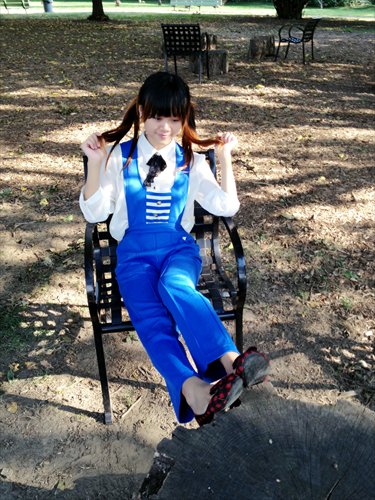
Jessica Tang, 32, wears her much- loved Shanghai school uniform. Photo: Courtesy of Jessica Tang
Formal policy
Last year, the city's education bureau announced its school uniform policy. According to this whether students have to wear uniforms or not, and the styles, material, colors and prices should be discussed by both school staff and parents.
But all the students that the Global Times talked to said that their schools had never approached parents about uniforms. A city school uniform supplier, the Jinhuoye Clothing Company, confirmed that uniform styles were usually decided by one or two school staff members. "We provide several samples and they select one," a company employee said.
The mother of a third year student at Shanghai Xijiao School said that she paid more than 700 yuan ($112) for her son's four sets of uniforms. The boy doesn't like the uniforms, but his mother, surnamed Wu, thinks the clothes aren't too bad.
"And they are not expensive," Wu said. She doesn't have to buy a lot of extra clothes for her boy because he wears a uniform five days a week. She thinks uniforms save her money and because everyone is dressed similarly, no one at the school has to try to "keep up with the Joneses."
Quality concerns
But many parents are concerned about the quality of the uniforms. Last year a storm erupted when the Shanghai Municipal Bureau of Quality and Technical Supervision, the city's quality watchdog, discovered that school uniforms made by the Shanghai Ouxia Clothing Company contained carcinogenic compounds. The "toxic" school uniforms affected some 30 schools in Pudong New Area.
The scandal also produced an unlikely television star. When one primary school student was asked on television about toxic school uniforms he blurted out: "That's why I always get bad grades at school. The uniform is to blame."
The woman who started the flood of memories, Tang, was delighted to be reunited with her navy blue overall, although this was not actually her original uniform. She had lost that years ago and the one in the photo was bought from a friend after she had settled in the US. "I went to great lengths to buy this but it was worth it in the end. A school uniform is kind of collective memory of old and beautiful school days in Shanghai. My original uniform cost about 90 yuan, a third of the school fees for a semester. It was of pretty good quality."
Newspaper headline: Shanghai’s school uniforms still evoke fond memories and dislike