Lao Luo’s exploration
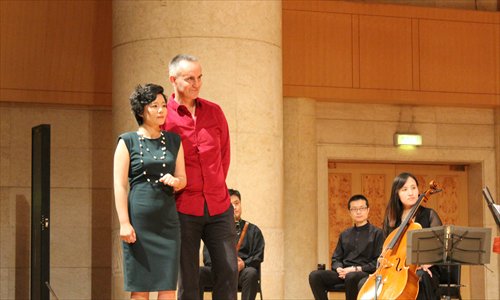
Gong Linna (L) and Robert Zollitsch (Lao Luo) Photo: Xiong Yuqing/GT
Afew years ago, if you had struck up a conversation about German composer Robert Zollitsch, or Lao Luo, as he is more widely known in China, most people would immediately think of some of his more unique sounding songs such as "Tante," "Jingubang" and "Fahai Ni Budong Ai" sung by his wife - singer Gong Linna. However, now people are likely to think of a different type of sound all together, as last year the couple refreshed their image by bringing new beautiful folk music to audiences.
During the singing competition Celebrity Battle on Jiangsu TV last October, Lao Luo showed off his fluent Chinese while captivating audiences with his unique understanding towards music. His adaptation of "Mingyue Jishi You" - a song based on a poem by Northern Song Dynasty (960-1127) poet Su Shi (or Su Dongpo) - differed from the gentler version by Teresa Teng or the cool cover by Faye Wong by bringing the song back to the bold and unconstrained style of a tipsy poet. Additionally, his adaptation of "Xiaohe Tangshui" used the ephemeral voice of Gong to present the reserved and peaceful emotions associated with Chinese folk music and move the audience to tears.
Now on June 8, Lao Luo will stand forth from his role as the man behind his wife's music to take center stage at the Forbidden City Concert Hall in Beijing for the first concert dedicated to his musical compositions - Chamber Works of Lao Luo.
Gong promoted her husband's concert on Sina Weibo by posting: "I'm really excited: The first solo concert for a foreigner happens to be for Chinese folk music. Just what kind of spirit is that?"
Later during an interview with the Global Times Gong laughed about the post saying, "Many people replied to me to say it was the spirit of a 'good Chinese son-in-law.'"
Folk combo
Except for a new song "Dongqu Chunlai," to be performed by Gong's female a cappella group Shengling, most of the pieces at the concert will be chamber works without vocals.
Combining traditional Chinese musical instruments such as sheng (a free reed wind instrument), guzheng and yangqin (both stringed instruments) with Western musical instruments such as the accordion and cello, Lao Luo's works fuse musical elements from both East and West with his own unique creations.
Lao Luo and his wife tentatively define his music as "folk music." "I don't want to call my music 'art music' this time around, because I think that would make the public feel that it's something far beyond what they could accept… We haven't found a better word than 'folk music' to categorize it. What I'm trying to express is that while my music is played with both Eastern and Western musical instruments, the soul behind the music is rooted in China and comes from the people," said Lao Luo during a press conference on Tuesday.
In his compositions Lao Luo has also decided to place extra focus on some instruments that usually don't play central roles in traditional Chinese folk music troupes. According to Nie Yunfeng, a 35-year-old sheng player at the Beijing Peking Opera Theatre who has cooperated with Lao Luo for more than 10 years, at most concerts his instrument usually plays a supporting role, but on June 8 he is sure to be one of the most important heroes at the concert.
Xia Jing, 25, a postgraduate student at the China Conservatory, said after she joined the guzheng trio called Sanchuan, which Lao Luo organized in 2008, she has been playing his original folk music ever since.
"His works are different from that of others, in my opinion he gets the best sounds out of the guzheng. He organized this guzheng trio in order to show the different ranges of this instrument," she said.
"He has dedicated himself to creating and promoting Chinese folk music. He has gathered small instrumental groups that play Chinese folk music and brought them to music festivals around the world," Nie told the Global Times.
Spreading the word
Lao Luo has long been connected to folk music, first learning folk music instrument the Bavarian zither back when he was a boy in Munich, Germany.
Growing up to major in music, he first heard traditional Chinese music in the early 1990s. He explained that while he couldn't understand the music all that well, he decided there and then to come to China and study the guqin (an ancient seven-stringed instrument) at the Shanghai Conservatory of Music in 1993.
"There were two main things that attract me to Chinese music: One, of course, is the beauty of the music, while the other is that I can see there is still so much room to improve and create when it comes to Chinese music," Lao Luo said, explaining that since Chinese music is not that well known in the West he feels he has much to offer when it comes to promoting Chinese music abroad.
"One of the reasons why I feel this way is that many Chinese musicians are not that confident in their own folk music," said Lao Luo. "I know many top composers, but they are all working on Western music in order to gain recognition around the world. This stands at odds to my hometown, where folk music is sometimes held in higher regard than even classical music."
Many times during our interview, Lao Luo expressed his appreciation of traditional Chinese music, especially mentioning The Bianzhong of Marquis Yi of Zeng, an ancient bell-like percussion instrument made in BC 433 and discovered in 1978 in Hubei Province.
"This musical instrument was put into a nobleman's tomb. From this we can see the high position music held in ancient times," said Lao Luo.
This year is Gong and Lao Luo's 10th wedding anniversary. Lao Luo proudly said that in his mind Gong is the best Chinese singer he has ever met, while Gong said the songs he has written for her over the years and his concert next month are the best gifts he could give her. "He makes me confident about my music," said Gong.