HOME >> BUSINESS
Inconsistencies send wrong signal to market
By Yu Xi Source:Global Times Published: 2014-5-29 21:03:01
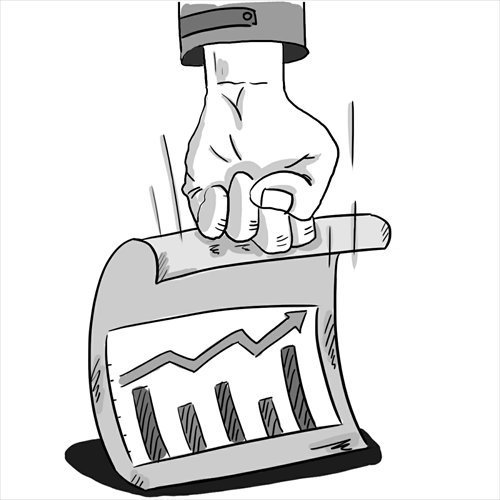
Illustration: Chen Xia/GT
State-owned trader Nanjing Textiles Import and Export Corp announced recently that it, along with 12 former executives with the company, would be fined a combined 1.53 million yuan ($244,616) for artificially inflating profit results to the tune of 344 million yuan between 2006 and 2010. This news has also thrust China's securities watchdog into the eye of a public relations storm, with critics claiming that the penalty it meted out was too mild.As a spokesperson from the China Securities Regulatory Commission (CSRC) explained at a press conference last Friday, its decision in the Nanjing Textiles case was based on relevant laws and regulations. But compared with outcomes of previous securities fraud cases, authorities seem to have not only gone soft on Nanjing Textiles, they've also squandered a perfect opportunity to flex China's anemic delisting mechanism.
Since its bogus results first came to light in 2012, Nanjing Textiles has gone back to revise its earlier reports. These revisions showed the company operating in a deficit during the period when it was found to have been cooking its books. This, as many saw it, should have been more than enough to get the company booted from public trading, since current delisting regulations stipulate that a company will face suspension if it suffers losses for three consecutive years. However, these adjusted results did not trigger the CSRC's delisting mechanism and now it seems Nanjing Textiles could retain its listing for at least the next few years - it disclosed actual profits for 2012 and 2013.
Letting Nanjing Textiles off the hook sets a poor precedent for the market. With authorities apparently unwilling to come down hard, companies teetering on the brink of delisting may decide that it's worth overstating their profits if it keeps them in the game.
This is not to say that the CSRC cannot throw the book at rule breakers when it feels the need. Roughly one year ago, Wanfu Biotechnology (Hunan) Agricultural Development Co and its listing sponsor incurred the commission's wrath after falsified revenue and profit results were uncovered in Wanfu's IPO prospectus.
Several members of Wanfu's upper-level management team received warning notes on top of fines ranging from 50,000 yuan to 300,000 yuan, according to information released by the CSRC. An unlucky few were even banned for life from participating in China's securities market. Ping An Securities was fined 76.65 million yuan too for failing to conduct adequate due diligence when backing Wanfu's IPO. Ping An, which established a fund to compensate investors affected by the debacle, also had its underwriting qualifications suspended for three months.
While no two cases of fraud are exactly alike, Nanjing Textiles and Wanfu are similar in that each presented investors with doctored financial information. Yet, the CSRC responded with radically different punishments. On the basis of severity, one could reasonably argue that since Nanjing Textiles' misdeeds were committed over a period of several years, it deserves a harsher penalty.
Over the years, the CSRC has repeatedly stressed its intentions to strengthen the country's notoriously ineffectual delisting system. But if recent events are any indication, authorities still have a long way to go.
Indeed, since delisting policies were first introduced in China back in 2001, only 78 companies have been ejected from public trading, a surprisingly small figure compared against the more than 3,000 companies delisted from the New York Stock Exchange and the nearly 8,000 removed from the NASDAQ Stock Market from 1995 to 2012, according to media reports.
Mature mechanisms are a prerequisite to building mature markets where well-managed companies are rewarded by investors and poor performers are eliminated.
In China though, where market access is still tightly controlled, companies have no shortage of options when it comes to evading delisting. To bolster their economic records, local authorities have historically kept floundering public enterprises afloat with financial handouts or politically motivated mergers. Such activities, while wasteful in their own right, create serious market distortions for promising rule-abiding companies.
Regulators should clarify and expand China's incomplete and problematic delisting regulations. Minimum business performance, liquidity and compliance standards should all be clearly defined. The consequences for falling short of such standards should be laid bare as well. Once this process is complete, authorities should apply these new regulations in a fair and consistent manner.
The author is a reporter with the Global Times. bizopinon@globaltimes.com.cn
Newspaper headline: Other loss makers may follow Nanjing Textiles’ lead after mild penalties
Posted in: Comments