Lights! Tourists! Action!
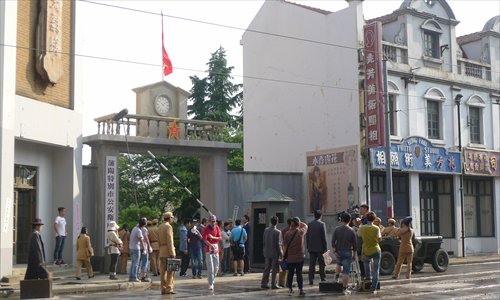
Actors and crew work on a scene at the Shanghai Film Studios Amusement Park. Photo: Wang Zhefeng/GT
Philippe is a French student studying at Tongji University in Shanghai's northeast Yangpu district. He has been in the city since last September and although he has already had a good look around, a trip across town on Monday gave him a special feeling.
He was heading to a job as an extra on a film being made in Chedun town, Songjiang distrcit. "Today I begin work as an actor - actually really just as an extra. We walk and move in the background for a few scenes."
Philippe's big day with a difference was at the Shanghai Film Studios Amusement Park. Tang Qianghua is the park's assistant manager and told the Global Times that the studios in 2013 had seen 56 movies and television series made there and had welcomed 350,000 tourists. At present the studios had some 2,000 extras listed on their books.
The park is one of the 10 major movie studios in China and is famous for its old Shanghai sets and backgrounds, especially for movies set in the 1920s and 1930s. Just about every movie set in that era in Shanghai comes here for shooting. It is also one of the few studios that is making a profit.
Great experience
For many movie fans being able to actually visit and experience the settings of favorite films is a great experience and after Disneyland came into being in 1955 (though that accented the amusement park aspect rather than the movies) film studios have been branching out and offering fans rides and insights into movie making at parks and studios all over the world.
China's first movie studio was the CCTV Wuxi Movie/TV Base. From 1987 the studio was home for major television series like Tang Ming Huang, Romance of the Three Kingdoms and The Water Margin.
After that film studios shot up all over the country - there are now almost 100 movie studios operating in China including the well-established Hengdian World Studios in Zhejiang Province, the Changchun Movie Wonderland in Jilin Province, the North Putuo Film and TV City in Beijing, the Zhenbeibu China West Movie Studio in Ningxia Hui Autonomous Region, the JiaoZuo Film And Television City in Henan Province and the Zhuozhou World Studios in Hebei Province.
With China's history going back thousands of years and Chinese movies and television shows reflecting this and ranging from the oldest stories to contemporary dramas and comedies, studios have to offer a huge range of costumes, props and sets. While some studios offer a diverse range of sets and scenery, the Shanghai Film Studios Amusement Park is more of a specialist venue.
"We focus on old Shanghai with our sets and costumes - we don't care how other studios expand or try to change their approach," the park's Tang Qianghua said.
"From an economic and cultural angle for movies, the 1920s and 1930s were Shanghai's golden days. Shanghai had started to split from Jiangsu Province, it was becoming a municipality and foreign countries had their concessions here. In those days Shanghai was the center of China and the biggest metropolis in the East. Old Shanghai was a treasury for storytellers."
Recreated road
In 1993, when Chinese director Chen Kaige filmed Temptress Moon, sections of the original Nanjing Road were recreated for the movie in Chedun town.
At that time, there was only one movie studio in Shanghai, the East China Sea Film Studios Amusement Park in old Nanhui district (now part of Pudong New Area). This studio, 72 kilometers from the downtown area, was built in 1991 by the Shanghai Municipal Administration of Culture, Radio, Film and TV and the East China Sea Farm.
"The sets there featured a lot of Jiangnan-style bridges over streams which are beautiful but in Shanghai, Zhejiang and Jiangsu provinces, it's easy to find these. And the studio was a long way away, " Tang said. In 1990s, this studio was a popular place for films but these days few movies are made there - mainly because the Shanghai Film Studios Amusement Park has opened and bought out the older studios.
The Shanghai Film Studios Amusement Park came about in the late 1990s, the Shanghai Film Group Co. Ltd decided to build a movie studio in Chedun town. The studio began operating in 1999 and opened its tourism business in 2000. The studio focuses on old Shanghai buildings and streets and here visitors can find sets for 1930s Nanjing Road, shikumen (a traditional style of architecture in Shanghai) homes, the old town, European buildings, Suzhou Creek, the Moller Villa and a church.
"Old Nanjing Road used to have the four largest Chinese-owned department stores and we have recreated three of them," Tang said.
Tang said the studio got its revenue from four sources - renting studios and sets for film and television productions, tourism (including wedding photography), leasing costumes, props and equipment, and building new sets.
"Renting sets for movies or series accounts for the largest part of our earnings, more than 30 percent. Next is tourism which makes up about 30 percent, then leasing equipment and the smallest sector is set construction which brings in less than 20 percent of our income annually."
Most expensive
The most expensive set a producer or director can hire is the elaborate Nanjing Road set which costs 12,000 yuan ($1,918 ) a day. The cheapest sets cost just 1,000 yuan a day to rent and generally these are just building facades. Renting a villa for interior filming costs between 2,000 and 5,000 yuan a day. But if a movie will be shooting for more than a month the studio offers a 10 percent discount.
Usually the studio links its rental, leasing and construction deals and offers filmmakers comprehensive packages. From its warehouses the studio can offer producers more than 200,000 costumes and 300,000 props for filming. "A period costume costs about 5 yuan a day but an vintage car will set you back 3,000 yuan," Tang said.
The studios have the latest equipment and for special effects they have trained explosives' teams who can arrange spectacular bomb blasts in complete safety.
In 2007, the producers of Mummy: Tomb of the Dragon Emperor rented the studio's Nanjing Road to shoot for a week which cost them 8 million yuan. In 2005, the Jet Li movie Fearless rented the largest studio on the lot for a week, paying 2 million yuan.
Zeng Yulin is the chief editor for the Hengdian Movie & TV Tourism, the fan magazine for the largest film studios in East Asia. He explained that today's movie studios were aiming at two sources of income - filmmakers and tourists. Hengdian World Studios had always tried to develop itself as a movie studio that also wanted to share its excitement and news with fans.
The Shanghai Film Studios Amusement Park has a slightly different approach to tourists than the Hengdian studios. "All the exterior filming can be watched by tourists. Visitors can watch actors performing and being filmed as it happens," Tang said.
Admission to the park costs 80 yuan for an adult. For wedding photographic parties however pay 800 yuan which allows seven people access - the bride and groom, photographers and assistants.
On Monday, when the Global Times visited the studios there were several films being shot as well as wedding photographs being taken.
Running at a loss
Most film studios in China run at a loss. Hengdian's Zeng said only 5 percent of China's movie studios were making a profit. Tang said his company had spent 200 million yuan in creating the studios but running costs and depreciation had also increased so the studios needed 15 million yuan annually to cover its costs.
"For the first few years, we lost money but now we are in the black because we have improved our operating systems," Tang said.
There is another studio in Songjiang district, the Shanghai Image Maker Corporation, but it didn't respond to requests for interviews from the Global Times.
At Chedun town, several new villas are being constructed in a vintage Shanghai-style building. Tang noted: "In the future, not only the studios but all of the town will be famous for its old Shanghai architecture." In 2012, the People's Congress of Songjiang district proposed promoting culture in Songjiang, and movie making is now a big part of this.
Newspaper headline: How film studios are welcoming filmmakers and sightseers