Houses of card
For the last decade, 67-year-old Zhang Huifang has recreated some of the city's most iconic buildings as card models.
Despite being blind in one eye, Zhang has used his skill and dexterity to design a dozen color, scale models of landmarks that include the Shanghai Oriental Art Center, Shanghai Science and Technology Museum, Shanghai International Convention Center, and the zigzag bridge and pagoda of Yuyuan Garden.
Over the past few years, the card models designed by him have been produced as card kits for children.
"Making card models of buildings has been much more popular in Western countries than in China. So in the past, the kits available to Chinese hobbyists were for Western architecture. Most of these were for old and historical buildings such as churches. So I had the idea to design kits for models of modern structures in Shanghai for our children," said Zhang, who used to work at the Shanghai Youth Science and Technology Education Center.
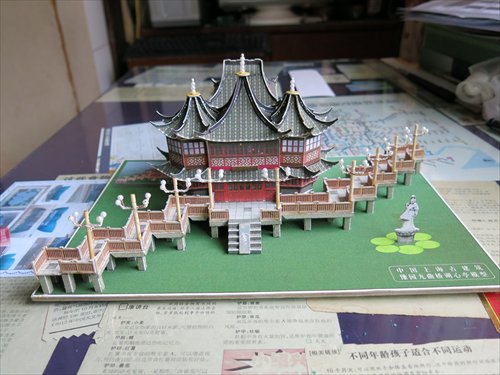
A paper model of Yuyuan Garden made by Zhang Huifang
Most people are familiar with building such models, but few have the experience of designing them from scratch.
Shanghai Oriental Art Center was a particular challenge, consisting of five hemispheres of differing heights and diameters. Without any blueprints or data about the design, Zhang calculated the height and the diameter of these hemispheres by counting the glass panels that cover the structure. Zhang counted some 4,700 of them.
In order to make his card models resemble the actual structures as closely as possible, Zhang takes hundreds of photos, including details such as the patterning on bricks. Photographing a structure can take him several days.
"All 20 patterned bricks of the bridge in Yuyuan Garden are different. The patterns on the window frames of the pavilion in the lake are also different. But the most complicated pattern I've encountered so far is the wall of the Shanghai Symphony Orchestra, the scale model of which I am working on at present. The wall's pattern is composed of bricks of three different colors. I've already taken 300 photos of its wall. There will be more to photograph," said Zhang.
Transferring the three-dimensional structures into flattened images that can be folded into models is even more complex, and can take him months of trial and error before he gets it right. He often has to make three or four card models before a satisfactory design is accomplished.
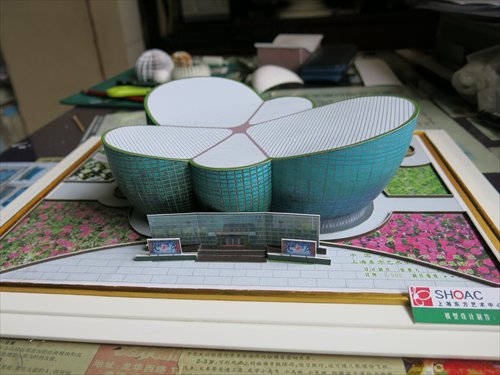
A paper model of Shanghai Oriental Art Center made by Zhang Huifang
"The designing and making of the scale models requires the ability to think and imagine in spatial terms. When children are building these models, their capacity in this respect is also trained, which will help in their study of geometry," said Zhang.
Zhang's previous experience as a tailor, a computer programmer and a page layout designer and typographer all contribute to his success in creating the models. His skills in Photoshop make it easier for him to draw the patterns for the card models, and his tailoring skills helped him work out how to incorporate the curves found in buildings such as the China Maritime Museum and the Shanghai Symphony Orchestra.
"The spherical parts of my models are rigid, thanks to the method of making the supportive structure that I worked out. It took me about two weeks to come up with. I cannot sleep well at night when I am trying to solve a problem. But whenever I work out a new structure or accomplish a new design, I feel a sense of achievement," said Zhang.
Zhang's small apartment is crammed with tools and machines for designing, printing and building the models, while sheets of card are stacked in every corner. He appreciates that his wife has been very supportive of his work.
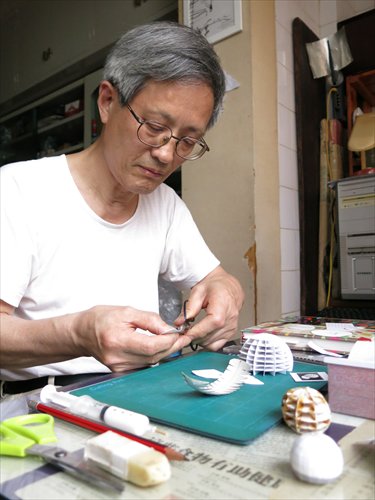
Zhang Huifang works on a card model that he designed. Photos: Du Qiongfang/GT
Zhang's most complicated scale model to date is the China Maritime Museum. "The shape of the two sails of the architecture is irregular and curved. It also has a spherical structure inside. And the hollow structure needs great patience and care. But I found that local students who take part in the architecture card model competition can already make the China Maritime Museum model very well," said Zhang, whose scale model designs are used as competition materials at the annual competition in Shanghai.
"I endeavor to design and make card models because I am happy that students are making use of them. Students' spare time after school is enriched and their manual dexterity is improved. Building models can also help alleviate pressure from study," said Zhang.
"But the most meaningful aspect of my work is that all the card models I designed can be built by anyone. It is not just a private hobby of my own," said Zhang.
Newspaper headline: Man creates scale models of city’s landmarks