Breathing life into cultural heritage
Of the 28 Chinese intangible cultural heritages designated by UNESCO, five are actively practiced in Shanghai. These are acupuncture, Kunqu Opera, Peking Opera, Chinese paper cutting and guqin music art (ancient Chinese zither).
Intangible cultural heritage is defined by UNESCO as "the practices, representations, and expressions, as well as the associated knowledge and the necessary skills, that communities, groups and, in some cases, individuals recognize as part of their cultural heritage."
The Chinese government also designates intangible cultural heritages on national and local levels. The country currently has 49 national-level and 179 municipal-level intangible cultural heritages, according to Gao Chunming, deputy director and researcher of the Shanghai Intangible Cultural Heritage Protection Center.
The problem of preserving and promoting intangible cultural heritage in modern society has been an abiding concern for communities around the world, and for countries and international bodies.
Celebrated masters of time-honored arts and crafts from China, Japan and South Korea gathered in Shanghai last Friday to share their experience of their own efforts to protect the roots of their culture.
They are also exchanging artistic ideas through an exhibition at Changning Library, which is showcasing their artworks until June 22.
Inclusive exhibition
The Fourth Chinese-Japanese-South Korean Arts Exhibition, organized by Shanghai Creative Industry Association and Changning district government with the support of Shanghai Art Collection Museum and Shanghai Art & Design Academy, highlights more than 110 art and craft pieces by some 80 masters from the three participating countries.
Exhibits from China range from jade and wood carvings to glass, embroidery and lacquer ware, to name but a few. The Japanese contingent presents puppets, glass, porcelain, metal work and graphic design; meanwhile, Korean artists contribute their distinctive Korean paper artifacts, writing brushes, porcelain and pyrography - the art of sculpting objects with fire.
Participating artists include national-level masters Wang Jinshan (embroidery), Liu Zhongrong (jade carving), and Xiao Jianbo (ivory carving) from China; Japanese graphic designer Katsumi Asaba and ceramic artist Masayuki Imai; and Kim Youngjo, a practitioner of pyrography from South Korea.
"China, Japan and South Korea are all endowed with abundant intangible cultural heritages, and the communication in the field of arts and crafts among the three countries has existed for hundreds of years," said Wang Ronghua, executive director of Shanghai Creative Industry Association. "The event, which saw the participation of some 200 masters in the previous three years, has now become an effective platform for artists from different countries to communicate and learn from each other."
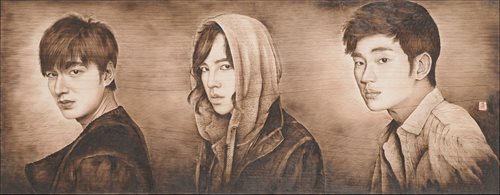
A work of pyrography from South Korea
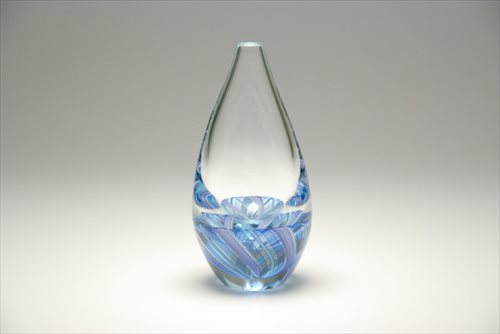
A glass work from Japan Photos: Courtesy of Shanghai Creative Industry Association
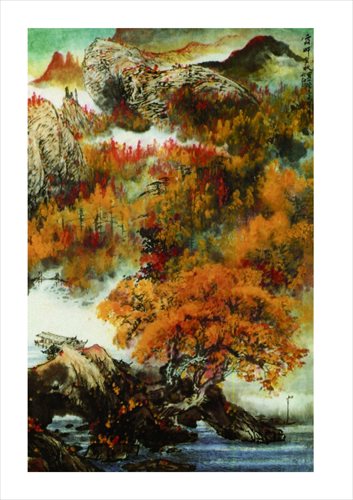
Embroidery by Chinese artist Di Jing
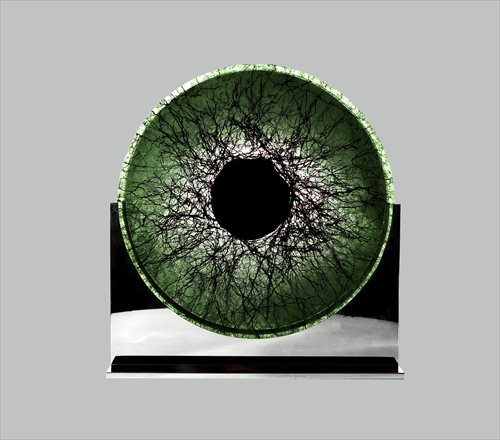
A glass work by Chinese artist Shi Senbin
Fresh blood
In Shanghai, the average age of people practicing intangible cultural heritages of the municipal level, and therefore keeping the arts and crafts alive, is 66.4 years old, while for national-level intangible cultural heritages it is 76.5 years old.
Arousing interest in the practices among younger people is essential, so that the skills and knowledge needed to continue the intangible cultural heritages can be passed on.
According to Gao, only 15 percent of the intangible cultural heritages in the city are able to generate a revenue of more than 100 million yuan ($16.25 million) per year. These include jade carving, the making of traditional musical instruments, and the crafting of gold and silver works. Meanwhile, the revenue for more than 60 percent is less than 1 million yuan per year, among them Gu embroidery and bamboo carving.
With such a low financial incentive to put in the years of study required to learn these crafts, Gao and others working to preserve intangible cultural heritages must find other ways to encourage their uptake among the young.
Kim, who rendered portraits of three popular TV stars with pyrography for the exhibition, said that as long as the craftsmanship of the artisans is astoundingly delicate and beautiful, they can win the hearts of every beholder.
Pyrography, a skill with a history of some 700 years, can be used to convey traditional landscapes as in the past, but it's also able to keep pace with the era to reflect contemporary Korean culture, he said.
While Joung Gyuho, general manager of the organizing committee of Cheongju International Craft Biennale in South Korea, suggested at the seminar that festivals should also be harnessed to link traditional arts and crafts to citizens.
The last biennale was held for 40 days in September and October. It featured not only an exhibition with hundreds of craft artists from South Korea and other countries, but also a range of workshops and marketplaces creating interaction between the artists and visitors.
University students and citizens were given in-depth training about the crafts. "We regard citizen volunteers as future partners to facilitate the development of crafts industry in the long run," said Joung.
Date: Until June 22, 9 am to 4 pm (closed on Mondays)
Venue: 3/F, Changning Library 长宁图书馆3楼展厅
Address: 356 Tianshan Road 天山路356号
Admission: Free
Call 3353-8801 for details
Newspaper headline: International debate of methods to preserve intangible inheritance