The waterways of Giethoorn
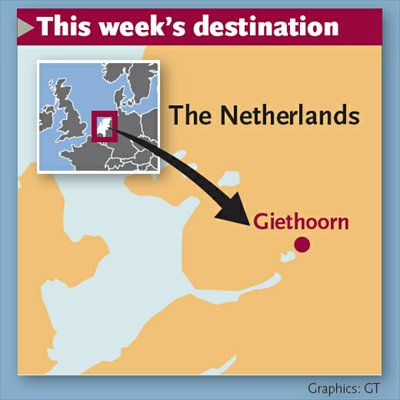
This week's destination
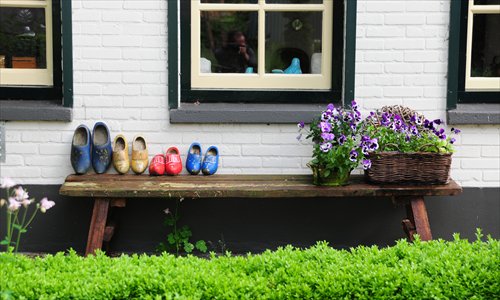
Dutch wooden shoes are seen outside the window of a thatched house in Giethoorn. Photo: Wu Gang/GT

Wooden bridges dot the canals here and there. Photo: Wu Gang/GT
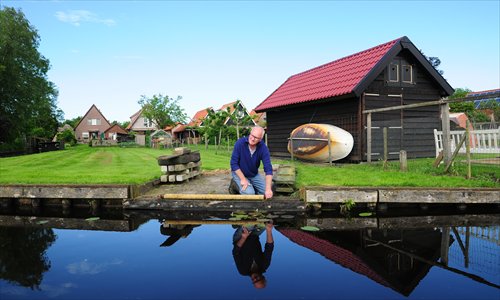
A man works by a canal at the backyard of his home in Giethoorn on May 22. Photo: Wu Gang/GT
If you plan to visit Amsterdam then it is likely you will find yourself onboard a boat along the canals that crisscross the city's stylish landscape.
Boat tours provide tourists with incredible views of Amsterdam's historical sights, but the popularity of the tours can leave you crammed into a glass-sealed boat with a hundred other tourists. The city's sights reduced to nothing more than rare glimpses from behind the heads of other camera-snapping tourists, I soon came to avoid them during my time in Amsterdam.
However, this distaste stopped the moment I stepped onto a small boat in the village of Giethoorn, just a two-hour train ride northeast of the city.
Although known as the "Dutch Venice," this tranquil village with less than 3,000 residents living in well-designed thatched houses scattered along the narrow canals and lakes of the Dutch countryside is a much different experience from any other heavily commercialized water city.
A stroll along the banks
My friend and I arrived in Giethoorn on a Wednesday afternoon in mid-May. We were met at the entrance of our hotel, the Hotel de Harmonie, by an energetic middle-aged man called Jan, who was quick to add that he was merely working for his wife, the real boss of the operation. After checking in and with the evening light fading, Jan suggested we walk along the banks of the canal since it was too late for a cruise down the village's waterways.
Although exhausted after having hauled our luggage through the village via tram, train and bus, we accepted Jan's advice and set out to capture the best photos as dusk was setting in.
Despite an overcast evening, the hazy sun occasionally peeked out from behind the clouds and the village resembled a postcard featuring the country life of the Netherlands. Cows idling in a grass field, long reeds by the canals, wooden bridges and clean-cut traditional houses reminded me of the landscape paintings of the 19th century Dutch artists of the Hague School.
Owners of the thatched or tile-roof houses take pride in the design of their property. The shapes and colors of the houses vary from one to another, yet share the most crucial feature in that they all uphold the style and scenery of the village. The front gardens of these houses are so delicate and refined, that each garden manages to maintain its own uniqueness in its choice of plants while still complementing their neighbor's gardens in their shapes, colors and patterns.
While we looked on at these houses admiringly, we struck-up a conversation with a middle-aged woman at the front of her house. Her name was Margaret, a mother of five children who moved here with her husband 13 years ago. With her children now grown and moved to bigger cities for work or university, Margaret and her husband, Bob, now live the quintessential retired life in this quaint picturesque village.
Margaret and Bob kindly invited us to take a look inside their house, which we accepted with much excitement.
Once inside their home, I was struck as much by the history of the house as its interesting interior.
"The sitting room used to be a cattle stable where the original owners lived decades ago," Bob said, pointing to the vast living room now decorated with cozy furniture, lamps and books.
One of the rooms, currently used as Bob's home office, had an enclave on one wall that drew our attention. A bed fit perfectly inside the enclave, as if hidden in a closet, which was apparently a sort of mini-bedroom that came from the original house owners.
Their house, like all in the village, takes a lot of care and maintenance to stay in their current state. The thatched roof of Margaret and Bob's house, made of dried reeds, had taken workers two weeks to refurbish and cost them close to 30,000 euro ($40,000).
The first night in the village we didn't venture too far down the banks of the canals, but we were not short of surprises and encounters with the local wildlife - for instance, getting chased by a swan who didn't share the locals' welcoming hospitality .
Whispering over the waters
The following morning we stepped out of our hotel onto a dock where several small boats were tied.
As with many properties in the village, the narrow canals often extend right up to the house entrance, making boat the most accessible and hassle free form of transport.
The boat waiting at the jetty for us was similar to boats found on the canal, no more than several meters long. We were surprised, however, when Jan casually told us that we would be driving the boat ourselves. With nothing more than a map of the confusing waterways to assist us, a young man untied the boat and we were cast adrift to make our own way.
Fortunately, the boat was propelled by a battery-powered engine and not a gasoline engine that would spit out dreaded exhaust fumes. In fact these battery powered boats are so quiet that the locals call them "whisper boats."
Steering the boat turned out to be much easier than expected. The gears of the boat were controlled by a round knob, which when turned clockwise would put the boat into motion and could reach gears one or two, the only two speeds possible.
After some trial and error, I found it easily to navigate the boat along the canals even though they are no less than 10 meters wide and at points can even shrink to less than five.
That morning on Giethoorn's canals, with the cool breeze in my face and ripples shooting across the water's surface from the hull of the boat, I breathed in the fresh smell of the outdoors and stretched out my arms - taking in the wonderful pastoral view of the Dutch countryside.
The boat took us past green banks of reeds and a colorful mix of flowers, soon passing under wooden arch bridges and past the backyards of houses. Slowly cruising by we were able to catch glimpses into the homes, and all the residents returned our waves and wished us a good morning.
The route Jan recommended on the map seemed straightforward and simple, with junctions appearing every now and then. The canal is well marked, with yellow and red arrows marking different routes - the yellow being the shorter route; the red leading to a larger tour of the waterways.
According to the hand-drawn map, we were supposed to make another major turn after running on a straight route for a while, but the waterway extended on and on, with no arrow posts or junctions to be found.
Panic began to set in. The confusion of where we were or how we would get back became increasingly distressing. Through all the excitement we had somehow become lost. "Did we miss the arrows at some point or have we just gone off the map altogether?" we began to ask ourselves.
Before we started the boat tour, Jan had pointed out the telephone number on the map just in case we got lost. Despite our distress, we could still see village houses in the far distance - a reassurance that sooner or later we would get back to them.
After taking a moment to calm down, I changed the boat's speed to second gear, the engine started to hum slightly louder and we continued on the same course at greater speed. Eventually, we saw a junction again and to our relief, a dear yellow arrow.
The canal opened up into a lake and then back into a canal that went through more local residential areas. As I maneuvered the boat through narrow bends in the canal, we saw the Hotel de Harmonie up ahead and I found myself not wanting the boat trip to be over nor my time in the wonderful village of Giethoorn.
Rules of thumb
Transport: It is better to arrive at Giethoorn on a weekday, because traffic on the canals will be busy over the weekend.
Bike and boat rentals are not expensive. The rent for boats range from 12 to 20 euro ($16-27) an hour. You can walk into the village and rent a boat there, it will be cheaper than at the village entrance.
Bring a credit card with a chip, as credit cards with only a magnetic strip are not accepted in many places.
Buy two-way tickets from Amsterdam to Steenwijk, the nearest station to Giethoorn. There is no ticket office at the Steenwijk station and the ticketing machines only accept the OV-chipcard used by local people. We were lucky to meet a kind lady who helped us buy two tickets with her OV card while we paid her in cash.
Restaurants: The family hotels often come with a restaurant, but you can also try out other eateries. We stayed at the Hotel de Harmonie, but also tried out a dinner across the road at the De Dames Van De Jonge Hotel Restaurant. The restaurant has no print menu so waiters just tell customers what they have available. The pork steak and fish fillet were delicious, along with their renowned onion soup.
Newspaper headline: Travel to a quiet village in the Netherlands