Campus architecture
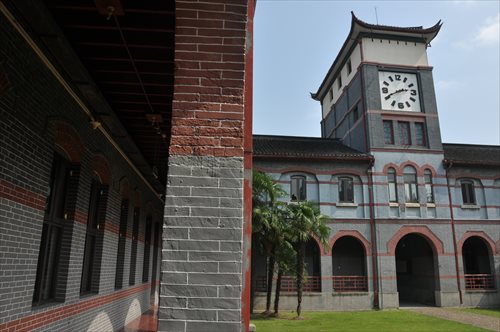
Taofen Building at East China University of Political Science and Law Photo: Huang Lanlan/GT
Shanghai has many historical buildings with various characteristics, charting the changing fortunes of the city over the past century. These include examples of Chinese architecture, such as 120-year-old siheyuan courtyard houses, and influences from overseas, such as German-style buildings from the 1930s.
While a lot of these buildings are well-known fixtures on the tourist trail, many can be found in more out-of-the-way places. University campuses are a prime example. The Global Times has picked several interesting old buildings at Shanghai universities that can be visited by the general public.
Taofen Building
Formerly known as Schereschewsky Hall, or S.Y. Hall, Taofen Building was built in 1895 to serve as a complex building for St. John's University, which was renamed East China University of Political Science and Law (ECUPL) in the 1950s.
Built in the siheyuan style, the quadrangle building has grey and red brick walls and brownish red porch railings of wood, making it look quaint and elegant.
"Originally, the designers planned to build a tower on the top, but opted instead for a clock face," Gong Yi, a staffer with the publicity department of ECUPL, told the Global Times. She added that the big black-and-white clock, which was made by an American company, brought convenience not only to students of the school but also to residents living nearby.
The name of the building was changed to Taofen Building in 1951 in honor of Zou Taofen, an alumnus of the school. Born in 1895, Zou was one of the most famous journalists in China in the 1920s and 1930s. Today, a sculpture of Zou stands in the middle of the building's courtyard, surrounded by banana trees.
"It is the most representative building of my school," said student Chen Wenting. Dressed in a graduation gown, Chen was taking graduation photos with her classmates in the courtyard when she spoke to the Global Times. "It is a very beautiful place, and I had all my classes here," she added.
Add: 1575 Wanhangdu Road
万航渡路1575号
Xiong Foxi Building
Built in the 1930s, the two-story Xiong Foxi Building at Shanghai Theatre Academy was originally a German country club.
Working at the school for more than 40 years, Yu Zhong, who is now in charge of its archives, told the Global Times that some Germans once built a club near Jinjiang Hotel in Huangpu district at that time during World War I, but that was later occupied by Frenchmen.
"There were a ballroom, a movie house and assorted facilities for leisure and recreation," Yu said. "It was said that in the 1930s the Germans in Shanghai often held parties here, with their horses tethered in a stable in front of the house."
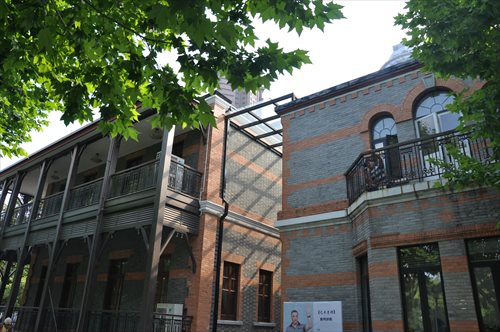
Xiong Foxi Building at Shanghai Theatre Academy Photo: Huang Lanlan/GT
The building was used as a film studio after World War II and the subsequent China's liberation war (1946-49). "It was also the biggest recording studio in the Far East in those years," Yu said, adding that many popular local movies in the 1940s were dubbed here. "Some film stars even lived in the building at that time, such as a famous movie and drama artist named Bai Yang," he said.
In 1956, when Shanghai Theatre Academy was relocated to Jing'an district, the building became a canteen and dormitory for students. The stable was removed, and a swimming pool was built during the Cultural Revolution (1966-76), Yu recalled.
Made of red and cyan bricks, in the 1990s the building was named after the first headmaster of the school, Xiong Foxi. Today it is used for meetings and exhibitions, as well as rehearsals for student plays.
Add: 630 Huashan Road
华山路630号
Lüwa Building
Chinese palatial architecture is a common sight in large, old northern cities such as Beijing and Xi'an, but rarely seen in the south. This is true of Shanghai, whose historical architecture consists mostly of Western-style villas and shikumen houses.
But at Shanghai University of Sport, people can enjoy the beauty of a Chinese palace modeled on the style of the Qing Dynasty (1644-1911). Covering some 6,000 square meters, the palatial building (pictured below), with a roof covered with green glazed tiles and a facade painted with colorful patterns, was completed in 1933 as the headquarters of Shanghai Special Municipal Government.
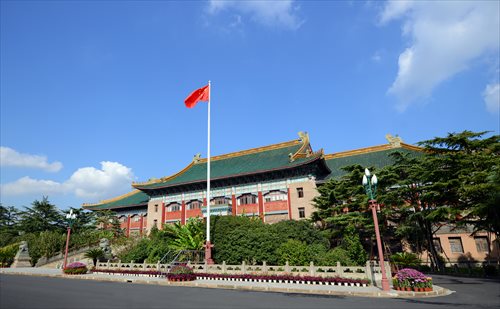
Lüwa Building at Shanghai University of Sport Photo: Courtesy of the university
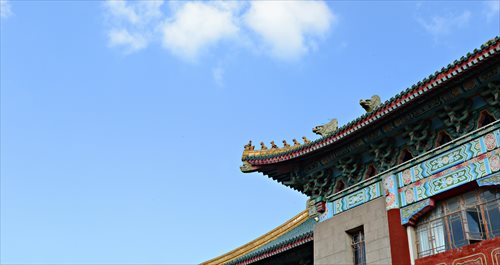
Lüwa Building at Shanghai University of Sport Photo: Courtesy of the university
"The construction of the building was an important part of the Great Shanghai Plan," said Xiong Xiaojian, a staff member at the school's publicity department. The plan was drawn up by the Kuomintang government of the Republic of China in 1927, which intended to build a new downtown area for the city in today's Yangpu district. "The old downtown districts were occupied by foreigners as concessions at that time," Xiong added.
In April 1935, the local government held China's first-ever group wedding ceremony at its headquarters, where more than 50 couples took photos in front of the gorgeous building.
"That day, lots of local residents gathered to watch the grand ceremony, and even famous foreign film companies such as MGM and Paramount came to cover it," Xiong said.
The Great Shanghai Plan was later interrupted by the Japanese invasion in 1937, and the building was severely damaged during the war. In the 1950s, when Shanghai University of Sport was relocated to Yangpu district, the building was repaired and used as an office building of the school.
"Now we call it 'Lüwa Building,' as 'lüwa' means green roof in Chinese," Xiong said. Inside the building, a map of Shanghai in the 1930s is carved on the floor, giving a glimpse into how the city looked back then.
Add: 399 Changhai Road
长海路399号
Newspaper headline: The historical buildings of Shanghai’s university campuses