Songyuan road station
Editor's Note
This year is the 21st anniversary of the opening of the Shanghai metro. The subway has facilitated more than 13 billion journeys during its 21 years, and half of Shanghai citizens cite the metro as their favored mode of transport. To commemorate the anniversary, each week the Global Times will take an in-depth look at one metro station and its surroundings. In the case of downtown stations, we will focus on points of interest within walking distance; while for suburban areas, we will cast our net a little wider.
In contrast to other thoroughfares with their bustling commercial hubs and entertainment centers, the neighborhood around Songyuan Road Station of metro Line 10 is a relatively quiet area in the southwestern part of Shanghai. Yet a few steps from the station will bring you to the interesting cultural and entertainment venues nearby.
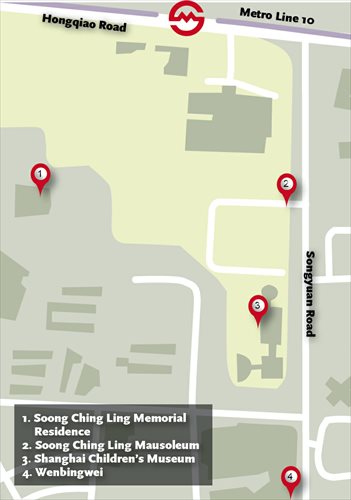
Map
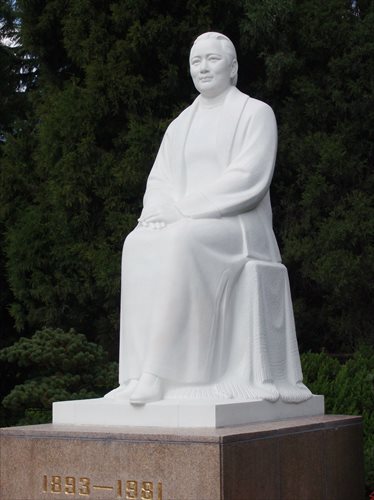
Soong Ching Ling
The Global Time recently went there to explore the classic museums and art spaces as well as some of the popular restaurants on Songyuan Road.
Songyuan
Songyuan, literally meaning the Garden of Song, got its name from the Soong Ching Ling Mausoleum (21 Songyuan Road, 6278-3104) located at the northern end of the road. Emerging from exit 2 of the metro station and walking east along Songyuan Road will bring you to the Soong Ching Ling Mausoleum, situated in a serene and solemn neighborhood.
Covering an area of 120,000 square meters, Soong Ching Ling Mausoleum was built upon the former site of the Shanghai International Cemetery in January of 1984 in honor of Madame Soong Ching Ling. She was the wife of Sun Yat-sen, the leader of the modern Chinese democratic revolution and honorary chairperson of the People's Republic of China.
The mausoleum is subdivided into the Soong Ching Ling Memorial Residence, the Celebrity Cemetery, the Foreigner Tomb Area and an activity zone for children. On the east end of the boulevard stands the Soong Ching Ling Monument. Its inscription reads, "Comrade Soong Ching Ling, the great champion of patriotism, democratism, internationalism and communism is immortal." It was written by Deng Xiaoping, one of the founding fathers of the People's Republic of China and chief designer of China's reform and opening-up drive.
On the west end of the boulevard lies the Soong Ching Ling Memorial Residence, including six exhibition halls and one video room. Over 400 photos and 100 objects give a vivid panoramic review of Soong's life journey, from truth-seeking teenager to devoted revolutionary. The video room has a documentary about Soong's revolutionary activities.
The mausoleum is home to the burial places of Soong's father, Charlie Soong, and mother, Ni Kwei-tseng, as well as Li Yan'e, Soong Ching Ling's housemaid who kept her company for more than 50 years. In front of the tombs stands a white marble statue of Soong Ching Ling (pictured above left).
Flanking the tombs are the Celebrity Cemetery in the northwest and the Foreigner Tomb Area in the northeast. Among those buried here are Uchiyama Kanzo (owner of Uchiyama Bookshop and a friend of Chinese writer Lu Xun), Talitha Gerlach (Soong's close friend and former consultant of the China Welfare Institute) and Bucur Clejan (a Romanian doctor who came to China during the War of Resistance against Japanese Aggression (1937-45) in 1939 and engaged trained medical personnel and treated wounded soldiers).
The mausoleum boasts a luxuriant natural green landscape with 300-year-old pines, 150-year-old osmanthus trees, 100-year-old magnolias, over 1,000 camphors and hundreds of dragon junipers and cedars. Idyllically set in wooded grounds that are exuberant throughout the year, the mausoleum provides an ideal place for commemorative and sightseeing activities.
Admission to the mausoleum is free. It opens from 9 am to 5 pm. Last admission to the mausoleum is 4:30 pm.
Children's museum
Sitting southeast of the Soong Ching Ling Mausoleum, Shanghai Children's Museum (61 Songyuan Road, 6278-3130) was the first museum in China to target children from 3 to 12 years old. The museum is aimed at fostering family relationships and growth based on Soong Ching Ling's educational principle of "building the future" and "offering children the most precious things."
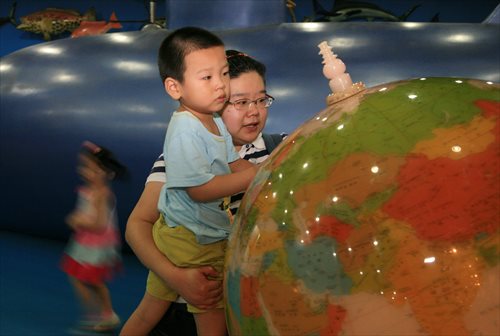
Visitors interact with a globe at Shanghai Children's Museum. Photos: CFP
At the entrance of the museum, a cartoon image of a little boy with a big round head and bright eyes attracts many children. The boy, named Gulu, will be wearing different costumes in different themed halls, and shares scientific knowledge with children through lively activities.
Covering an area of 9,000 square meters, the museum is composed of a storage room on the ground floor, regular exhibition area on the first and second floors and a multipurpose area on the third floor.
The regular exhibition area focuses on science, with a Nautical Hall, Space Hall, Moon Hall and Astronomical Hall. There is also an interactive exploration area dedicated to role-playing games for preschool children.
The museum also features a well-equipped electronic reading zone, a 3D books reading zone, a pictorial storybooks reading zone and an audio visual zone. Children can choose from a wide variety of reading materials and enjoy themselves in the vast sea of knowledge.
A distinguishing feature of the museum is the 350-square-meter hemispheric film screen, which regularly shows animations like The Enchanted Reef, Dynamic Earth, Dark Star Adventure and Legend of the Night Sky. Each showing is 20 yuan ($3.24) per person.
The museum has a big team of volunteers made up of students from primary schools, middle schools and universities. They help organize interactive activities, serve as on-site guides to children and their parents, and maintain public order in the museum.
Entry is free, but adults will only be admitted if they are in the company of a child. The opening time is 8:45 am to 4:45 pm (closed on Mondays). Last admission is 3:30 pm.
Japanese restaurants
Songyuan Road is dotted with popular Japanese restaurants like Wenbingwei (79 Songyuan Road, 3252-1986), whose signature dishes are buckwheat noodles and tempura. The restaurant is elegantly laid out with Japanese-style tatami seats and high dividers that shield neighboring tables from each other, providing a sound venue for private talks. With a considerable patronage of Japanese customers, the restaurant boasts a team of well-trained waiters who can speak fluent Japanese.
Maekawa (2/F, 191 Songyuan Road 6270-6107) is another Japanese restaurant that has won much acclaim. Its goma tofu, chirashi sushi and sashimi are among its best-selling dishes.
The interior decoration is typical of Japanese classical design aesthetics.
Newspaper headline: History and science come to life at nearby attractions