Dream production
Because of the job of a relative, Chinese theater director Pei Kuishan often gets the opportunity to visit a mental hospital and meet the patients there.
"They attract me because I appreciate their almost unconscious ecstasy regarding certain things they like, and the strong affection involved," he told the Global Times.
Pei felt the same about the later works of Swedish playwright Johan August Strindberg (1849-1912), completed after Strindberg became mentally ill.
In Pei's opinion, the protagonists in those works are portrayals of the author. "Strindberg uncontrollably poured his personal emotions into these characters like an insane man," Pei said. "I believe that the hero in the greatest work of a writer must be himself."
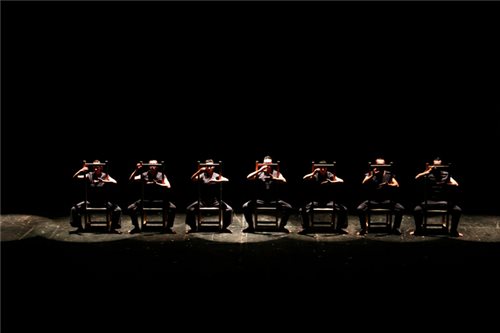
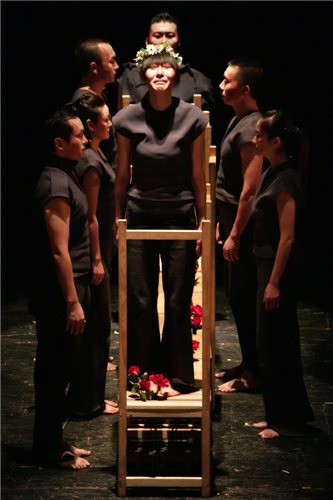
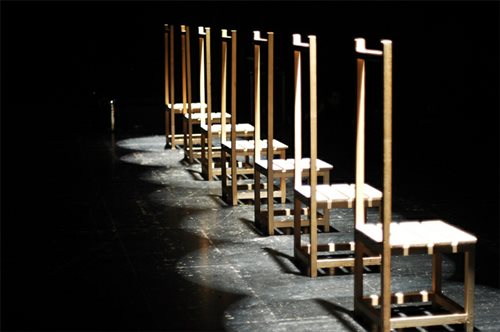
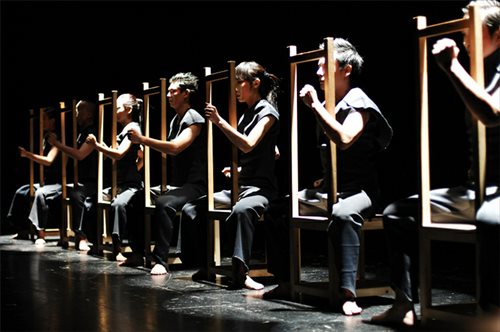
Scenes from A Dream Play Photos: Courtesy of Ke Center for the Contemporary Arts
This is the challenge that lies at the heart of Pei's Chinese production of Strindberg's A Dream Play, written in 1901.
"It is great, but it is also very difficult to stage since we must try to seize and understand an insane man's emotions and logic," Pei said.
Difficult to stage
Strindberg's A Dream Play is mainly built on a montage of scenes following the dream of the central character, who is the daughter of the Vedic god Indra. She turns herself into a beautiful woman and comes down to Earth to find out why humanity is so discontented.
During that time, she meets many different people and experiences the various pains of being human. At the end, when she ascends back into heaven, she throws her shoes into the fire of purification as she leaves a world of never-ending conflicts and contradictions.
According to Pei, the difficulties of the play lie mainly in its complex structure and abrupt scene changes. At one moment, the setting may be an interior, the next moment, the seaside.
"Besides that, there are more than 20 roles in the play," said Pei. "In addition, the themes the author tries to touch upon are multifarious. If you can not present crisp, clear lines among those different characters and themes, the audience will feel very confused."
Although A Dream Play is regarded as being difficult to stage, many celebrated directors have still taken up the challenge, including Swedish theater and film director Ingmar Bergman (1918-2007), who staged A Dream Play four times during his life.
"Bergman is my favorite director," Pei said. "When I read his autobiography The Magic Lantern, I unexpectedly noticed that one of his favorite plays was A Dream Play. It gave me more courage to take on the challenge."
Seven actors, seven chairs
Pei told the Global Times that, since the whole story is set in a dream, there is much scope for creativity in terms of set design, props and appearance. In Pei's production, there are just seven actors, while the stage holds seven chairs.
"I merged over 20 characters in the original play into those seven actors and since there are so many scene switches, the chairs can double as many other things, like doors or beds," Pei said.
The actors all wear the same black clothes to minimize differences between them and allow the audience to concentrate on the acting.
Pei also made a few changes to make the script more relatable for a modern Chinese audience.
For instance, Strindberg talked about marriage and education issues in Sweden in his time in the original play. Pei changed them into similar issues currently affecting China.
"As long as the spiritual core of the play remains universal for all human kind, making such changes really doesn't matter," said Pei.
In Pei's opinion, the spiritual core of A Dream Play is that Strindberg presented almost all important issues in human life from birth to death. The themes include survival, ego, responsibility, ideals and belief.
"Strindberg himself thought that humans are unrealistically invested in illusory dreams of life, but in fact, no one of us can really extricate ourselves out of those issues in the secular world," Pei said.
A pessimist
In a diary entry on April 17, 1907, when A Dream Play was first performed in Stockholm, Strindberg said the play was "my most beloved play, the child of my greatest pain."
Another reason for Strindberg to be so emotionally invested in that performance is that its leading actress, Harriet Bosse, was Strindberg's third wife who had divorced him. The play led the author to the conclusion that life is an illusion that never fulfills people's dreams.
"I believe Strindberg was a pessimist," Pei said. "Even if he wrote of a flower blooming from the fire when the daughter of the Vedic god returns to heaven, who knows how long the flower can survive?"
Date: Until Sunday, 7:30 pm
Venue: Ke Center for the Contemporary Arts
可当代艺术中心
Address: 613 Kaixuan Road
凯旋路631号
Tickets: 150 yuan to 280 yuan
Call 6131-3498 for details
Newspaper headline: Chinese adaptation of Strindberg play deals with fantasy and reality