In search of the spirit of law
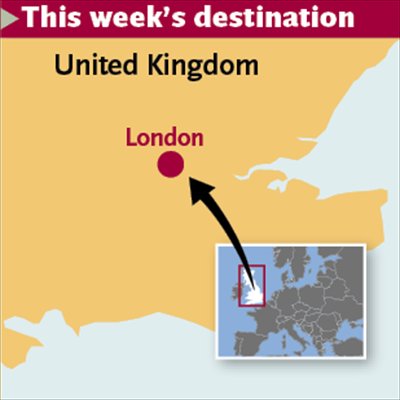
This week's destination
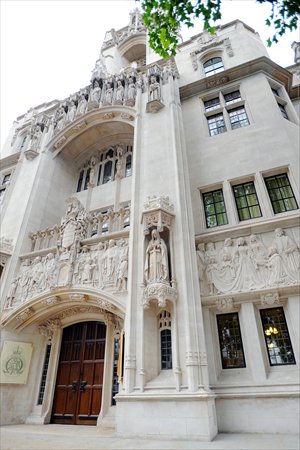
The gate of the UK Supreme Court Photo: CFP
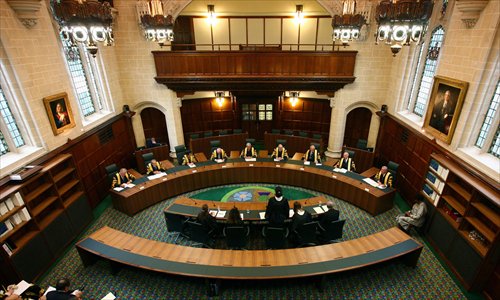
Inside of the UK Supreme Court established on October 1, 2009 Photo: CFP
The Magna Carta of 1215, also known as the Great Charter, has long been seen as laying the foundation for the evolution of parliamentary government and subsequent declarations of human rights in Great Britain and the US. In attempting to establish checks on the king's powers, this document asserted the right of "due process" of law and is regarded as the fundamental cornerstone of English constitutional law.
However, despite the existence of this great document, the Supreme Court of the United Kingdom was only established on October 1, 2009, much later than many other countries in the world. Just what caused this gap between tradition and reality? With this question in mind, I decided to visit the UK Supreme Court, located opposite of the House of Parliaments.
The Supreme Court sits on the western side of Parliament Square. It is highly symbolic of the UK's separation of powers, balancing judiciary and legislature across the open space of Parliament Square. The other two sides of the square are occupied by the executive (the Treasury building) and the church (Westminster Abbey).
Past and present
The creation of The Supreme Court was established by the Constitutional Reform Act 2005, pushed through by Tony Blair's government. With its establishment The Supreme Court replaced the Appellate Committee of the House of Lords as the highest court in the UK in October 2009. "This is the last step in divorcing the law lords from any connection with the legislative business of the House of Lords," said Lord Phillips, then President of the new court.
Parliamentary sovereignty is a principle of the UK constitution. It makes Parliament the supreme legal authority in the UK, which can create or end any law. Due to historical reasons, the House of Lords had long served both as legislative and judicial bodies. The Appellate Jurisdiction Act 1876 provided for the appointment of Lords of Appeal in Ordinary - professional judges working full-time on the judicial business of the House. Although these law lords were able to vote on legislation, in practice they rarely did so. Even so, this involvement in Parliament made their constitutional position confusing.
Now, while The Supreme Court's 12 Justices maintain the highest standards set by the Appellate Committee, they are now explicitly separate from both Government and Parliament.
The Court hears appeals on arguable points of law of greatest importance to the public, for the whole of the UK in civil cases, and for England, Wales and Northern Ireland in criminal cases. Additionally, it hears cases on devolution matters under the Scotland Act 1998, the Northern Ireland Act 1998 and the Government of Wales Act 2006.
Openness and transparency
When choosing a home for The Supreme Court, there was a list of 80 properties which met a variety of criteria for the site selection. The old Middlesex Guildhall built between 1906 and 1913 was the final choice. The Grade II building stood out not only because of its symbolic location, but also its legal and judicial connections. At the time the building was home to a Crown Court.
As you face the new-gothic style building and look above the entrance, you can see the Royal Coat of Arms, which indicates that the Monarch is the source of the Court's authority.
When the building was chosen as the location for the new Supreme Court, a major renovation operation took place to restore the building to its former grandeur and equip the building with modern facilities while emphasizing its historic Middlesex Guildhall features, such as stonework shields and stained glass windows.
After a standard security check similar to what you'd go through at an airport, visitors are allowed to freely walk around the building. There are three courts in total. Unlike the common scene in movies where a judge sits behind a raised desk, there are no raised seats in all three courts, which are furnished with custom-made crescent shaped benches for the Justices and legal teams. The court rooms have been specially designed for their purpose: To discuss important points of law within an atmosphere of a learned seminar, rather than the adversarial environment seen in many other courts.
When The Supreme Court is in session, members of the public are welcome to watch the Justices at work. You can take a seat behind the lawyers in any court room where a case is being heard. These are the only courts in the UK where every case is filmed and visitors can also watch proceedings live on screens in the exhibition area.
Court One on the second floor is the largest of the courtrooms. Famous hearings held here include WikiLeaks founder Julian Assange's appeal against his extradition to Sweden to face allegations of rape and sexual assault in February 2012. At the time, the case drew the curiosity of the media and the public, and by 7:30 in the morning people had already lined up outside the building waiting for a chance to watch the proceedings. Court Two on the first floor is the most modern of the three. Walls are decorated with wall hangings by Timorous Beasties and a large glass sculpture of The Supreme Court emblem. Visitors can watch proceedings behind a glass screen, on which there are the words "Justice cannot be for one side alone but must be for both."
Court Three on the ground floor is also the office of the Judicial Committee of the Privy Council (JCPC). The JCPC is the highest court of appeal for over thirty jurisdictions which include the commonwealth countries, crown dependencies and UK overseas territories.
At the heart of the building is the law library. Walking through glass doors which show a facsimile of the Magna Carta in its original Latin, you will see a triple-height space created for the Justices and their assistants to contemplate and study case law. Dark wood shelves are set off by red leather reading surfaces. A wood and glass balustrade is engraved with pithy quotes chosen by the Justices themselves: "'Judges ought to be more learned that witty, more reverend than plausible and more advised than confident' - Francis Bacon; 'Good actions give strength to ourselves and inspire good actions in others' - Plato."
Symbolic emblems
Walking in the building, apart from the perfect fusion of tradition and modern and an awe-inspiring sense, a pattern you can't miss is the emblem of the Supreme Court.
The official emblem was designed by Yvonne Holton, Herald Painter at the Court of Lord Lyon in Scotland. It uses traditional symbolism, combining four heraldic elements, which are equally represented in the design, reflecting the jurisdictions within the UK. The inner ring is formed with the Tudor rose of England, the leaves of the Welsh leek, the thistle of Scotland, and the flax of Northern Ireland. These four national elements are embraced by an almost-circular frame representing both Libra, the scales of justice, and Omega, symbolizing the final source of justice for the UK. The Royal Crown surmounts the emblem, symbolizing the source of The Supreme Court's authority.
A symmetrical five-petalled wild rose with stalk and leaves has been an English symbol since the Tudor dynasty (1485-1603). The green leaves of a Welsh leek are derived from the medieval legend that St David ordered his Welsh soldiers to wear leeks on their helmets during a battle against the Saxons. A purple thistle is associated with the tradition that an early Scottish army was saved when barefooted Viking invaders stepped on prickly thistles in the dark, crying out in pain and waking the defenders. A light blue five-petalled flax flower, represents the linen-weaving industry in Northern Ireland which was so valuable that nineteenth century Belfast was known as "Linenopolis."
An echoing version of the emblem is printed on the carpet throughout the building. The carpet was specially designed by Sir Peter Blake, famous for designing the Beatles' Sergeant Pepper's Lonely Hearts Club Band album cover.
The emblem is also on justices' ceremonial robes. The robes are made from black brocade in a Tudor design featuring the rose and crown. They are also trimmed with gold lace and some gold on the sleeves, and embroidered with the emblem on the back.
The Justices do not wear these robes for normal sittings at court. They only wear them on special occasions such as their swearing-in, the Opening of the Legal Year and the State Opening of Parliament. During normal sittings, Justices usually wear suits to create a more relaxed environment.
Although the Supreme Court was established very recently, behind it stands a centuries old spirit of law. As Andrew Motion, the British Poet Laureate between 1999 - 2009, wrote in the lines for The Supreme Court:
New structures but an old foundation stone:
The mind of Justice still at liberty
Four nations separate but linked as one:
The light of reason falling equally.
Rules of thumb
Visiting: Public visitors can visit the building during opening hours. During the legal terms the courts are normally in session: Mondays - 11:00 to 16:00; Tuesday to Thursdays - 10:30 to 16:00. You can observe cases when the court is in session. The court does not sit on Fridays.
On Fridays, there are paid guided tours. Booking in advance is advised. The 50-minute-tour provides a comprehensive introduction of The Supreme Court.
The exhibition area underground is very informative. It tells the story of the Supreme Court and UK legal systems. You can also follow previous high profile cases by watching an interactive display and see if you can come to the same decisions as learned judges.
Newspaper headline: A journey to the UK Supreme Court