HOME >> ARTS
A look at the fine art of handcraft dough figurines
By Xu Ming Source:Global Times Published: 2014-6-24 20:03:01
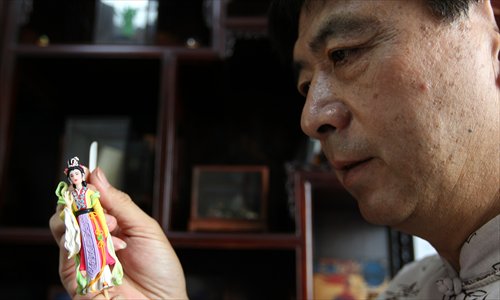
Zhang Baolin Photo: Cui Meng/GT
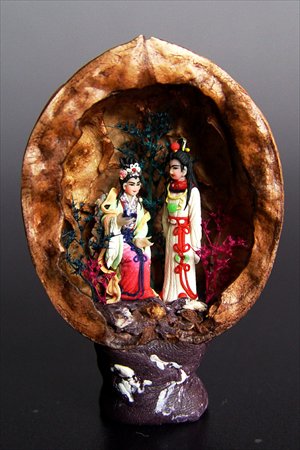
Zhang Baolin's dough figurine sculpture featuring Lin Daiyu (L) and Jia Baoyu from A Dream of Red Mansions Photo: Courtesy of Zhang Baolin
Wednesday, the annual Smithsonian Folklife Festival will kick off in Washington DC. This year's festival will feature eight Chinese performing art programs and 16 folk handcraft art forms showing a comprehensive picture of Chinese folklife as part of a tour titled China: Tradition and the Art of Living. The tour's next stop is the China Now Festival at the Harbourfront Centre in Toronto, Canada.More than 100 Chinese artists and craftsmen will show up at the festivals to exhibit traditional Chinese arts with their nimble fingers. Among them will be Zhang Baolin, a master of dough figurine making from Beijing who will bring dozens of his tiny sculptures to the festival.
"Though tiny, it is a craft and art that carries the profound culture of China and its 5000-year history," Zhang told the Global Times during an interview days before departing for the US.
Tiny ambassadors
A famed dough figurine artist, Zhang has traveled to more than 20 countries and regions to demonstrate his art. This time he is bringing figurines that reflect traditional Chinese culture, including Confucius, the Eight Immortals and the 12 animals of the Chinese horoscope.
"Compared to my other works, these can't be considered 'high-level,' but they are easily understood and closer to the lives of the general public, which makes sense since this will be a folklife festival," said the artist.
A traditional Chinese folk art, dough figurines are tiny sculptures usually several centimeters in height made from dough and sculpted by hand with simple tools. Originating from dough offerings made during traditional sacrificial ceremonies, the art can be traced back to the Han Dynasty (206BC-AD220).
Through the years, the art form has developed into different schools presented in various ways in different regions. Several schools such as "Mianren Li" (Li style dough figurines) in Shandong Province and "Mianren Zhao" (Zhao style dough figurines) in Shanghai are considered to be the top schools.
"Mianren Tang" and "Mianren Lang" are two big schools in Beijing. A student of the "Mianren Lang" school (itself an offshoot of "Mianren Zhao"), Zhang explained how the Lang and Tang schools differ from each other, with the former more like the gongbi (detailed strokes) style of painting which emphasizes fine brushwork, while the latter, which has a more free-form style, bears a greater similarity to traditional xieyi, or freehand, painting styles.
Most of Zhang's works consist of historical figures and important images from Chinese literature and are closely related to Buddhism, Taoism and Confucianism. Walking around his workshop you can guess who many of the figurines are by the way they dress, such as Yang Yuhuan, Lin Daiyu (from A Dream of Red Mansions), Bai Suzhen (Madam Snake) and so on.
Zhang explained that even though it's a folk-craft, making dough figurines demands that practitioners are well learned when it comes to history and culture, which can only be accumulated through years of reading and visiting places of historical interest.
"Mostly they have to already be in your mind. You don't have time to check a book during an improvised performance," he said.
"There's a story behind every figurine. When I performed overseas before, I told the stories behind the figurines to foreigners and they showed a lot of interest." Zhang said.
He added that this is what makes dough figurines great cultural ambassadors, "By learning these stories they grow more interested in China and its culture."
Self-taught artist
An inheritor of intangible cultural heritage, the 60-year-old Zhang has engaged in dough sculpting since childhood. His works cover a wide range of subjects, including history, literature, fairy tales and even important present day figures.
Zhang's works are famous for their meticulous portrayal and lifelike images, which have won him numerous awards. Among his most famous works are miniature figurines of the 108 heroes from Water Margin and the Buddha with 1,000 hands and 1,000 eyes.
His group sculpture of 133 important intellectuals ranging from the Warring States (475BC-221BC) period through to the first half of the 20th century is regarded as a breakthrough in dough figurine history.
Though well known among dough figurine circles, Zhang revealed that this was not something he inherited from his family, as for generations the Zhang family had originally earned their way by rigging shelters for vendors at temple fairs since the Qing Dynasty (1644-1911). When he was young this gave him the chance to get to know many craftsmen, including his teacher Lang Shao'an, the founder of the "Mianren Lang" school.
Obsessed with dough figurines, Zhang watched closely while Lang made his figurines and from there he started to learn the art.
"I'm not an official apprentice of Lang, but he was my teacher. I learned it as a hobby and made some figures in my spare time, which I would then bring to Lang to ask for his suggestions," Zhang said.
He started to create figurines professionally as a teenager in the 1970s, but later he experienced a tough time when he encountered the Cultural Revolution (1966-76), the advocates of which were cracking down on the creation of dough figurines. Zhang managed to continue the hobby stealthily, accumulating knowledge by reading books about clothing in Chinese history and comic books, and even by observing paintings of classic Chinese novels on cigarette cases.
From 1978 on, Zhang was able to earn a living by making dough figurines. After the China's opening-up policy came into effect, his works were put on the shelves of big shops and tourist sites, and for a time, he was even invited to hotels that catered especially to foreign tourists to sell his traditional handicraft items.
Passing on tradition
In addition to inheriting the skills of his master, Zhang has also added his own innovations, incorporating anatomy, perspective and color techniques, and Chinese painting techniques into his works.
Looking to present dough figurines in a different way, he has adopted modern means to make dough look like ivory or fine gemstones. For example, his sculpture of the Buddha with 1,000 hands and 1,000 eyes looks like it was carved from an emerald because he coated it with green fingernail polish.
However, passing on tradition is not easy, as most dough figurines nowadays are made to earn money and so many of the traditional handicrafts found in market places today are produced by machines. "They are just commodities, not art," Zhang noted.
Zhang now mainly focuses on teaching dough figurine making in communities and schools as part of a public welfare program.
"I used to go to universities like Tsinghua and the Communication University of China. Now my focus is on primary schools. It's important to let kids know about their traditional culture starting from an early age."
Newspaper headline: A bit of culture
Posted in: Art