Independent spirit
Young pianist talks music and life
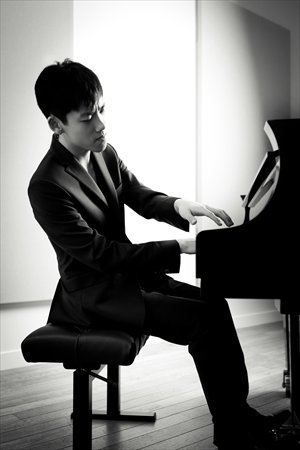
Zhang Haochen Photo: Courtesy of Zhang Haochen
While Lang Lang and Li Yundi are two of the most well-known piano idols in China, new names keep popping up all the time.
While one of these names, Zhang Haochen, may still sound unfamiliar to many people outside music circles, the deep and peculiar thoughts about music and life that seem far beyond what this twenty-something's age would indicate have been bringing more attention to this young pianist.
After years of studying abroad in the US, Zhang is currently set to tour his home country together with the Sydney Symphony Orchestra. Starting from Beijing and traveling to cities like Guangzhou, Shanghai and Shenzhen, Zhang will cooperate with the orchestra to perform Beethoven's "Emperor Concerto," one of the most challenging works for pianists and Zhang's favorite piano concerto.
Developing talent
The youngest and first Chinese competitor to be awarded the gold medal at the Van Cliburn International Piano Competition, Zhang entered the public spotlight on June 7, 2009, at the age of 19. Held every four years, the Van Cliburn International Piano Competition is regarded as one of world's biggest piano competitions, alongside the International Chopin Piano Competition and the International Tchaikovsky Competition.
A surprise to many, the award quickly brought Zhang's story to the attention of the public: Born in Shanghai, and learning the piano since childhood he gave his debut recital at the age of 5. After studying under Lin Heng, Wu Zijie and famous Chinese piano professor Dan Zhaoyi, Zhang moved to the US to attend the Curtis Institute of Music in 2005, becoming a student of renowned musician Gary Graffman.
Often referred to as a "talent" or "piano genius," Zhang said, however, that he never worries about whether or not he receives praise since he can't control the labels that other people give him. He also mentioned that he feels such labels are "very subjective and vague," and cannot define what a person really is.
Noting that he does believe talent to be the most important aspect for an artist, he feels that distinguishing between talent and effort is the wrong idea.
"For me they are just two sides of the same coin. The size of your talent enables how much you are driven to work, and how much you are driven to work shapes the continuous growth of your talent. I simply cannot treat them as two separate things," he told the Global Times in an e-mail.
Zhang is representative of the many Chinese children who begin to learn an instrument at an early age in order to cultivate their talent as well as fulfill the hopes of their parents. While Zhang has taken this hobby and made it into his life career, a majority of children often struggle to fulfill their parents' wishes. When asked his opinion on this type of education, Zhang replied that while it's a very positive thing to want children to develop in a well-rounded way, there's still a question of how to go about it the right way.
"When it comes to this, I think the path that lots of Chinese parents choose to take is not very 'healthy.' High scores on tests are only short term successes, not long-term," he wrote, referring to this way of thinking as "killing imagination."
Endless charm
Young he is, Zhang feels more affinity with the works Beethoven and Brahms produced during their later years or other types of as he puts it "introspective" music.
"This is probably due to my introverted personality," Zhang explained.
Understanding that he is still in an early phase of his life and still lacks rich life experience, Zhang admitted that he still can't fully understand these works, but at the same time he believes that when it comes to music age does not automatically mean one can comprehend something better as they get older.
"Music, due to its extremely abstract quality, should not be analyzed with 'thoughts' or 'philosophies' - inexplicable intuition plays the main role in music, unlike the role explicable thoughts and philosophies play in literature and most other arts. Therefore, the progress of worldly life does not necessarily define the depth of music," he told the Global Times.
Despite his love for these classic musicians, he still doesn't regard any musicians, contemporary or classical, as his idol, as he sees idolism as being linked to commercialism.
While he does admit that he does get inspiration from other contemporary artists, Zhang believes that in the end every artist should find their own path. "Not someone else's, be it career-wise or artistically," he said.
As a performer, Zhang is of the opinion that the endless reinterpretation of classical works by different performers is what gives them their eternal charm.
"Once a work is finished by a composer, the process of creation is passed down to the performers," he explained, adding that this is not always true of a work of music as it also depends on what kind of music it is and whether it allows personal interpretations.
At a time when it is hard to separate commercialism and art, young rising artists may find themselves losing their way. Which is one of the reasons why Zhang believes, "The most important thing is to always try your best to keep your artistic soul undisturbed and innocent."
Newspaper headline: Young pianist talks music and life