Shanghai Library Station
Quiet part of town steeped in art, literature and history
Editor's Note
This year is the 21st anniversary of the opening of the Shanghai metro. The subway has facilitated more than 13 billion journeys during its 21 years, and half of Shanghai citizens cite the metro as their favored mode of transport. To commemorate the anniversary, each week the Global Times will take an in-depth look at one metro station and its surroundings. In the case of downtown stations, we will focus on points of interest within walking distance; while for suburban areas, we will cast our net a little wider.
Despite being in the heart of downtown, Shanghai Library Station on metro Line 10 on Huaihai Road Middle is in a world of its own tranquility. Nearby can be found many cultural landmarks, historical buildings and the former residences of noted people.
Shanghai Library
Shanghai Library (1555 Huaihai Road Middle, 6445-5555) covers a total area of 127,000 square meters and is obviously the station's most important cultural landmark, best accessed from exit 2 of the station.
Founded in 1952, the building's exterior looks a little out-of-date, but once inside, you are quickly immersed in its strong cultural ambiance.
The library has over 53 million items in Chinese and other languages. As well as books, there are essays, articles and personal letters by noted figures, and newspapers, magazines and periodicals.
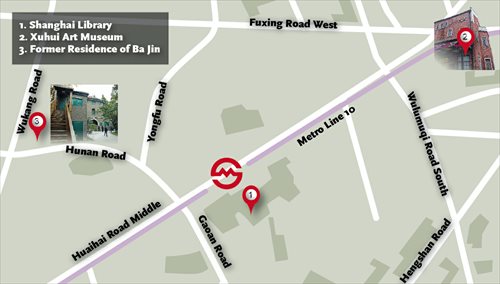
map
Readers aged 14 and above are eligible for a library card. There are different kinds for different services.
As well as regular reading and study rooms, the library also has lecture and exhibition halls, with free lectures and exhibitions regularly open to the public.
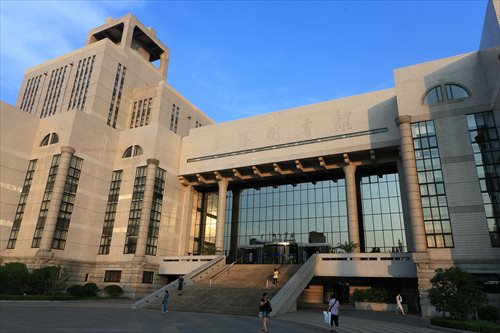
Shanghai Library is one of the city's most iconic cultural landmarks. Photos: Hu Bei/GT and CFP
One current exhibition, Reasons for Loving Shanghai (Wednesday to Saturday, 10 am to 5 pm) showcases cartoonists' depictions of Shanghai landmarks. Forthcoming is an exhibition of various ethnic musical instruments from China's minorities groups (July 8 to 14, 10 am to 5 pm).
A lecture on Saturday will focus on Mao Dun (1896-1981), the Chinese novelist and cultural critic, and his time living in Shanghai. The lecturer is Yang Yang, a professor from the Chinese department of East China Normal University.
For more information on joining the library and its upcoming events, visit http://www.library.sh.cn/.
Xuhui Art Museum
A 5-minute walk from the library at the intersection of Huaihai Road Middle and Fuxing Road West is Xuhui Art Museum (1413 Huaihai Road Middle, 6431-3738).
It is a three-story European-style red-brick building built in 1932 as Hongying Library. It is a protected district-level historical and cultural site. It was reopened as a museum in 2005.
The first two stories of 600 square meters are exhibition spaces. The wooden staircase reflects the museum's elegant style.
The current exhibition shows contemporary paintings from eight young Chinese painters mainly from Beijing, Shanghai and Guangzhou. The regional variations between them are clearly apparent. The exhibition will last until July 13 (9 am to 5 pm, closed on Mondays). The museum also regularly holds academic and education events.
Former residence of Ba Jin
Emerging from exit 3 of the station and walking along Gaoan Road to Hunan Road for about 10 minutes will bring you to the former residence of Ba Jin (113 Wukang Road, 3368-5656) near the junction of Hunan Road and Wukang Road. It opens from 10 am to 4 pm, Tuesday to Sunday and admission is free.
Ba Jin (1904-2005) was a Chinese literary giant who lived in the three-story Spanish-styled garden villa in the former French concession from 1955 to 1999. Originally built in 1923, the villa was reopened to the public as the former residence of Ba Jin in 2011, displaying items from his life, original manuscripts of his works and also photos of Ba Jin with his family and friends.
The first floor is where Ba Jin would work and meet with friends. Guests included French writers Jean-Paul Sartre and Simone de Beauvoir, the Nobel Prize-winning Chinese-French writer Gao Xingjian, and other literary names such as Shen Congwen, Cao Yu and Xia Yan.
At the small desk under the window on the first floor, Ba Jin wrote the masterpiece of his later years, Random Thoughts, which is generally regarded as the first example of a rethinking and honest examination of the Cultural Revolution (1966-76).
When Ba and his wife, Xiao Shan were living in the house, they suffered terribly during the Cultural Revolution.
Xiao eventually died in 1972 after being deprived of medical care.
Ba Jin's bedroom is on the second floor, with a small bed near the wall.
As well as Ba Jin's former residence, Wukang Road was also home to about other 30 well-known Chinese personages. These included Huang Xing (1874-1916), a revolutionary pioneer during the Republic of China (1912-1949) at 393 Wukang Road, and Tang Shaoyi (1862-1938), the first premier of the Republic of China, at 40 Wukang Road.