Tasting tail
Restaurants that serve up dishes with a twist
Compared with Western cuisine, Chinese cuisine is more creative, not only because of its complicated cooking methods but also because of the various novel materials used in the dishes. Duck necks and chicken feet, cast in the trash by Western cooks, are turned into delicious dishes. The Global Times has picked some restaurants in Shanghai that specialize in one such ingredient: animal tails.
Stew soup of pig tail with soybean
Located on Shanxi Road South near Tianjin Road, chain restaurant A Yingbao, featuring Hangzhou-style cuisine, is well-known for its stew soup of pig tail with soybean. Offering the dish for over 10 years, it is always among the three best-selling dishes across the chain. Eight out of 10 tables at the restaurant will order the dish.
Pig trotter and soybean stew soup has long been a favorite among Chinese people for its high nutritional value. But villagers in Zhejiang Province discovered the amount of collagen in pig tail is even higher than that of pig trotter. This led the restaurant to start offering the dish.
The most arduous part of cooking the dish is removing the hair on the tail. "The tails that have been preprocessed by slaughterhouses still have many tiny hairs on them," said Liu Jiang, executive chef of A Yingbao. "We have to epilate the tails manually, which is time-consuming. At least three hours will be spent preparing one dish. One dish contains three to four pig tails."
The restaurant uses small non-transgenic soybeans produced in Northeast China, which are softer than soybeans produced in other places. The seasoning and flavoring materials are common, such as dark soy sauce, rock candy, a large amount of yellow rice wine to reduce the smell of the tail, a little chicken essence and a little bit of hot pepper.
After the pig tail is cooked in water and cleaned, it is stewed in the water with a little lard oil, spring onion, ginger, pepper and yellow rice wine. When it has been cooking for an hour, the soybean is added and is cooked for another hour.
Since the pig tail contains much collagen, after two hours of stewing there is not much water left, making the soup thick and sticky. When it is cooled, the soup even turns into a jelly. The sticky soup is particularly good for the skin. There is no fat on the tail, only skin, lean meat and the bone. After two hours of stewing, the bone is very crisp.
Roast sheep tail
Tucked away on Renmin Road, Top Meat is a mutton restaurant featuring the Tan breed of sheep from Ningxia Hui Autonomous Region. The restaurant is owned by Shanghai Top Meat Agricultural Development Co, which has its own farms. The restaurant launched its roast sheep tail dish in Shanghai six months ago.
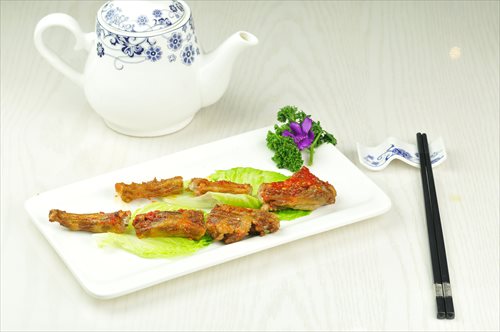
Roast sheep tail Photos: Courtesy of the restaurants
"The sheep is fed with grass, liquorice and herbs grown in our own farms, and mineral water produced in Ningxia. Since the sheep is fed with such natural foods, the meat is of high quality, tastes good and does not have the strong smell that other breeds of sheep usually have," said Zhou Xiaoyi, market specialist of the company.
"Tan sheep have long and fatty tails, which can be 30 to 40 centimeters long," said chef Mu Zhicang.
"The tail bone with a little flesh is only 15 to 20 centimeters long and has a diameter of 3 to 4 centimeters after the fatty outer skin is removed from the tail. Then the tail is pickled in scallion, ginger, pepper, star anise, cumin, bay leaf and other spices for two or three hours. Then the tail is roasted in the oven at 280 C for 15 minutes," said chef Gao Chunguang.
The roast sheep tail is a delicious light snack similar to mutton kebabs.
Oxtail braised with red wine
Hong Kong Cucai Restaurant is a Hong Kong-style cafe and restaurant that celebrates the traditional Cantonese method of cooking. The Shanghai branch of the chain restaurant is located on the fifth floor of Tengfei Plaza on Tianyaoqiao Road.
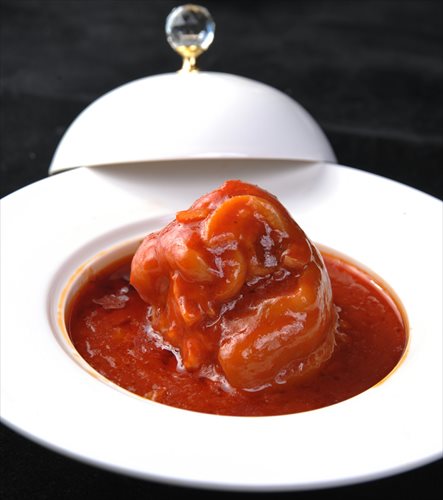
Oxtail braised with red wine
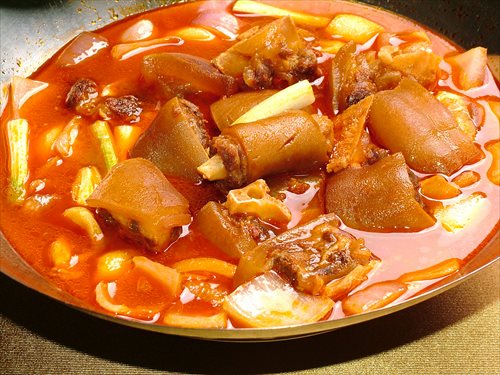
Oxtail braised with red wine Photos: Courtesy of the restaurants
Oxtail is widely used as a cooking material in China but oxtail braised with red wine (pictured below) is not a typical Cantonese dish. Like pig trotter, oxtail is rich in collagen.
Oxtail has a diameter of about 10 centimeters and it is usually about 1.5 meters long. "But only the middle part is suitable for eating. There is no thick fat, just skin and lean meat around oxtail bone," said Chen Jianchao, director of the restaurant.
Preparation is complicated. After it is washed, the tail is scalded with boiling water to remove long hair. Then it is burned to remove the tiny hairs. Finally, the cook plucks out the remaining hairs with tweezers.
The key to cooking oxtail is red wine. Chen suggested sweet red wine works best, with around 50 grams of red wine for every 500 grams of oxtail. Other cooking materials include celery, onion, carrot, parsley, cinnamon, bay leaf, sugar, honey, salt and chicken essence.
The oxtail and red wine are placed in a pot with these materials and a little water. It is then stewed in the oven for two hours. The taste is a little bit salty, and quite different to other forms of beef. "Since the oxtail has all the skin, lean meat and bone, its taste is better than beef," said Chen.