HOME >> ARTS
Unmasking history
By Xu Ming Source:Global Times Published: 2014-7-7 19:23:01
Tibetan artist looks to pass down tradition
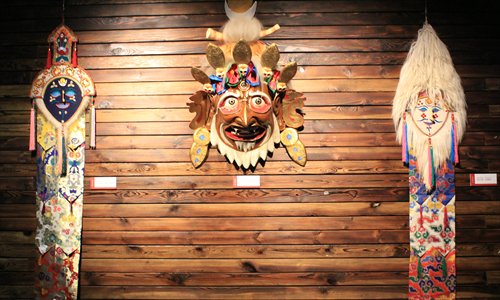
Three Tibetan masks hang on a wall during Exhibition of Tibetan Masks held at the Baimamedo Art Center in Beijing. Photo: Xu Ming/GT

Jamyang Yeshe stands in front of a religious Tibetan Mask. Photo: Xu Ming/GT
Educating people about the cultural heritage they have dedicated their lives to is the goal of many people who have chosen to carry on China's intangible cultural heritage. As such Jamyang Yeshe, a dedicated Tibetan mask artist, couldn't be happier with the exhibition that ended on Monday at the Baimamedo Art Center in Beijing."This is the biggest exhibition specially focusing on Tibetan masks that I can remember. It's an excellent platform to let people from other areas in China and even from the world learn more about this art," Jamyang, the curator of the exhibition and a master of the art form, told the Global Times on Sunday during his visit to Beijing to wrap up the exhibition at the 798 Art Zone.
Religious origins
Starting a month ago at the Baimamedo Art Center, a center specializing in promoting Tibetan culture by holding exhibitions and activities in the capital, the exhibition boasted 75 masks from different parts of Tibet, giving the audience a chance to view traditional art that is seldom shown to the public.
Derived from religious art, Tibetan masks have a history dating back more than 1,000 years. Masks can be divided into three types - religious masks, Tibetan opera masks and masks for folk performances. No matter their type, masks show a great variety of characteristics depending on what part of Tibet they are from and the occasion for which a mask is to be used.
In 2007, Tibetan masks were listed as part of China's intangible cultural heritage for the art form's distinctive regional features and the variety it possesses.
According to Jamyang, one of only two certified inheritors of Tibetan mask culture in Tibet, religious masks are mainly used in a religious rite called God Dance or hung in temples for worship. An excellent example of the mystique of religion, such masks are images of different types of gods, protective deities, ghosts and phantoms and therefore help human beings connect with the being they portray during the rite.
Tibetan masks use symbolic logic and hyperbole to highlight the characteristics of different figures. According to Jamyang's introduction, people familiar with Tibetan culture and religion can tell what a mask is by its shape, color and unique appearance.
For example, the masks of the deity known as the God Mother all feature a small nude body in her big mouth.
"It symbolizes the mercy of a mother. She catches her child with her mouth to prevent it from falling down," Jamyang explained.
Other masks, such as those depicting protective deities have several skulls on their head as means to protect from evil spirits.
Compared to religious masks, Tibetan opera masks are more secular and simpler in form, with three holes for eyes and a mouth and decorations for the head. They mainly represent figures, including people, gods and animals, from legends, history and fairy tales.
Similar to the role of facial makeup in Peking opera, one major feature of Tibetan opera masks is how they use different colors to represent characters in different roles. Dark red symbolizes a king, yellow a living Buddha and green a princess. Meanwhile, good people's masks are white and bad people's are black, while witches' are half white and half black, which shows their nature as double-dealers.
Inherited treasure
Masks used in religious rites are mostly made of wood, while those that get hung on the walls of temples for worship are made of clay, leather and paper pulp.
According to Jamyang, such masks require artists to have a basic foundation in fine arts, because they are actually sculptures that need to be carved or sculpted, colored and decorated.
Since these masks are related to Tibetan Buddhism, makers need to have at least a general knowledge about the figures that appear in Tripitaka (Buddhist cannon) and Tibetan legends.
"Even though figures vary in appearance in different areas and even in different temples, they have basic characteristics that cannot be changed," Jamyang said.
Comparatively speaking, Tibetan opera masks are easier to learn and make, as they are two-dimensional masks made of cloth. According to Jamyang, one can master this skill within four or five months.
Now 55, Jamyang used to study stage design at the Shanghai Theatre Academy. In 1983, his work led him to start learning how to make Tibetan masks. Now as a certified inheritor of the art, he teaches in a training institute for Tibetan masks in Lhasa.
"It is easier to make Tibetan opera masks, and they are in relatively more demand due to how well Tibetan opera is flourishing today. There are many workshops and factories that produce these masks," Jamyang said.
He pointed out that the Cultural Revolution (1966-76) caused a break in the passage of this art to the next generation. During this period, many Tibetan masks were destroyed, and now religious masks are mainly made by in temples and small workshops.
Another problem when it comes to passing on this tradition is that fewer young people are willing to take the time to learn the art, as it can take four to five years to master the art of making religious masks.
"People want quick returns. Most students at the institute are young people from rural areas who have no better options," he told the Global Times.
But Jamyang is not pessimistic about the future. With the support of the government, making masks has become an elective in vocational schools in Tibet, giving students who are interested the option to carry on this tradition.
Posted in: Art