Full of energy
Development of Xinjiang resources crucial to nation and local economy
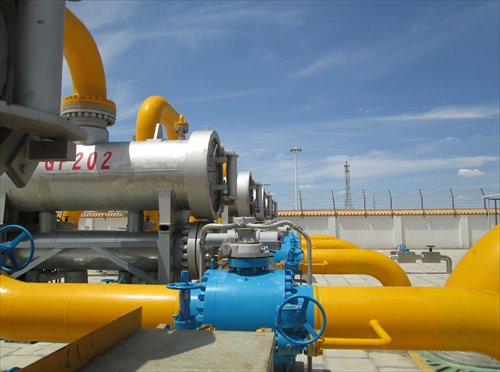
The gas gathering station of PetroChina Tarim Oilfield Co, a subsidiary of China National Petroleum Corp Photo: Liang Fei/GT
Located 200 kilometers west of Korla in Northwest China's Xinjiang Uyghur Autonomous Region and surrounded by the Gobi Desert, not much seems to be going on around the small town of Lunnan.
In reality, the area is full of underground energy resources and a vital part of China's natural gas industry.
Zhang Husheng works at a gas gathering station of China National Petroleum Corp (CNPC), the country's leading oil and gas producer, near the small town.
"My job is mainly to make sure all the facilities run properly and that there are no leaks," Zhang told the Global times on June 26.
Zhang's station gathers the natural gas produced from CNPC's gas field in the Tarim Basin. The station is located right next to the starting gas station of China's first West-East Gas Pipeline, which receives around 50 million cubic meters of natural gas from Zhang's station each day.
This pipeline, which begins in Lunnan and ends in Shanghai, has been transporting Tarim natural gas to the nation's eastern provinces for 10 years.
The Lunnan station transported 22 billion cubic meters of natural gas to eastern provinces in 2013, Zhang said, and with new gas fields in the Tarim Basin starting production, the volume could reach over 30 billion cubic meters annually in the future.
Strategic importance
Xinjiang is of great importance on China's energy map. The region is an important gateway for bringing crude oil and natural gas from Central Asian countries to China.
Xinjiang's oil and natural gas resources are mainly found in the Tarim Basin, Junggar Basin and the area near Turpan and Kumul.
The first West-East Gas Pipeline runs through nine provinces and regions and mainly channels natural gas produced in the Tarim Basin.
In 2013, the Tarim Basin produced 18.43 percent of the total 120.9 billion cubic meters of natural gas produced in China in 2013 - around 22.3 billion cubic meters, according to PetroChina Tarim Oilfield Co, a CNPC subsidiary that mainly explores the crude and gas resources in the basin.
Two other major natural gas blocks are under construction at present, the company told the Global Times on June 26, and annual production volume of the basin is expected to grow to 31 billion cubic meters in 2015.
The West-East Gas Pipeline system has contributed a lot to the country's energy supply. The second and third West-East Gas Pipelines, starting at the Horgos land port in west Xinjiang, mainly transport natural gas from Central Asian countries such as Turkmenistan and Kazakhstan.
More pipelines will be built to channel the natural gas from Central Asian countries. Besides the third West-East Gas Pipeline that is under construction at present, another two major gas pipelines are also under planning, officials at the China Petroleum West Pipeline Co, a subsidiary of CNPC in Xinjiang, told the Global Times on June 24.
Currently there are three major land passages for imported energy - Central Asian oil and natural gas via Xinjiang, Russian natural gas via Northeast China, and Myanmar natural gas via Southwest China's Yunnan Province.
Lin Boqiang, director of the China Center for Energy Economics Research at Xiamen University, said that the region will have a more important role. "Oil and natural gas resources from Russia and the Middle East may also come into China via Xinjiang in the future, and Xinjiang itself also has great potential in energy."
Chinese Overseas Port Holdings Ltd took over the operation of the Gwadar Port in southwest Pakistan last year, which will enable the transportation of crude oil from Iraq and Iran via the port to Xinjiang's Kashgar and is expected to form a fourth route for imported energy, experts noted.
Other resources
Besides crude oil and natural gas, Xinjiang has also stepped up efforts to explore its rich coal resources. Media reports said that the total predicted coal reserve of Xinjiang is at around 2.19 trillion tons, accounting for 40 percent of the country's total predicted reserve.
In March, China's National Development and Reform Commission approved Xinjiang's plan to become a major coal base for the country.
Currently Xinjiang's coal mainly supplies itself and nearby Gansu Province. In the long run, Xinjiang will also boost supply to Southwest China's Sichuan Province and Chongqing Municipality as well as central provinces, information on the website of Xinjiang's Development and Reform Commission showed.
Liu Jiyuan, vice president at CNPC subsidiary PetroChina Urumqi Petrochemical Co, noted that the energy sector would still be the focus of future development of Xinjiang, including oil and coal.
"Thermal power, coal chemical and coal gas projects have become an important part of future energy development in Xinjiang," Liu told the Global Times on June 24.
Xinjiang is also boosting clean energy such as solar and wind power, but Lin noted that it should keep its focus on traditional energy such as oil, as the cost of power production with solar and wind is too high.
Local benefits
Xinjiang's rich energy reserve does not only benefit State-owned companies as the energy industry is also opening to private capital, which will especially benefit local private firms, experts said, and more successful private companies are expected to emerge in the sector in the future.
Wang Yunquan, an executive at privately-owned Xinjiang Sanbao Industry Group, which used to focus on trade, told the Global Times on June 25 that the company is planning to invest 20 billion yuan ($3.2 billion) with companies from other provinces in Xinjiang's coal resources.
PetroChina, the listed arm of CNPC, said in May that it would establish a separate company comprising some assets of its first two West-East pipelines and introduce private investment. The move is part of CNPC's plan to introduce the mixed-ownership model.
Liu from PetroChina Urumqi Petrochemical Co also said that the company is looking to utilize the mixed-ownership model to explore opportunities in the petrochemical industrial chain.
Development of the energy sector has also brought tangible benefits to Xinjiang locals. PetroChina Tarim Oilfield Co has invested 6.4 billion yuan in a natural gas project in south Xinjiang, which finished construction in 2013. The project makes natural gas available for 4 million people living in south Xinjiang.
The CNPC oil chemical subsidiary that Liu works for has around 11,000 employees. Liu said that over 90 percent of them are from Xinjiang, with 19 percent from minority groups.
"It is very good to work here, as the energy sector usually pays well," said Kayer abay, a 32-year-old Uyghur employee who works at Liu's company and earns around 5,000 yuan each month at the plant.