Cutting the garbage mountain down to size
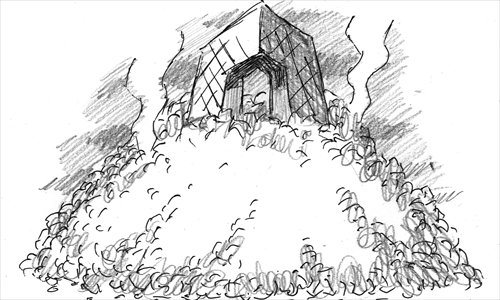
Illustration: Peter C. Espina/GT
In the 2006 science fiction comedy Idiocracy, a 26th century US city is destroyed by a great garbage landslide, in which a huge heap of trash outside the metropolis, accumulated over centuries, reaches its tipping point and collapses. Humanity, the movie suggests (tongue in cheek), is in danger of being buried alive under mountains of its own waste products.
Obviously the scene depicted in the film is an exaggeration. Nevertheless, nobody can seriously argue with the implication that for contemporary urban communities such as Beijing the efficient collection and disposal of trash is a pressing (and depressing) problem.
Solving it must keep urban planners awake at night. Where to put discarded plastic bags and rotting food? How to separate what can be recycled from stuff that cannot? How to decide which items are safe to be buried in landfills and which are not? How, in other words, to cut the garbage mountain down to size before it engulfs the city?
In this instance, it seems crucial that the issue of how to dispose of rubbish should be addressed via clear procedures which are well understood and adhered to by the city's populace. Unfortunately, in Beijing the necessity of implementing fixed guidelines for getting rid of waste appear to be lacking at present.
A case in point is the city's trash cans. These are everywhere, which is good, and come in pairs marked for 'recyclable' and 'non-recyclable' waste, which is also good. However, what is less good is the fact that there is no indication what type of waste is considered recyclable and what is not. At the moment, it seems that one is supposed to guess which can to throw one's candy wrapper into.
I also can't help but notice that students and employees on the campus where I teach appear, despite frequent proclamations about the importance of "green living," to be completely oblivious of the need for good garbage disposal habits. Most waste in dormitories ends up in big sacks, with nothing sorted at all. When bins overflow, rubbish is left lying all over the floor without a care, which is a recipe for cockroach infestation. In addition, a glance inside the dorm rooms themselves reveals that students do not keep their habitations any cleaner.
But it is not only the students who are at fault in this neglect. Festering piles of rubbish dot the city at frequent intervals. Our local park has its own 'garbage mountain' at the back of the public toilets. Most back streets are afflicted with pungent heaps of rotting food, from which ooze streams of disgusting effluent.
The point here is that effective systems for waste disposal seem to be lacking. In Beijing there are no containers, as there are in many European cities, into which to place bottles, paper, plastic and other recyclable items.
Thus the problem of waste disposal is one that Beijing urgently needs to tackle if it is to achieve the goal of becoming a truly world-class city with a clean environment. Rhetoric about green living and environmental consciousness is all fine and dandy; but only by developing proper systems to cope with trash and educating citizens in their use can China's capital hope to live up to the rhetoric, and avoid sinking under the weight of its very own garbage mountain.
This article was published on the Global Times Metropolitan section Two Cents page, a space for reader submissions, including opinion, humor and satire. The ideas expressed are those of the author alone, and do not represent the position of the Global Times.