HOME >> ARTS
Casting a spell
By Lu Qianwen Source:Global Times Published: 2014-7-15 18:53:01
Popularity of TV talent shows a boon for Chinese character learning
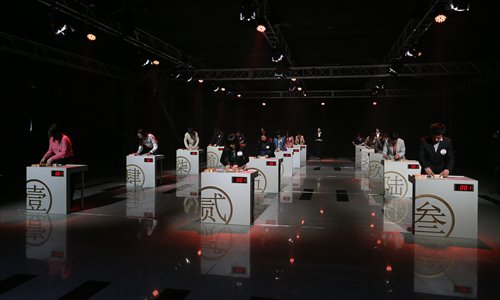
Contestants pit their character-learning skills against one another in the TV show Idioms Congress Photo: Courtesy of CCTV
One of the world's oldest living languages is facing a threat unlike anything it has encountered in its thousands of years of history. Like any language, Chinese has evolved throughout history - whether it was the decision to simplify Chinese characters or the rise of popular Internet phrases, the 20th century in particular has seen a tide of changes sweep the language. But now an unexpected challenge has come calling - lack of usage.Although they are part of the roots of Chinese culture, Chinese characters and idioms face the dilemma of being overlooked by modern people. Once they've graduated from high school and relieved of the taxing burden of handwriting homework, most students may seldom consciously try to memorize or practice writing Chinese characters or use idioms (except for those majoring or working in related disciplines).
Nowadays, it's not uncommon to pick up a pen only to find oneself unable to write a character - practically a normal social phenomenon now, excused by the fact that "we are in a digital era" - threatening a rift in the cultural consistency of the country. The question is now being asked: How can people maintain their interest in these traditional characters and idioms? The answer may come from an unlikely source - television.
Popular talent shows
Since a craze for talent shows first swept the country in 2005, with Hunan satellite TV's broadcast of Super Girls (a female singing competition), reality and talent competitions have become the go-to formula for TV producers looking for an easy hit, spreading to different types from stage performance to outdoor parenting.
Jumping on this trend, talent shows about spelling Chinese characters and idioms have appeared during the past years. This Sunday saw the second season of Dictation Assembly of Chinese Characters, a name that can trigger many people's memories about their elementary and middle-school period, debut on national screens. Produced by CCTV (China Central Television) and premiering in August last year, the first season has proved something of a hit among young audiences. With contestants drawn from Chinese middle schools across the country, Dictation Assembly aroused their enthusiasm as different levels of contests were held across the country.
Dictation Assembly is aiming to achieve the same longevity as the decades-old American show Spelling Bee, with producers making adjustments to each season according to the feedback of audiences.
Criticism that the program has put too much focus on the contestants' spelling ability, to the detriment of their understanding of those Chinese characters, has been well received: now a new round tests knowledge of those characters' origins and cultural evolution.
And Dictation Assembly is not the only program to focus on characters. The online Chinese Spelling Hero a co-production from iqiyi.com and Henan TV, premiered in 2013 and broadcast a second season earlier this year. Although smaller in scale compared to its CCTV counterpart, Spelling Hero has still garnered acclaim for the cultural take delivered by contestants and guests.
Look this way, young ones
On October 18 last year when the final competition of Dictation Assembly was broadcast, the audience rating for the program reached 2.59 percent, beating many other programs over the whole week. Despite this, an obvious limit to the program is its target audience, who are mostly middle and high school students - it fails to garner attention from young adults, who are considered a key force in maintaining cultural continuity.
Realizing this limitation, TV producers have this year developed several new programs, such as Chinese Idioms Congress by CCTV and Idioms Hero by Henan TV and iqiyi.com, both of which expanded their demographics of contestants beyond high-school students, especially Chinese Idioms Congress, which attempted to target college students and white-collar workers.
However, the reception for those programs did not go as well. Compared to the influence of Dictation Assembly after it was first broadcast, both Chinese Idioms Congress and Idioms Hero seem a little overshadowed. Maybe young people today are too busy focusing on careers and worrying how to pay their debts to fret too much about which radical goes where. Idioms like Hai kuo tian kong, literally meaning "unrestrained and far-ranging" but similar to "The sky's the limit" in English, are also much less a part of day-to-day life than writing characters.
According to figures provided by the CCTV Development and Research Center, the total viewership for Dictation Assembly was 670 million, as opposed to 559 million for Chinese Idioms Congress. Sponsorship for Dictation Assembly soared to 126 million yuan ($20 million) for its second season.
Still, compared to entertainment shows like Voice of China, the audience ratings are less reassuring. A quick Baidu search reveals their relative value: 65.5 million search results for Voice of China (compared to 84.7 million for the breakout reality show Where Are We Going, Dad?) but only 15.8 million for Chinese Idioms Congress.
Encouraged and protected
The insufficiencies of Chinese character spelling and "idiom contest" programs are obvious: They both suffer from generic formulae (even sharing the same rules, including gesticulations and guesswork); are rarely able to showcase interesting contestants, who can help boost the profile of a show beyond a traditional audience by sparking online conversation; practice an overarching focus on learning the characters, as opposed to their cultural heritage; and have a lack of interesting judges or guests. These are just some of the problems.
But when wrongly written words or mispronounced characters become commonplace, the ability to understand rare and historically-valued literature is degenerating and imitating foreign entertainment programs has become the norm, original cultural programs are precious and need to be protected.
As President Xi Jinping once declared: "Let those words in ancient books become alive again." Indeed, this is the actual slogan for the second season of Dictation Assembly; the country's leaders have more than once stressed the importance of cultural renaissance to the revival of the country.
When the mission undertaken by these programs is elevated to such a height, they are injected with a new energy. Dictation Assembly has mobilized nearly 12 million students across the country to participate in spelling contests, with more than 30,000 middle schools holding regional heats to choose contestants. Only 180 students may make the final grade on the TV screen - but it seems that increasing numbers of their viewers are seeing the benefits of good spelling, too.
Posted in: TV