The balance of penjing parenting
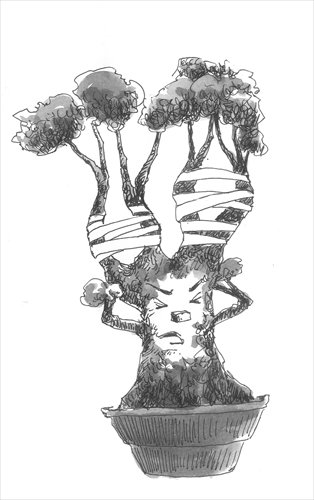
Illustration: Luo Xuan/GT
My father is an avid fan of penjing, the ancient Chinese art of miniature trees in potted landscapes, similar to those of Japanese bonsai trees. In our backyard, he maintains hundreds of these plants with fierce dedication.
An art form that dates as far back as the Tang Dynasty (618-907), trees are styled by the use of wires that are wrapped around branches to secure them in a set position, or they are clamped so that they grow in a particular manner. It is an art form that requires a meticulous approach to the pruning and nuturing of plants.
My father takes the same approach to parenting as he does with penjing: strict and largely traditional. When I was growing up, he didn't wrap my brother and me in wires or clamps, but we were nurtured to focus on our schooling and extra-curricular activities. If we misbehaved, we were put back in line. It was easy to resent my father growing up when all I wanted was to hangout and play with friends.
Once when I was 14 years old, I went into the backyard and asked my father for permission to spend the night at a friend's house. He was examining one of his favorite trees, a jade plant. Originating from South Africa, a jade plant was an unconventional choice of species for penjing, even though its shape was not unusual.
"Why do you want to stay up all night?" he asked, reaching for a pair of steel scissors. Delicately he trimmed a few of the new leaves from the jade plant.
"Because all of my friends…,"I started.
"Your friends have nothing to do with this," he said firmly. "You'll understand when you're older."
This was not an atypical exchange in our household. My parents staunchly refused to allow me to attend sleepovers, or to go on outings where boys would be attending, let alone on dates. Throughout high school my father walked me to the bus stop every morning, and waited at that same stop every afternoon for my return. Never once was I allowed just hangout after class.
On the other hand, my father tends to the penjing with the right amount of water, nutrients, and sunlight. Every day he meticulously checks that the trees are free from mold and insect eggs.
His patience is immeasurable - penjing trees take years to grow, inch-by-inch. Despite not being a traditional species for penjing, his jade plant has flourished. Sometimes if one of his trees begins to grow outside of the intended style, he adapts and adjusts the design to suit it.
He cared for his children in much the same way. He gave us weekly pocket money to teach us how to manage our own finances. He sent me to art and piano classes, and then allowed me to quit when I told him I wasn't interested. It was a little embarrassing to have my father follow me to the bus stop every morning, but it was also a relief when it rained in the afternoon and I saw him waiting there, umbrella in hand.
Raising children is not the same as growing penjing trees, but for both one needs to strike the right balance between control and natural development.
This article was published on the Global Times Metropolitan section Two Cents page, a space for reader submissions, including opinion, humor and satire. The ideas expressed are those of the author alone, and do not represent the position of the Global Times.