Literature’s lost lovers
The Chinese couple who astonished Britain and then vanished
In the winter of 1934, in London's West End, the premiere of Lady Precious Stream, an English play based on the traditional Chinese Peking Opera Red Mane Horse, made a great splash. English theater fans and critics discovered to their surprise that the elegant drama was written and directed by a Chinese man, S. I. Hsiung or Xiong Shiyi (1902-91) who had left China for Britain in 1932 to study Western theater.
After the premiere in London, the play was also performed throughout Europe as well as the US and British colonies of the time including Hong Kong, Sri Lanka, Trinidad and South Africa.
With Lady Precious Stream, Hsiung became the first Chinese director to work in the West End and on Broadway. And the script of Lady Precious Stream was adopted as a classroom text in Britain during the 1930s and the 1940s.
While Hsiung was in Britain from 1932 to 1936, he also translated the classic Yuan Dynasty (1279-1368) play The Romance of West Chamber into English.
In 1952, Hsiung's wife Dymia Hsiung (Cai Daimei) wrote a book in English - Flowering Exile: An Autobiographical Excursion and was reportedly the first Chinese woman in Britain to have published a fictional autobiography work.
Lives chronicled
Now the lives of this pioneering couple have been chronicled in a new book The Happy Hsiungs. Written by Diana Yeh, a senior lecturer in sociology at the University of Winchester, the book traces the lives of the Hsiungs, from their childhood in the Qing Dynasty (1644-1911), through their youthful adventures with the radical May 4th Movement to their struggles to succeed in Britain and the US.
According to Yeh, this is the first English book published on this fascinating Chinese couple. For her research Yeh traveled to London, Beijing, Taipei and Washington to interview surviving friends and family of the couple.
"The Happy Hsiungs is an attempt to reinstate that history, while also providing a means of thinking about pressing issues of race, identity, migration and belonging and the challenges of living with differences that we continue to face today," Yeh said.
"They were once highly visible in Britain, but are now largely forgotten in Britain and in China," Yeh told the Global Times.
Several years ago, when Yeh read the copy of Lady Precious Stream for the first time, she was spurred to do further research about the Hsiungs and she discovered to her surprise that the Hsiungs' story had largely been forgotten in academic literary circles. Her task was made difficult because the couple had never been given much scholarly recognition.
"Although Lady Precious Stream enjoyed enormous success and visibility in the 1930s in Britain, the Hsiungs when they were living in Britain, still faced real challenges in making the contributions that they hoped to."
According to Yeh, even though Lady Precious Stream was widely praised, some British newspapers of the time, for example, described it as the "oddest play in London."
"What was 'odd and new' about it was that its author was Chinese," Yeh said.
"And some even doubted Hsiung's claims to authorship, saying the quality of his play suggested a collaboration between 'three or four of the best living European dramatists.'"
As Hsiung himself once wrote, "whenever I refused a cigarette ... my host invariably apologized for not being able to supply me with a 'pipe of peace' [opium] ... wherever my wife went, her feet always proved to be the chief attraction."
In her book Yeh argues that although the Hsiungs enjoyed enormous success and fame, their influence was in fact limited.
"Certainly, the challenges they faced as 'Chinese' writers in 'the West' remain very pertinent today," Yeh said.
During their time in Britain, the Hsiungs became acquainted with many major literary figures like George Bernard Shaw and James Barrie. It was Shaw, in fact, who advised Hsiung, "try something different. Something really Chinese and traditional," and this motivated him to adapt the Peking Opera for the British stage.
According to Yeh, in China, the couple's homeland, Hsiung's legacy has been rendered almost invisible for a long time due to his reputation as a "right wing" writer. His wife Dymia's work, Flowering Exile is not acknowledged at all.
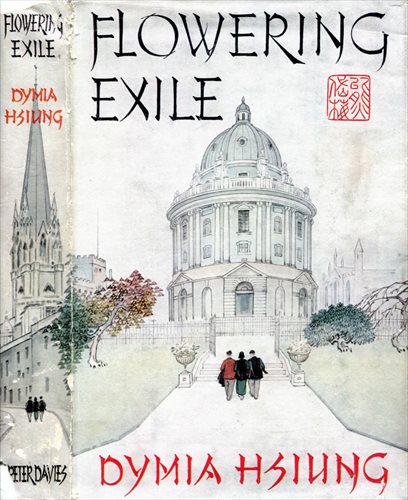
Flowering Exile, an English book written by S. I. Hsiung's wife Dymia Hsiung in 1952 Photos: Courtesy of Diana Yeh
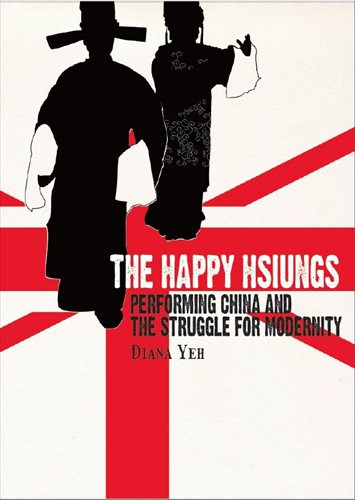
The cover of The Happy Hsiungs by Diana Yeh
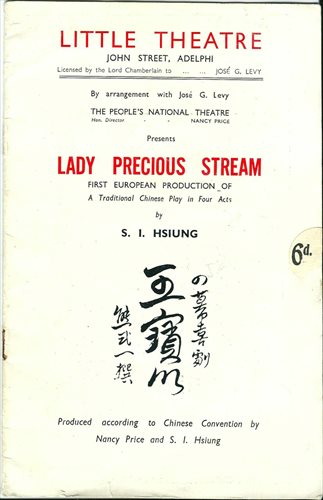
The script of Lady Precious Stream by S. I. Hsiung
All but hidden
"The Hsiungs' story has been almost all but hidden - even their second son Deni Hsiung kept their history from his own children until the 1980s for fear of political reprisals.
"The Chinese mainland version of Lady Precious Stream wasn't published until 2003 by the Commercial Press," Yeh told the Global Times. "And in 2010, several of Hsiung's essays originally published in the journal Hong Kong Literature were collected in a book entitled Bashi Huiyi, published by Dolphin Books in 2010. Since then, scholarly articles on Hsiung have begun to emerge in China."
The 1943 novel The Bridge of Heaven, another of Hsiung's important English works about a Chinese family in the late Qing Dynasty was published in Chinese for the first time in 2012.
The Bridge of Heaven was generally regarded as a vivid social commentary about China in the late 19th and early 20th century and included vivid accounts of local customs in Nanchang, Jiangxi Province, Hsiung's place of birth.
Yeh said S. I. Hsiung, who was born in 1902, has recently been declared by Shu Yi, the son of Lao She and former president of National Museum of Modern Chinese Literature, as "one of the three masters who greatly contributed to the cultural exchange between China and the West," alongside Lin Yutang and Chiang Yee (Jiang Yi).
The couple returned to China from Britain in 1936. From the 1950s on, S. I. Hsiung taught at universities and colleges in Hong Kong and overseas. He died in Beijing in 1991.