Appearance is everything for modern Chinese
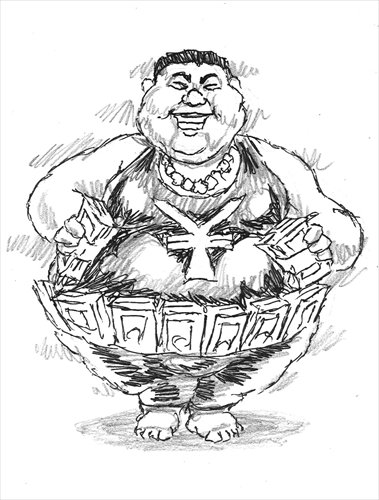
Illustration: Peter C. Espina/GT
It is said that whenever a policeman wrangles with an ordinary person on the street, Chinese netizens automatically side with the ordinary citizen and blast the policeman altogether. But wait, this is not true if the "bullying" policeman involved is very handsome.
The netizens, seen as embodiment of justice, are truly a group of emotional fence-sitters. In a recent case, Jiang Hu, a traffic policeman in Deyang of Sichuan Province, was exposed online for bullying a car driver. According to an online post, Jiang stripped off his own uniform, preparing for a fight, and said aggressively, "Come on! I am undressed and you can beat me as you wish!"
Several photos were attached. Jiang, trying to grasp the camera, was half-naked, with perfect muscles, stout body lines and a handsome, melancholy face. Netizens were totally heartbroken, "How could such a handsome guy make any mistake?" Jiang was reportedly dismissed soon by local authorities for violating discipline on duty and hurting the image of the police.
After the incident, Jiang posted a Weibo statement, with a selfie, saying that everything had settled down and he had learned a lesson. Although Jiang has only written four posts on his Weibo, the number of his followers has soared to more than 27,000. One netizen joked, "I am totally disappointed at this superficial world that only looks at your face."
I have to say that the Chinese are increasingly straightforward when talking about the importance of appearance. Just one or two decades ago, people still at least pretended to care more about character, rather than outward appearance.
But today, whenever a girl complains on her miserable matchmaking experience online, batches of netizens would arrive, question about her looks and ask her to reflect upon her own appearance.
A bestseller teaching girls to find Mr Right, lists "dressing up and wearing makeup" as the No.1 golden rule. In the author's words, "If you are not beautiful, people do not even have the interest to learn about your internal beauty, okay?"
Increasing importance attached to appearance is part of the materialistic values in current Chinese society. One female friend, talking about the criterion to judge a guy's appearance, said, "What is being handsome? A rich guy can automatically become handsome."
This may sound too money-worshipping, but it is not totally groundless. Those with higher incomes often spend more time on their figure and pay more attention to their looks. They go to the gym, buy fine clothes, and the nice environment they live in also make them look better.
In China, those who prioritize "looks" when they judge others say they belong to the "appearance club."
One famous microblogger once defended this club, saying that it is totally scientific to judge a person in this way, "Standing posture exposes one's demeanor, and a few steps can tell how he judges himself. Facial expression narrates whether he is happy recently, while on the forehead you can find his past years. Aesthetic tastes and personality are in clothes and hair styles. Self-cultivation is on his feet, whereas profession is manifested through hands." Finally, this microblogger added, "poverty can be seen from all the parts I just mentioned."
Personally I see it a good thing that people stress appearance more, at least for the country's national image. I remember there was a survey, saying that the mainland tourists abroad could be easily identified, because they are not just loud, but usually carry more cellulite. It is good that this is changing. Nowadays more and more Chinese stay fit and neat.
But a country that puts appearance above everything else may find itself hollowed out from the inside. On the eve of the national college entrance examinations, there was a widely circulated microblogging post, "Try your best tomorrow teenagers, because this will be the last battle in your life which doesn't judge you by your looks."
The author is an opinion editor with the Global Times. chenchenchen@globaltimes.com.cn