'Make cashmere like Japanese food’: Q&A with fashion designer Junko Koshino
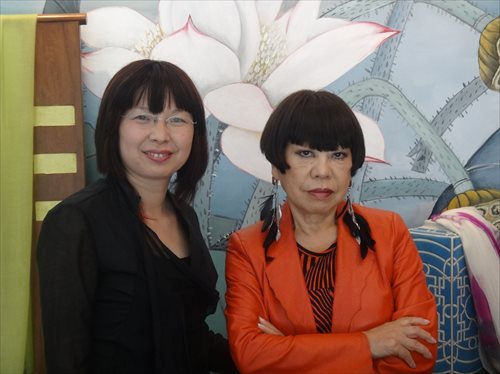
Juliet Guo (left) and Junko Koshino Photo: Sand River
Interviewer:You came to China in 1978 and later held several fashion shows here. It can be said that you witnessed the entire development and evolution of China's fashion industry. What do you think about the changes in China's fashion?
Junko Koshino:I clearly remember that after my first fashion show, my husband and I walked on Shanghai's Nanjing Road. Our hairstyle and clothing were so unconventional in 1985 China that more than one hundred people followed us on the street. At that time in China, so-called fashion was almost a blank field. Therefore when we held our first show in China, we had to hire an ANA charter to bring nearly everything, such as clothing, carpets, cosmetics and even glue from Japan. Same as Ms Li Zhao, when I made that show I had a sense of responsibility to let Chinese see what the world's fashion trends are.
And because of that, then Beijing's mayor invited us to open a boutique on famous Wangfujing Street "to decorate the shabby Wangfujing," he said. In 1987, I opened the first boutique on Zhushikou Street in Beijing. And we sold cashmere and wool products at that shop. But because back then Chinese technology and textiles were still relatively less developed, which could not meet the design and style I expected, the only thing I could do for China's textile factory was just coloring. The cashmere sweaters they made were too thick to be called fashionable.
I witnessed China's fast development over the past decades and Chinese have made great leaps in their understanding of fashion. Chinese culture is the root of Asian culture. Shanghai was much more fashionable than Japan a hundred years ago, and Shanghai's fashion influenced Japan until the early Showa period (1926-1989). Needless to say, Tang Dynasty (618-907) culture nourished and brought a steady stream of fashion to Japan.
Due to various reasons, I've been in cooperation with European companies since 1990. But now, it seems that fate has brought me back to China after going half way around the globe. As in Japan, the Chinese believe that everyone seems to flock to European brands. I think this belief should be proven wrong. The East will certainly have its own top brands in the future, and I have high expectations for China. Also I am looking forward to Sand River's success.
Interviewer:Sand River (www.sandrivercashmere.com) is a new China brand. What attracted you, a famous master designer, to cooperate with Sand River and be its chief designer?
Junko Koshino:First, I couldn't let go of my 30-year relationship with China. I love it. Secondly, I really like cashmere; it's a high-quality raw material. Besides, Ms Guo, the founder of Sand River, has more than two decades of experience working with cashmere and also spent two years studying textile program development and fashion technology. She is a master of the cashmere craft. What's more, Sand River has its own special rangeland resource in Inner Mongolia, China. It produces the highest quality raw material for cashmere. Such precious and rare raw material is incomparable. In my opinion, Sand River can turn my design idea into a real clothing product, which I have never been able to achieve before. I have even cooperated with an Italian cashmere company and they could not realize my design idea. But Sand River can! Our relationship happened so naturally. It's fate.
I often say that, the clothing industry has three elements: materials, technology and design. Sand River has good cashmere and advanced technology, and I have design. Therefore the three elements are all here. And these elements combine with and promote each other to achieve our goal, the Arts of Cashmere. I believe that the cashmere we make is not only a product, but also high fashion, even an art. We have boundless prospects.
Interviewer:We know that you like using squares, circles and triangles in your designs. And you like using contrasting colors, such as black, red and gold. Will you continue to use these ideas at Sand River?
Junko Koshino:Of course I will. The Eastern concept of Yin and Yang is my inspiration for design. I think it is the essence of Oriental culture. The so-called Yin Yang represent dialectics such as the heaven and earth, male and female, white and black and left and right.
The first time I arrived in China several decades ago, the idea of Yin and Yang was already deeply rooted in my mind when I caught sight of the Temple of Heaven and the Forbidden City. You know, the Temple of Heaven is round and the Forbidden City is square. Round heaven and square earth represents the Eastern perception of the world and nature.
As I said before, there is a myth surrounding European brands and culture in Asia. In fact in my opinion, Eastern and Western brands both have their strong points. Western-style clothes are functional while Japanese kimonos are aesthetically pleasing. We describe good food as meiwei, which means it's not only delicious but is visually appealing. Therefore, oriental design style should make up for what European style doesn't have. It should be complementary.
We will make cashmere like Japanese food. Sand River's products are not only visually appealing but also practical. You know, cashmere is suitable for all ages and high-quality, light and fashionable cashmere products are essential for every family. Therefore our products are rich and varied. Our product lines range from women's and men's to kids' clothing, from coats, scarves, sweaters, pants, gloves and socks to pajamas. The price is just a little higher than normal clothing. It is affordable to the increasing number of China's middle-class families and it can help them experience a sense of affluence. We hope that these cashmere products will go global and change the world's stereotype of them. You will find cashmere products are not only warm and delicate, but also fashionable and beautiful.
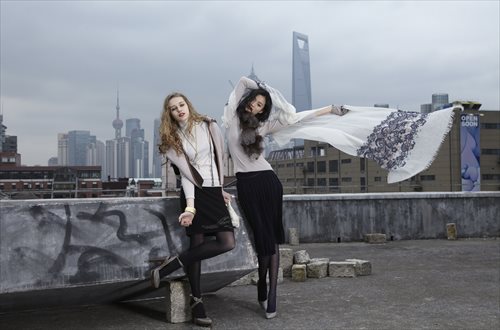
Photo: Sand River