HOME >> CHINA, METRO SHANGHAI
A home abroad
By Huang Lanlan Source:Global Times Published: 2014-8-5 19:08:01
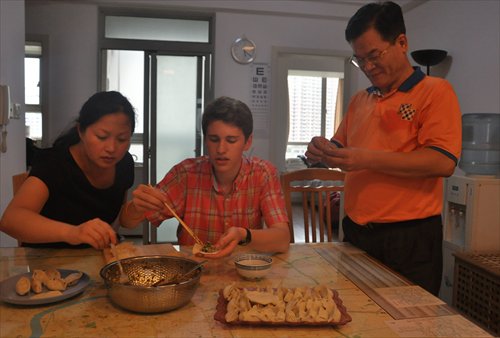
Sitting at a dinner table, 17-year-old Ranulph Hely Hutchinson, from the UK, wrapped dumplings with a middle-aged Chinese man whom he had known less than a week.
It was an ordinary Sunday evening at the end of July. The pair chatted as they worked. "I'm going to travel to Yunnan Province," Ranulph said slowly in Chinese.
"That is a beautiful place," said the man, Wang Koubao. "In western Yunnan, there is a 'kingdom of women,' where the local Naxi people live with their mothers and don't even know who their fathers are."
Ranulph came to Shanghai with the intention of traveling around China for two months. He studied Putonghua for two years in high school and has been to Shanghai three times before. Rather than stay at a hotel, this time he chose to live with a Chinese family in Baoshan district.
"Homestay is much more interesting, as I could stay with real Chinese people rather than in a fabricated environment," he told the Global Times. "There's nothing to do just staying in the hotel."
In April, Ranulph found Homestay Shanghai online, an agency that helps foreign visitors find a host family in the city. He sent the agency an e-mail with his application and resumé. The agency responded with a photo of Wang and his wife, as well as some basic information about them.
Homestay Shanghai receives several applications a month from foreigners, though the number can reach as high as 20 just before and during the summer holiday, said Shen Yiqing, the agency's director.
Shen added that many of her homestay applicants come to Shanghai to attend Chinese-language classes. "Most are 20-year-olds from Western countries such as the US, the UK, Germany and France," she said.
Living with locals, these students can practice the language while immersed in Chinese culture.
Homestay Shanghai was established by Shen and her Dutch friend Martin Doth in 2007, when she was working for a local language training school. Her foreign students and friends encouraged her to start the business. "Actually homestay was quite new to China at that time. Most people had no idea what it was," she told the Global Times.
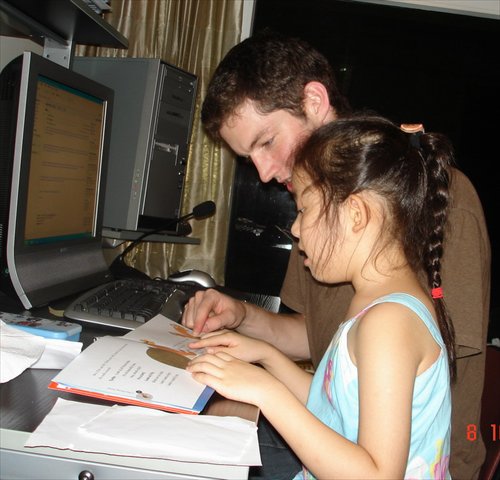
The agency arranges free homestays as well as those that cost a fee. The latter requires guests to pay rent to the homeowner, which runs between 1,500 yuan ($242) and 2,500 yuan a month. The free homestay requires guests to teach their host families English for five hours a week.
The agency has registered more than 100 local families willing to host a foreign guest. All of them live close to a metro or bus station and are able to offer private bedrooms to the guests, Shen said.
Wang's family has hosted about 20 foreign guests. Sharing a 120-square-meter apartment with just his wife, Wang sometimes feels lonely at home. "I like talking with young people," said the 54-year-old, adding that his daughter no longer lives with him.
As a homestay family, the couple has an opportunity to meet young people from many countries. Although Wang and his wife speak only a little English, they don't have problems communicating with their guests, as Wang said he usually has a Chinese-English dictionary at hand.
Gestures can also help get the message across. Wang mentioned that on one day in 2008, he tried to tell his British guest that it was going to rain. When she didn't understand, he pointed out of the window and turned on the water faucet. "That made sense to her," he said with a smile.
Wang is proud that he can remember the name, age and personality of every guest who ever stayed at his home. Many of his guests still stay in touch with the family after leaving Shanghai. "They are young, friendly and outgoing," he said.
The only exception was an Austrian woman who stayed in Wang's home in May. Wang said she was introverted and unsociable. He tried many times to talk with her, but she always refused and walked away. The woman finally cut short her homestay after living with the family for 10 days.
"For the guests and hosts, tension is sometimes inevitable because of the cultural differences between China and other countries," Shen told the Global Times.
She mentioned that one morning she received a call from a host family, who complained that their guest had washed her slippers in their washing machine, which is a no-no as many Chinese believe that shoes are too dirty to wash in the same machine as their clothing.
The guest, a woman from the UK, later told Shen that she was quite confused that day. The woman had no idea why her host was unhappy and chose to complain to someone else rather than directly to her. "Generally speaking, Chinese people are reserved, and they are reluctant to criticize someone to his face, while foreigners, especially Westerners, are more willing to directly express their feelings," Shen said. "I strongly suggest that host families and guests communicate with each other, as communication is the best way to clear up misunderstandings."
Those interested in applying for a homestay can go to http://www.homestayshanghai.net/index.htm for more information.

It was an ordinary Sunday evening at the end of July. The pair chatted as they worked. "I'm going to travel to Yunnan Province," Ranulph said slowly in Chinese.
"That is a beautiful place," said the man, Wang Koubao. "In western Yunnan, there is a 'kingdom of women,' where the local Naxi people live with their mothers and don't even know who their fathers are."
Ranulph came to Shanghai with the intention of traveling around China for two months. He studied Putonghua for two years in high school and has been to Shanghai three times before. Rather than stay at a hotel, this time he chose to live with a Chinese family in Baoshan district.
"Homestay is much more interesting, as I could stay with real Chinese people rather than in a fabricated environment," he told the Global Times. "There's nothing to do just staying in the hotel."
In April, Ranulph found Homestay Shanghai online, an agency that helps foreign visitors find a host family in the city. He sent the agency an e-mail with his application and resumé. The agency responded with a photo of Wang and his wife, as well as some basic information about them.
Homestay Shanghai receives several applications a month from foreigners, though the number can reach as high as 20 just before and during the summer holiday, said Shen Yiqing, the agency's director.
Shen added that many of her homestay applicants come to Shanghai to attend Chinese-language classes. "Most are 20-year-olds from Western countries such as the US, the UK, Germany and France," she said.
Living with locals, these students can practice the language while immersed in Chinese culture.
Homestay Shanghai was established by Shen and her Dutch friend Martin Doth in 2007, when she was working for a local language training school. Her foreign students and friends encouraged her to start the business. "Actually homestay was quite new to China at that time. Most people had no idea what it was," she told the Global Times.
The agency arranges free homestays as well as those that cost a fee. The latter requires guests to pay rent to the homeowner, which runs between 1,500 yuan ($242) and 2,500 yuan a month. The free homestay requires guests to teach their host families English for five hours a week.
The agency has registered more than 100 local families willing to host a foreign guest. All of them live close to a metro or bus station and are able to offer private bedrooms to the guests, Shen said.
Wang's family has hosted about 20 foreign guests. Sharing a 120-square-meter apartment with just his wife, Wang sometimes feels lonely at home. "I like talking with young people," said the 54-year-old, adding that his daughter no longer lives with him.
As a homestay family, the couple has an opportunity to meet young people from many countries. Although Wang and his wife speak only a little English, they don't have problems communicating with their guests, as Wang said he usually has a Chinese-English dictionary at hand.
Gestures can also help get the message across. Wang mentioned that on one day in 2008, he tried to tell his British guest that it was going to rain. When she didn't understand, he pointed out of the window and turned on the water faucet. "That made sense to her," he said with a smile.
Wang is proud that he can remember the name, age and personality of every guest who ever stayed at his home. Many of his guests still stay in touch with the family after leaving Shanghai. "They are young, friendly and outgoing," he said.
The only exception was an Austrian woman who stayed in Wang's home in May. Wang said she was introverted and unsociable. He tried many times to talk with her, but she always refused and walked away. The woman finally cut short her homestay after living with the family for 10 days.
"For the guests and hosts, tension is sometimes inevitable because of the cultural differences between China and other countries," Shen told the Global Times.
She mentioned that one morning she received a call from a host family, who complained that their guest had washed her slippers in their washing machine, which is a no-no as many Chinese believe that shoes are too dirty to wash in the same machine as their clothing.
The guest, a woman from the UK, later told Shen that she was quite confused that day. The woman had no idea why her host was unhappy and chose to complain to someone else rather than directly to her. "Generally speaking, Chinese people are reserved, and they are reluctant to criticize someone to his face, while foreigners, especially Westerners, are more willing to directly express their feelings," Shen said. "I strongly suggest that host families and guests communicate with each other, as communication is the best way to clear up misunderstandings."
Those interested in applying for a homestay can go to http://www.homestayshanghai.net/index.htm for more information.
Homestayer Ranulph Hutchinson makes dumplings with his host family. Photo: Huang Lanlan/GT
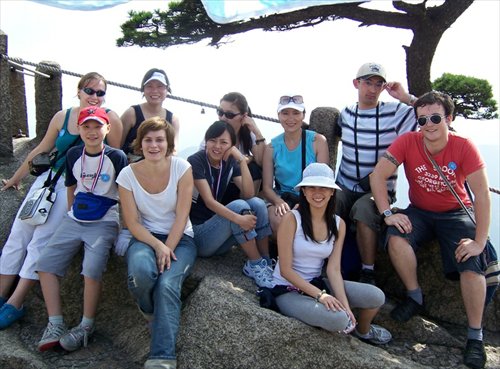
Foreign visitors on homestays in Shanghai visit Huangshan Mountain and sing karaoke with their host families.
A visitor teaches English to the daughter of his host family. Photos: Courtesy of Shen Yiqing
Posted in: Society, Metro Shanghai