HOME >> ARTS
Clay cuties
Source:Global Times-Sanlian Life Week Magazine Published: 2014-8-7 19:33:01
Intangible heritage uses market to survive
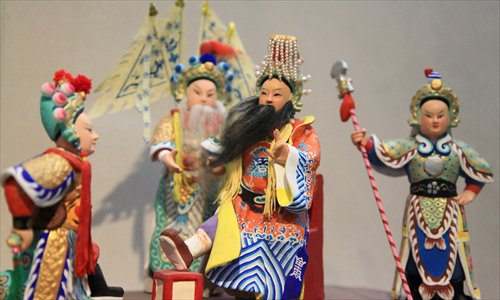
A set of opera figurines Photo: CFP
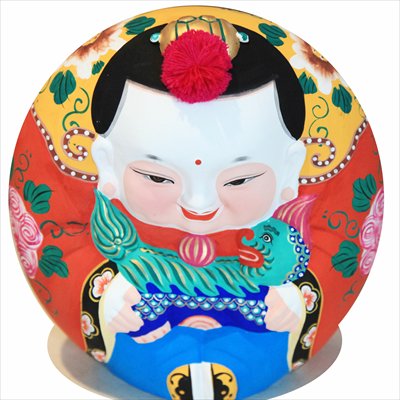
An A Fu figurine Photo: CFP
Listed as part of China's intangible cultural heritage since 2006, Huishan clay figurines are probably one of the most commercialized types of intangible cultural heritage. For visitors traveling to Wuxi, a hot vacation spot in Eastern China's Jiangsu Province, nine out of 10 will make sure to make a stop at the city's Huishan district to buy a couple of these cute local traditional clay figurines.
While many may still stick to the conventional concept that commercialized objects can never be true art, these clay figurines show the opposite to be true. The high commercialization of these figures not only underscores these artworks' popularity among visitors, it also protects this ancient cultural heritage from withering and dying, a danger that many other intangible heritages in the country are facing.
Commercialized artwork
Dating back to the Northern and Southern Dynasties (386-589) period, the art of making Huishan clay figurines has been developing and evolving for more than 1,000 years. While the Ming Dynasty (1368-1644) is considered a prime period for the art's development, in the Qing Dynasty (1644-1911) professional handicraft workshops began to appear. These shops can still be seen sitting row after row along the streets of Huishan.
Of course the figurines themselves aren't just limited to the Huishan disctrict, visitors can see them at boutiques or big stores at almost every sightseeing spot in Wuxi. Smiling while holding either peaches or a shoe-shaped gold ingot (both auspicious signs in traditional Chinese culture), dozens or even hundreds of A Fu (the chubby little boys that are the most popular image used in clay figurines) sit side by side on the store counter. Ranging from dozens to hundreds of yuan, many of them end up being bought and taken to different places around the country or even the world.
"Some foreign visitors prefer figurines without any color, just plain clay," said Wang Mudong, the former president of the Huishan Clay Figurine Research Institute. "Our understanding is that they come here to experience real local culture, and that clay is the core [of this culture]."
Smooth and soft, the clay in Huishan has distinctive characteristics. Not easily broken or separated, local clay is perfectly suited to be molded by hand. "Looked at as a work of art, the spirit of a clay figurine is the most important part, since it can invoke different emotions in whoever buys it," said Wang.
Huishan figurines count among the collections of museums throughout China. Whether it's the National Art Museum of China or local museums in Wuxi, people can see many different types of Huishan clay figurines on display.
In one go
Of course whenever a particular art form enters the market place, changes to the form are inevitable, but not all those changes are necessarily negative. The types of Huishan clay figurines seen today are the most popular images that have been chosen by over 1,000 years of development and market forces. Out of all of these, A Fu is the one that sells the best.
"The images of cats and cattle (that used to be popular) are gone now, A Fu is the only one left," said 75-year-old Yu Xianglian, one of the most experienced veteran clay figurine artists in the region.
Besides A Fu, traditional opera figures are also very popular. Presented as an individual or in a group, these opera characters exemplify the essence and competitiveness of Huishan clay figurines, which are often compared to Tianjin clay figurines, another historically famous type of intangible cultural heritage.
Whereas Tianjin clay figurines can add or remove pieces of clay as needed, Huishan clay figurines are more about molding a certain amount of clay into shape.
"Clay must be molded in one go. Hence for those who make these figurines, they must have a very clear image of the product they want to make before they start," Yu explained.
These different handcraft techniques cause the two types of figurines to have different characteristics. While Tianjin clay figurines look more realistic in appearance, their Huishan counterparts are more about conveying an abstract spirit or feeling, which is further underscored by another distinctive characteristic: the use of color.
A touch of color
A popular saying among figurine makers shows just how important this coloring is, as every figurine is seen as consisting of "30 percent molding and 70 percent color." This coloring is another feature that sets Huishan figurines apart from those made in Tianjin.
Usually after Yu finishes molding a piece by hand, the rest of the work is completed by her partner, coloring master Wang Nanxian. This coloring work can be especially difficult for some figurines, such as figures from traditional opera, as delicate coloring is used to underline facial expressions and the make-up used by these performers, as well as their costumes and small details like accessories.
These designs often have symbolic significance. For example, the clothing of Liu Mengmei - the hero of the Ming Dynasty play The Peony Pavilion, is covered with small plum flowers, a call back to his name - Mengmei (Dreaming of plums).
"Besides clothing, facial expressions are also important when it comes to conveying the characters' emotions, as well as the personality of the character from a play," said Wang.
"Eyes, eyebrows and lips are all key areas that show a character's temperament."
Whether it's the intoxicated Yang Guifei - one of the famous four beauties of ancient China and the imperial concubine of Emperor Tang Xuanzong - or the toadying Gao Lishi - a famous eunuch from the Tang Dynasty (618-907) - the touches added by Wang's brush help capture the spirit of the individual.
However, despite their high popularity, Huishan clay figurines face the same quandary that many other intangible cultural heritages face as well: a lack of experienced and talented individuals who can carry on this art form's legacy. According to a report by the Xinhua News Agency at the end of last year, the income for workers at a Huishan clay figurine workshop only amounts to 20,000 yuan ($3,240) per year.
Although the Wuxi government has established training classes to pass on this art form to students, only around half of students choose to work at a clay figurine workshop after graduation. This lack of motivation to pick up this ancient art, is also hindering the further development of this art, and makes it difficult to keep it from becoming a purely commercialized product.
Global Times - Sanlian Life Week Magazine
Posted in: Art