Extend Your Fist
Paintings by Ecuadorian master Oswaldo Guayasamin
Jose Maria Borja Lopez, the Ecuadorian ambassador in China, called Oswaldo Guayasamin one of the greatest artists in the history of Ecuador as he cut the ribbon at the recent opening of Extend Your Fist: Paintings Exhibit of Ecuadorian Master Oswaldo Guayasamin at China Art Museum, which will run till October 7.
Part of the Together: 2014 Gallery Group Exhibition, it is the first time Ecuadorian painting has been the basis of an art exhibition on the Chinese mainland.
Born in 1919, Guayasamin lived until 1999, witnessing a huge swathe of time in the development of his country and, indeed, the world.
Having grown up in a poor family and experiencing war and unrest throughout his youth, Guayasamin was keen on defending the human species and denouncing the cruelties that men inflict upon each other in wars, bombings, dictatorships, repression, incarceration and murder.
His work, and its focus on these themes, made a powerful impact on spectators worldwide.
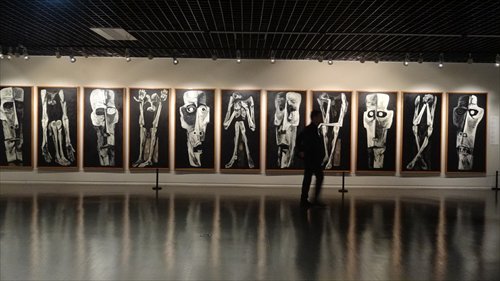
Waiting series
Guayasamin used to say that his paintings were intended to hurt, scratch and hit people's hearts, and to show what man perpetrates against man.
A fistful of honors
His daughter, Verenice Guayasamin, described her father's works as unique.
"When he was young, his paintings were influenced by Mexican artists," she said. "But, with time, he was able to develop his own way of expression, and share his own messages. Some people say they can see some influence from Picasso, but I would like to say that he developed his own characteristics."
Prizes Guayasamin won included the first prize at the Ecuadorian Salón Nacional de Acuarelistas y Dibujantes (Ecuadorian National Exhibition of Watercolorists and Illustrators) in 1948; first prize at the third Hispano-American Biennial of Art in Barcelona in 1952; and being named the best South American painter at the fourth Biennial of Sao Paulo in 1957.
The most important acknowledgment of his art took place at the IX Summit of Presidents and Chiefs of State in Cuba in 1999, where he was named the Painter of Hispanic America.
The current exhibition is made up of around 120 paintings throughout Guayasamin's career. They are organized chronologically, divided into the Huaycanan (Trace of Tears) series, Waiting series (pictured above), Desperate series, Woman Crying series, Still Life series, Mother and Child series, and the Chinese Watercolor series.
"He loved painting portraits and caricatures," his daughter said. "The exhibition includes a portrait of his mother, a portrait of his father and many caricatures. At primary school, he used to draw caricatures of his teachers during classes. His teachers were unhappy about it. They often punished him and made him write 'I am uncultivated; I am uncultivated; I am uncultivated.' He almost dropped out of school because of this."
Maternal influence
Motherhood is a recurring theme in Guayasamin's paintings, as he considered mothers to be the basis of society, the ones who give the most love but who also suffer the greatest.
The eldest of 10 children, he once said he remembered his mother as being "always pregnant." Although his father did not support his painting, Guayasamin said his mother was always there for him. Once Guayasamin was looking for a color to paint the sky, but could not find the shade he wanted. His mother gave him some breast milk to mix into his paint, and he finally obtained the right color.
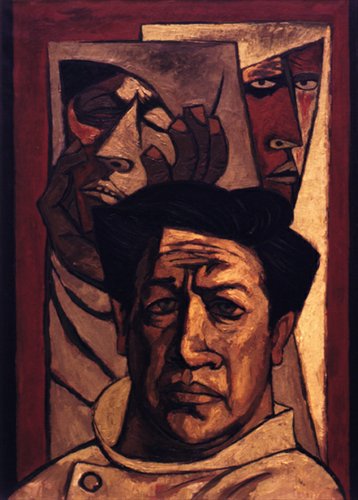
A self-portrait by Oswaldo Guayasamin
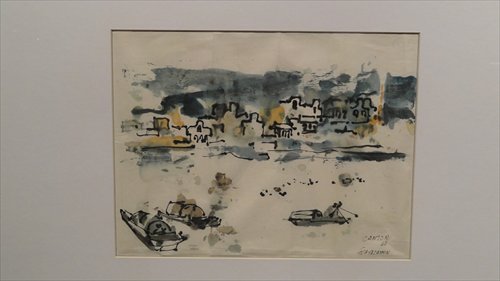
A watercolor work Canton Photos: Yang Lan/GT and courtesy of China Art Museum
Guayasamin was always grateful to his mother. In his later years, he created a series called As Long As I Live, I Will Always Remember You,' dedicated to his mother. The current exhibition includes several paintings from this series, and another entitled Mother and Child.
Most of the paintings in his Waiting series are in black and white, and demonstrate the artist's feelings toward war and suffering. His later works used more colors as he wanted to show love and warmness. One can see the difference between the Still Life series and the Mother and Child series.
Paintings of China
The exhibition also displays several paintings that Guayasamin did when he visited China in 1961. It is the first time these paintings have been displayed in public.
"My father was invited by Mao Zedong to a cultural exchange visit in 1961," Verenice Guayasamin told the Global Times. "As a member of the delegation, he had an interview with Chairman Mao. It was a great cultural shock for him seeing China, and the trip inspired him. Also, it was very interesting for him. He said that people in the rural areas of China seemed very similar to the people of the rural areas of Ecuador."
After becoming acquainted with China and its rich culture, Guayasamin hoped to return to the country someday, although he never managed to.
It has been a long-cherished dream of the Foundation Guayasamin and cultural forces in China to present an exhibition of the Ecuadorian artist in China. With the help of the Ecuadorian embassy in China and the China Art Museum Shanghai, the dream has finally become a reality.
The exhibition displays several watercolors Guayasamin created in China, such as Canton (Guangzhou), Hangchon (Hangzhou), and Muelle (the dock).
Guayasamin's works have been displayed in over 200 international exhibitions in museums such as L'Hermitage Museum in St. Petersburg, Russia; L'Petit Palace of Modern Art and the Palace of Luxembourg in Paris, France; the Queen Sophia Museum, the National Library and Madrid's Conde Duque in Spain; and other cities across America and Europe.
Date: Until October 7, 10 am to 6 pm, closed on Mondays
Venue: China Art Museum
中华艺术宫
Address: 161 Shangnan Road
上南路161号
Addmission: Free
Call 400-921-9021 for details