'History's Crossroads'
Series commemorates Deng Xiaoping
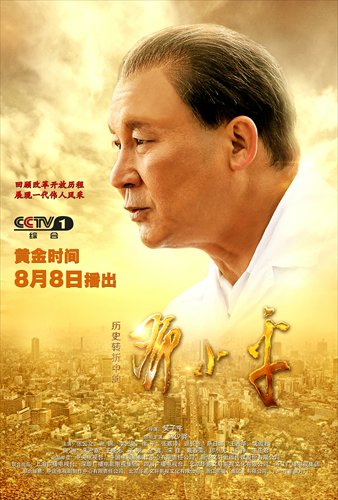
Ma Shaohua as Deng Xiaoping in Deng Xiaoping at History's Crossroads Photo: CFP
With August 22 marking the 110th birthday of former leader Deng Xiaoping (1904-97), many places in the country have begun gearing up in preparation for various activities commemorating the pioneer behind China's opening-up and reform. Among these many official and non-official activities, the CCTV TV series Deng Xiaoping at History's Crossroads has caught many people's attention, not just for the emotional resonance it has struck with audience members who personally experienced that period, but also because of some unexpected breakthroughs when it comes to political taboos.
A closer look
Taking the helm after the country just went through the 10-year-long catastrophe that was the Cultural Revolution (1966-76), in the eyes of many people over the age of 50 Deng is undoubtedly a great savior. Until today, many of those who lived through that era and whose fates were thus completely altered view Deng through a distant and admiring lens, without having much of a chance to truly know the man himself.
Unlike their elders, the majority of the youth born during the 1990s never had the chance to experience the changes brought about by this leader's vision. For them, their knowledge of Deng is limited to a dictionary-like understanding of the term "reform and opening-up."
Be it him, bending over to pick up a screwdriver from under the table for his handicapped son, or rubbing his son's back with a towel, Deng Xiaoping at History's Crossroads fully depicts the 72-year-old Deng's role as a father and husband.
"Different from many other historical political figures, Deng absolutely did not put on airs with his family," said Ma Shaohua, the actor who plays Deng in the TV drama. Prior to this, Ma was widely known for his portrayals of Sun Yat-sen in many TV and film works.
"Sun was different, he was prone to putting on airs, but Deng was just so ordinary and very easy to approach. I believe this has much to do with his practical style when it came to work," Ma told the Global Times.
Just several episodes in, the 48-episode-long Deng Xiaoping has already touched many audiences by showing details that portray Deng as a person, instead of an unapproachable god.
"I was really moved by the scene in which Deng's family turned on the water faucet [to prevent from being overheard]," wrote critic Buming on popular social platform zhihu.com.
"It was so detailed and showed a real person. Deng's nature was such that he didn't try to drum up ideology, he was a doer."
The use of a water faucet in this scene was based on a real historic detail. As Deng was confined for most of the time during the Cultural Revolution, the family would turn on the water faucet whenever the family was discussing something in order to avoid being overheard. This habit is also mentioned in the book Deng Xiaoping and the Transformation of China by the US author Ezra Feivel Vogel.
A step back
While broadening Deng's image by providing more intimate details, the TV drama is also being widely discussed because of another highlight, the first time appearance of politically controversial figures such as Hua Guofeng (1921-2008) and Hu Yaobang (1915-89) on screen.
Appearing in the first episode, Hua contributed greatly to breaking-up the "Gang of Four" in October of 1976. After that, he became the top leader of the Party as well as the country until June of 1981.
The controversies surrounding these figures are some of the main reasons historical dramas have avoided them over the years. For instance, it has been argued for years whether Hua saw Deng as a threat to his authority and opposed Deng's return to political life. However, in the series, while Hua's contributions to bringing down the "Gang of Four" are recognized, in his second appearance he is shown opposing Deng's return to political life, an act that some people find as accurately reflecting history.
Hua is also controversial for other reasons, such as his blind support for Chairman Mao, and the very negative role he played during his later years in power, when it came to redressing the wrongs carried out against political prisoners that were persecuted during the Cultural Revolution.
The fact that the series has decided not to avoid this controversial figure has made Hua's upcoming appearances in future episodes something that audiences are really looking forward to with anticipation.
Expectations are also high when it comes to another controversial figure, Hu Yaobang - the General-Secretary of the CPC from 1982-87. Like other sensitive figures, Hua's contributions during the early stages of the countries opening-up have been widely acknowledged. The main controversy surrounding him lies in the ineffective role he played in controlling the rapid spread of "bourgeois liberalization" that began in the mid-1980s.
At this point, Hu has yet to appear in the series, but according to the credits at the end of every episode actor Li Guangfu is credited as playing Hu. Listed in fourth place after Deng, Ye Jianying and Chen Yun in the credits and as a significant figure in China's history after the arrest of the "Gang of Four," Hu is sure to play an important role in the series.
Differing from Hua, criticism of Hu has been much more favorable and in recent years historians have been increasingly heading toward a consensus regarding his role in history. In 2010, then Premier Wen Jiabao published an article "Returning to Xingyi to Recall Yaobang" in the People's Daily, recalling the time he accompanied Hu to Guizhou in 1986 to survey the area.
A step forward
"People can watch the opening of our politics and the progress of the country through this work," said Wu Ziniu, director of Deng Xiaoping. As an individual growing up during that period, Wu said he wasn't aware of the behind-closed-doors details of some of the historic events depicted in the series until he started working on them. "It's similar to a process of declassification," said Wu.
No matter if it's a literary work or a TV series, accurately depicting the history of the day is nothing but difficult. No matter where you go in the world, taking a behind-the-scenes look at history takes time and a certain amount of finesse. Looking at it this way, Deng Xiaoping underscores the current increasingly open political environment in China. However, it is rather unrealistic to expect everything to be shown.
Reflecting the period between 1978 and 1984 means that some events that these figures took part in will not be shown in a TV series. However, compared to other works depicting the country's top leaders, this work for TV has already made a huge breakthrough by showing everyone involved.
While Deng Xiaoping helps paint a more personal picture of Deng, it also provides a look at the big picture of that era by acknowledging that Deng was not alone in opening-up the country and making China what it is today. By commemorating Deng, it also commemorates the entire group of pioneers that helped usher in a new era.